
Views: 228 Author: Eyunhome Vacuum Publish Time: 2026-10-05 Origin: Site


Content Menu
● Why Source Compact Cordless Stick Vacuums from China?
>> Established Manufacturing Clusters
>> What Recent Market Research Actually Shows
● How These Manufacturers Were Selected
● Top 10 Compact Cordless Stick Vacuum Manufacturers in China
>> 1. Ningbo Eyunhome Electric Technology Co.,Ltd.
>> 2. KingClean Electric Co., Ltd.
>> 3. Suzhou Chunju Electric Co., Ltd.
>> 4. Suzhou EUP Electric Co., Ltd.
>> 5. TEK Electrical (Suzhou) Co., Ltd.
>> 6. Suzhou Dibea Electrical Technology Co., Ltd.
>> 7. Suzhou Houseclean Electric
>> 8. Suzhou E-Clean Electric Appliance Co., Ltd.
>> 9. Shenzhen Minfutech Industrial Co., Ltd.
>> 10. Suzhou Weitek Electric Co., Ltd.
● Manufacturer Comparison: Capacity, MOQ, and Certification Evidence
● Technical Buying Guide for Compact Cordless Stick Vacuums
>> Define "Compact" Before Comparing Quotes
>> Compare Cleaning Performance, Not Isolated Suction Numbers
>> Specify Materials and Assembly Controls
>> Review Compliance as a Product System
● Supplier Verification, Samples, and Logistics
>> Verify the Factory and Contracting Entity
>> Use a Controlled Sample-Approval Process
>> Plan Lithium-Battery Shipping Early
● An Overlooked Procurement Trap: Same Model Number, Different Product
● Conclusion: Choose the Partner That Can Support Repeatable Supply
● FAQs
>> 1. How Can I Check Whether a Factory's ISO Certificate Has Expired or Been Suspended?
>> 2. Does an Existing CE Report Cover My Private-Label Version?
>> 3. How Can I Confirm That Quoted Production Capacity Is Actually Available?
>> 4. How Should Buyers Manage Battery Substitution After Sample Approval?
>> 5. How Can a Smaller Brand Reduce MOQ Without Creating Excessive Supply Risk?
China offers a broad sourcing base for compact cordless stick vacuums, from specialized private-label factories to large manufacturers with integrated motor development and extensive assembly operations. For professional buyers, however, the challenge is not finding a supplier. It is identifying a manufacturing partner that can maintain product consistency, support customization, document compliance, and deliver reliably as order volumes grow.
A compact cordless stick vacuum combines several demanding systems in a relatively small enclosure: a high-speed motor, lithium-ion battery pack, electronic controls, filtration components, and frequently a powered floor brush. A competitive quotation means little if the production version differs from the approved sample.
This guide presents ten China-based manufacturers worth evaluating, beginning with Ningbo Eyunhome Electric Technology Co.,Ltd. It compares publicly available company information and explains what buyers should verify before awarding a contract.
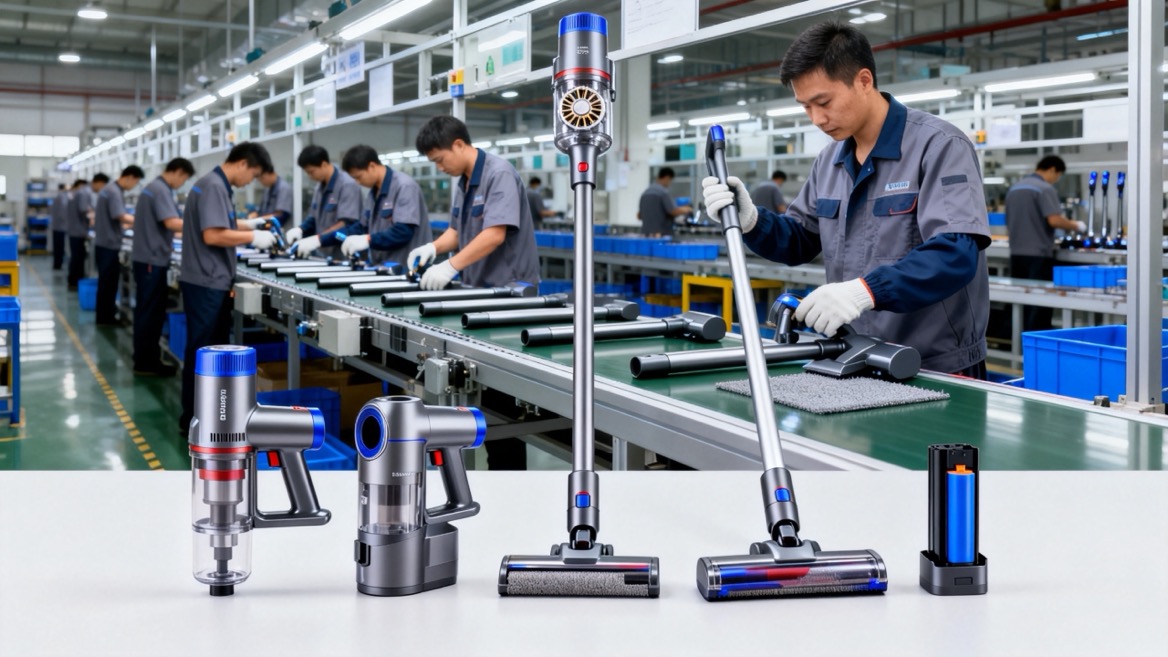
The suppliers reviewed here illustrate three relevant manufacturing locations:
- Suzhou, Jiangsu: Home to established cleaning-appliance manufacturers, including KingClean, Chunju, EUP, Dibea, and several specialist factories.
- Ningbo, Zhejiang: A sourcing location for compact household appliances, including Eyunhome, with access to ocean and air transportation.
- Shenzhen, Guangdong: A development location for electronics-oriented cleaning-appliance businesses such as Minfutech.
These clusters give buyers access to different supplier profiles rather than a single standardized manufacturing model. KingClean emphasizes motor technology and extensive production infrastructure, while smaller factories may offer a more focused approach to existing-platform customization. The appropriate choice depends on project complexity, expected volume, and the buyer's engineering resources.
Global Market Insights' household vacuum cleaner report, published in August 2026, estimates that the worldwide market was worth USD 20.3 billion in 2025 and would reach USD 21.6 billion in 2026. These figures cover household vacuum cleaners broadly; they are not a measurement of compact cordless stick vacuums alone.
That distinction matters. Household vacuum market value, commercial vacuum sales, robotic cleaner shipments, and cordless stick vacuum exports are different datasets.
For export analysis, buyers can consult China's General Administration of Customs statistics portal. HS heading 8508 provides a starting point for vacuum-cleaner trade research, but the heading-level total should not be described as compact cordless stick vacuum exports. Relevant subheadings, reporting periods, destination markets, and the inclusion of parts must be checked before drawing conclusions.
The selection prioritizes manufacturing relevance and information transparency rather than promotional claims.
A supplier should be evaluated across six dimensions:
| Evaluation dimension | Evidence buyers should request |
|---|---|
| Product relevance | Current cordless stick vacuum models, configurations, and production samples |
| Engineering capability | Engineering team structure, design responsibilities, tooling capability, and validation records |
| Quality control | Incoming inspection, process controls, final testing, calibration records, and corrective-action procedures |
| Compliance readiness | Current management-system certificates and model-specific product documentation |
| Delivery stability | Available capacity, component procurement plans, production schedules, and recent delivery records |
| Commercial support | Customization boundaries, order requirements, communication procedures, and spare-parts commitments |
Public websites are useful for creating a shortlist, but they cannot establish actual factory performance.
In particular, a listed facility size is not production capacity. Annual company-wide output is not available monthly capacity for one cordless stick model. Likewise, a certificate logo does not demonstrate that the buyer's customized configuration is covered.
The procurement principle throughout this guide is traceability: every important promise should connect to an identifiable product, document, material specification, or contractual responsibility.
Founded: 2011
Location: Ningbo, Zhejiang
Market coverage: International customers; specific principal export destinations are not identified on the reviewed company-introduction page.
Eyunhome describes itself as a manufacturer focused on battery-powered cleaning products. Its product navigation includes cordless stick vacuums, corded stick vacuums, handheld cordless vacuums, portable vacuums, and 2-in-1 vacuum cleaners. The company reports a 7,500-square-meter facility and an emphasis on engineering, quality control, personalized solutions, and responsive customer service.
For small and medium-sized brands, Eyunhome is a candidate to evaluate for value-oriented OEM/ODM projects requiring direct communication and adaptation of existing product platforms. Its published invitation to provide customer-specific design suggestions supports this positioning, although comparative cost advantages, response times, and order flexibility should be established through an actual quotation and development discussion.
Relevant customization discussions include:
- Brand identity, product colors, and packaging.
- Accessory combinations and regional product configurations.
- Charger specifications and market-specific documentation.
- The feasibility of battery, filtration, or structural modifications.
- Spare-parts supply and after-sales arrangements.
Its website lists GS, CE, EMC, LVD, RoHS, REACH, CCC, CB, and other compliance-related claims, and describes operation under an "ISO 9000 system." Buyers should request the exact current management-system certificate rather than interpreting that wording as confirmation of an active ISO 9001 certificate. BSCI should also be treated as a social-compliance assessment framework, not a product safety approval.
Best-fit purchasing scenario: A brand seeking a focused manufacturing discussion, practical private-label development, and a supplier relationship that can accommodate evolving product requirements.
Founded: 1994
Location: Suzhou, Jiangsu
Market coverage: International appliance customers; a secondary industry profile reports exports to more than 100 countries and regions.
KingClean identifies ultra-high-speed digital motors as a core technology. Its official website reports ten production bases worldwide and a total industrial plant area of 800,000 square meters. Its history also documents an ODM origin, beginning with one vacuum cleaner, one production line, and a 2,000-square-meter workshop.
Its relevance to compact cordless stick vacuum procurement lies in its engineering depth and vertically integrated manufacturing background. Buyers developing higher-volume programs or seeking substantial motor and appliance-development capabilities should consider it for evaluation.
OEM/ODM discussion priorities include motor-platform selection, proprietary product architecture, tooling investment, and the allocation of engineering resources. The reviewed public information does not establish a standard MOQ or currently available capacity for compact cordless stick models.
Buyer caution: Large infrastructure does not automatically mean that a small launch order will receive suitable commercial terms. Confirm project acceptance, minimum annual commitments, development fees, and model-specific support before proceeding.
Founded: July 1999
Location: Suzhou, Jiangsu
Main markets: Asia, Europe, Australia, New Zealand, and the Americas.
Chunju's official website reports a 300,000-square-meter production site and 203 patents, including 29 invention patents. It also identifies engineering, industrial-design, and research facilities supporting its cleaning-appliance business.
The company's portfolio includes vacuum cleaners, steam cleaners, air purifiers, and humidifiers. An industry sourcing profile describes its OEM/ODM business and integrated manufacturing operations, but older capacity figures should not be treated as confirmed 2026 output.
Chunju is worth evaluating for buyers seeking a substantial cleaning-appliance manufacturer with broader product-development resources.
OEM/ODM discussion priorities: Product architecture, tooling responsibilities, validation ownership, and the availability of a genuinely compact cordless platform.
Buyer caution: Ask the factory to separate production-site scale from the assembly lines, tooling, and engineering personnel allocated to the proposed model.
Founded: 1994
Location: Suzhou, Jiangsu
Main markets: Europe, North America, the Middle East, and Australia, according to its chamber-of-commerce profile.
EUP's profile on the China Chamber of Commerce for Import and Export of Machinery and Electronic Products describes capabilities in motor production, testing, computerized tooling, plastic injection, and product research and development. It also reports exports to more than 50 countries and regions.
These capabilities make EUP relevant to buyers seeking established manufacturing processes and coordinated component development.
Customization discussions should cover existing cordless platforms, tooling changes, motor sourcing, accessory development, and the division of responsibilities between the buyer and factory.
Buyer caution: The chamber profile references ISO 9001:2000 and historical product approvals. Those references demonstrate background, not current certificate validity. Obtain updated certificates and reports for the exact product under consideration.
Founded: March 1998, according to its historical chamber profile
Location: Suzhou, Jiangsu
Market coverage: International manufacturing background; current destination-market priorities require confirmation.
TEK's chamber-of-commerce profile describes household cleaning-appliance design, development, and production, with a historical annual vacuum-cleaner capacity of seven million units. It also references earlier quality-management certifications.
Its inclusion requires a qualification: TEK-related corporate history connects with the development of Ecovacs, and a current Ecovacs company profile describes the former TEK Electrical name. Buyers should therefore establish the current contracting entity and whether external private-label projects are available before treating TEK as an accessible standalone supplier.
Potential fit: A technically experienced cleaning-appliance manufacturing organization, subject to confirmation of current corporate identity and OEM availability.
Buyer caution: Do not transfer historical production figures, certification records, or group capabilities to a proposed supplier without matching the legal entity and manufacturing site.
Founded: 2007
Location: Suzhou, Jiangsu
Market coverage: More than 80 countries and regions, according to its brand information.
Dibea combines a consumer-facing brand with household-appliance research, manufacturing, and marketing. Its published information identifies OEM/ODM partnerships, while supplier listings include cordless stick vacuums, handheld vacuums, wet-and-dry cleaners, and dust-collection station products.
This makes Dibea relevant to buyers seeking product platforms informed by international consumer-market experience.
OEM/ODM discussion priorities: Design-based customization, model availability, packaging, regional configurations, and whether the proposed platform is shared with Dibea-branded products.
Buyer caution: Define territory rights, design exclusivity, and channel restrictions. A product sold under the factory's own brand may not be commercially exclusive to an importer.
Founded: 2017
Location: Suzhou, Jiangsu
Main markets: The company reports service to more than 60 markets and identifies early exports to Europe and North America.
Houseclean reports a facility expansion to 11,600 square meters and annualized capacity exceeding one million units. Its published engineering focus includes brushless motor control, removable battery architecture, dust-sensor integration, and multi-cyclone filtration.
The company also describes an in-house laboratory, functional testing, battery-cycle testing, and durability evaluation. These are supplier-published claims rather than independently verified audit findings.
Potential fit: Buyers developing lightweight or feature-rich cordless platforms who want explicit engineering and validation discussions.
OEM/ODM discussion priorities: Battery interchangeability, control electronics, lightweight structures, filtration configuration, and compliance-document availability.
Buyer caution: Request calibration records, test procedures, representative reports, and evidence that the quoted annualized capacity applies to current operating conditions.
Founded: 2014
Location: Suzhou, Jiangsu
Main markets: Europe, Australia, the Americas, and Southeast Asia, according to its company profile.
E-Clean's official homepage reports a 5,400-square-meter facility, three production lines, and annual capacity of one million vacuum cleaners. Its product listings include cordless stick and handheld configurations, with OEM offerings visible on supplier platforms.
This manufacturer is relevant to buyers evaluating existing-platform private-label products and straightforward configuration changes.
OEM discussion priorities: Housing colors, labeling, packaging, accessory selections, and model-specific order requirements.
Buyer caution: Different pages on its website show different capacity figures, including an older reference to 300,000 units. Request a dated capacity statement and confirm the current operating address before auditing.
Founded: 2021, according to its current company information
Location: Shenzhen, Guangdong
Market coverage: Global B2B customers; the reviewed pages do not provide a verified regional sales breakdown.
Minfutech, operating under the Minfu name, presents OEM/ODM services across robot vacuums, cordless vacuums, wet-and-dry cleaners, and other cleaning appliances. Its cordless product page lists brushless-motor stick vacuum platforms and private-label applications.
The company's homepage reports annual capacity above 1.5 million units, but this is a broad company-level figure rather than a confirmed compact cordless stick vacuum allocation.
Potential fit: Brands comparing multiple cleaning-appliance categories or seeking electronics-oriented customization.
OEM/ODM discussion priorities: Existing platforms, control features, product definition, packaging, and manufacturing responsibility.
Buyer caution: Verify the legal entity, production site, in-house operations, and subcontracted processes. Broad portfolio coverage should be supported by a clear manufacturing map.
Founded: Reported as June 2017 in a supplier profile; registration should be verified
Location: Suzhou, Jiangsu
Market coverage: Export-oriented household-appliance supply; specific principal markets are not established by the reviewed sources.
Weitek's public profiles identify vacuum-cleaner design, manufacturing, and sales, including cordless handheld and stick configurations. Its official contact page identifies an address in Suzhou's Wuzhong District.
Weitek is a candidate for buyers evaluating a specialist supplier rather than a large diversified appliance group.
OEM/ODM discussion priorities: Available compact platforms, ownership of molds, customization depth, and engineering support.
Buyer caution: Public information about current capacity, MOQ, and certification coverage is limited. Treat it as a preliminary sourcing candidate until documentation and a factory assessment establish suitability.
The table distinguishes published claims from information that still requires a quotation or document review.
| Manufacturer | Published capacity or scale | Public MOQ evidence | Certification or compliance information |
|---|---|---|---|
| Eyunhome | 7,500 m² facility; annual output not disclosed | Not disclosed; request configuration-specific MOQ | Lists GS, CE, RoHS, REACH, CB and others; exact certificates require review. |
| KingClean | Ten worldwide production bases; 800,000 m² plant area | Not disclosed | Obtain current site certificates and exact-model reports. |
| Chunju | 300,000 m² production site; current unit capacity not established | Not disclosed | Current project-specific documentation must be requested. |
| EUP | Integrated motor, tooling, injection, and testing capabilities | Not disclosed | Chamber profile contains historical ISO and product approval references. |
| TEK Electrical | Historical seven-million-unit annual vacuum capacity | Current OEM availability and MOQ require confirmation | Historical quality certificates; current entity and documents require verification. |
| Dibea | Current annual capacity not established | Model-specific quotation required | Obtain exact-model certificates and reports. |
| Houseclean | Supplier reports over one million units annualized capacity | Not disclosed | Claims ISO 9001:2015 and multiple market-related compliance platforms. |
| E-Clean | Homepage reports one million units annually; older page differs | Listings show 100, 500, and 1,000 pieces for different products | Lists GS, CE, CB, RoHS and other compliance claims. |
| Minfutech | Supplier reports over 1.5 million units annually across its portfolio | Promotes low MOQ; no fixed quantity established | Cordless page claims ISO 9001 and CE/FCC/RoHS. |
| Weitek | Not established | Not established | Request current management-system and model-specific documents. |
Marketplace MOQs should not be interpreted as commitments for customized orders. Battery selection, packaging, color batches, accessories, and exclusive tooling can change the actual minimum purchase requirement.
"Compact" is not a sufficiently precise purchasing specification.
Create a product brief covering:
- Complete operating weight, including battery and powered head.
- Handheld-unit weight and balance.
- Storage dimensions and packaging volume.
- Required floor types and debris conditions.
- Runtime under a defined operating mode.
- Removable or integrated battery construction.
- Dust-cup capacity and emptying mechanism.
- Filter maintenance and replacement requirements.
This prevents suppliers from quoting materially different products under the same description.
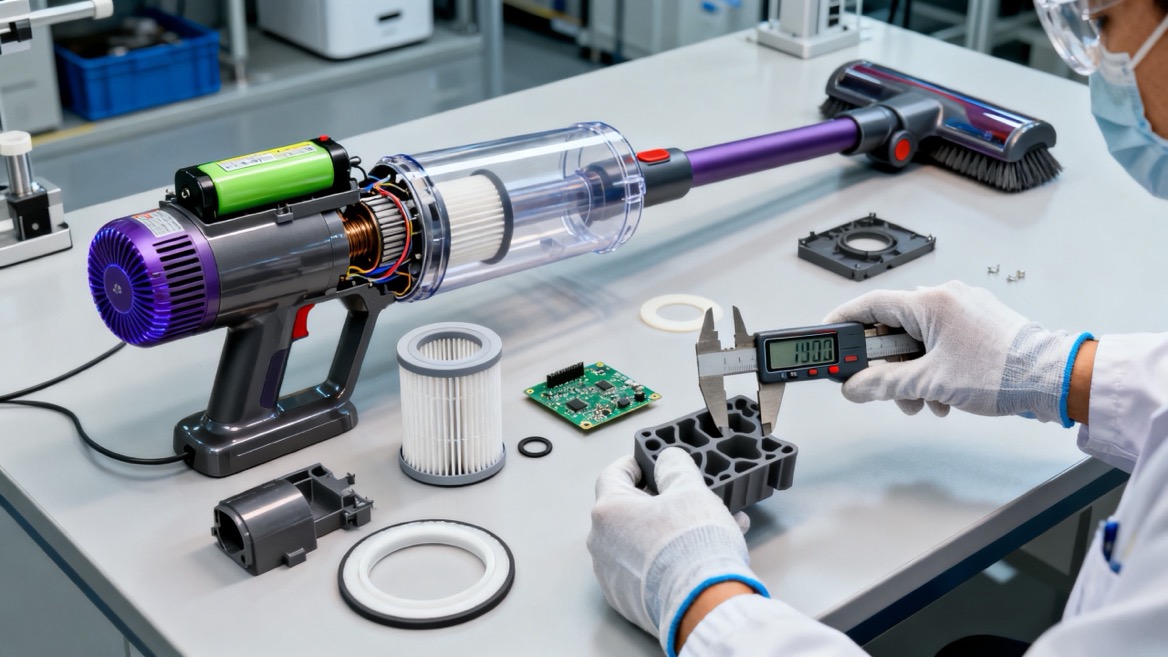
A pressure figure in kPa does not, by itself, establish floor-cleaning effectiveness. The brush head, airflow path, seals, filtration resistance, and operating mode all affect practical performance.
Use a common test procedure across samples. For cordless dry vacuum cleaners, discuss the applicability of IEC 62885-4 with the testing laboratory; Houseclean, for example, identifies this standard in its published testing information.
The comparison should record:
1. Test surface and debris.
2. Battery condition.
3. Operating mode.
4. Installed floor head.
5. Filter condition.
6. Runtime and pickup results under the same conditions.
Avoid comparing one supplier's maximum-pressure claim with another supplier's normal-mode cleaning result.
Do not accept "premium plastic" as a material specification.
Ask the supplier to identify resin grades and approved sources for the housing, dust cup, latches, brush-head components, and other critical parts. The purchasing specification should also define any permitted recycled content and the conditions under which material substitutions require approval.
Useful validation requirements include latch-cycle testing, drop testing, dust-cup seal inspection, fastener controls, and compatibility with expected cleaning chemicals.
These are proposed purchasing controls, not claims that every listed factory currently follows the same process.
CE marking is not a centrally issued quality certificate. The European Commission explains that the manufacturer must identify applicable requirements, complete the appropriate conformity assessment, prepare technical documentation, and issue an EU Declaration of Conformity. A business selling a product under its own brand may assume manufacturer responsibilities.
For a cordless vacuum project, assess the complete configuration:
- Vacuum body and electronics.
- Battery pack.
- Charger.
- Powered attachments.
- Labels and instructions.
- Applicable chemical-substance requirements.
The vacuum's operating voltage and the charger's mains connection may lead to different regulatory considerations. Have a qualified laboratory confirm the applicable standards and legislation rather than copying a compliance list from another product.
RoHS and REACH documentation should also match the relevant materials and configuration. A website logo alone cannot establish compliance.
Before paying a production deposit:
1. Match the business license to the quotation and contract.
2. Identify the actual manufacturing address.
3. Check whether the payment beneficiary is the contracting entity.
4. Establish which operations are in-house and which are subcontracted.
5. Review current quality-system certification.
6. Conduct an on-site or independent factory assessment where commercially justified.
For management-system certificates, IAF CertSearch provides searches by company name or certificate number and displays status, scope, issuing body, and related accreditation details. Also verify questionable documents directly with the issuing certification body.
A useful development sequence is:
- Platform sample: Evaluate the existing product.
- Customized sample: Review agreed changes.
- Compliance sample: Test the intended market configuration.
- Preproduction sample: Check production-intent components and assembly.
- Pilot production: Evaluate repeatability.
- Shipment inspection: Verify conformity before release.
Retain an approved reference sample together with its bill of materials, photographs, firmware version where applicable, and test results.
Approval should mean that the production configuration is defined—not simply that one attractive sample performed well.
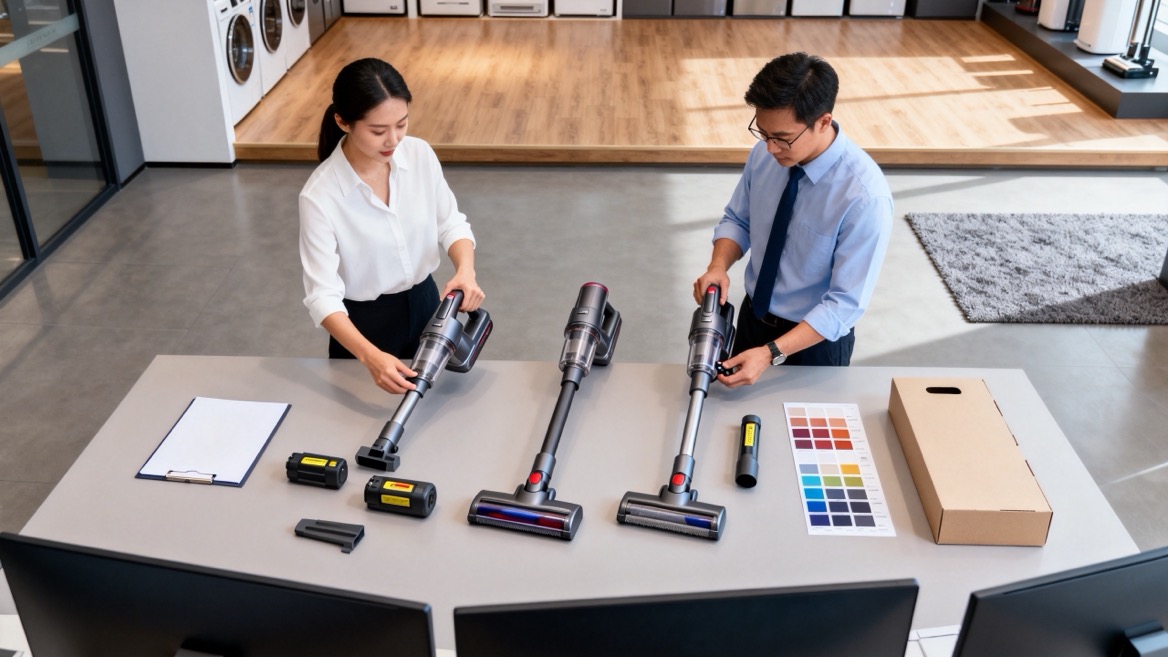
Lithium-ion batteries create transport obligations that should be discussed before the first commercial shipment. IATA guidance explains that applicable lithium cells and batteries must meet UN 38.3 testing requirements and that manufacturers and subsequent distributors must make the test summary available.
Ask the forwarder to confirm the requirements for the actual shipping configuration: batteries installed in equipment, packed with equipment, or shipped separately.
The UN 38.3 test summary does not replace all other shipment documentation. Packaging, markings, declarations, carrier acceptance, and applicable state-of-charge restrictions depend on the shipment and transport rules in force.
An important risk is the assumption that an unchanged model number guarantees an unchanged product.
A supplier may propose an "equivalent" battery cell, filter medium, charger component, gasket, or resin grade while retaining the same housing and product name. The replacement may affect durability, performance, or the relevance of existing test evidence.
The practical control is configuration management:
- Freeze the approved bill of materials.
- Identify critical component manufacturers and part numbers.
- Require written approval for substitutions.
- Record applicable firmware versions.
- Match test documentation to the shipped configuration.
- Use independent testing or teardown inspection where the project's risk warrants it.
This is a failure mode to guard against, not an allegation about any manufacturer in this list.
CE technical documentation must be kept up to date, and IATA emphasizes consistency between manufactured battery types and the specifications subjected to transport testing. Those requirements reinforce why component changes should never be treated as purely commercial decisions.
The right compact cordless stick vacuum manufacturer is the one whose capabilities match your product brief, order scale, compliance requirements, and service model.
KingClean and Chunju offer substantial publicly documented manufacturing infrastructure. Dibea combines international brand activity with OEM/ODM offerings. Eyunhome presents a focused battery-cleaning product portfolio and customer-specific development approach that smaller and growing brands can evaluate through samples and a detailed quotation.
For a tailored proposal from Ningbo Eyunhome Electric Technology Co.,Ltd., prepare your target market, expected order quantity, desired operating weight, battery requirements, accessory package, branding specifications, and compliance needs.
Then request a current platform recommendation, customization feasibility review, sample plan, model-specific documentation, production schedule, and spare-parts proposal. The objective is not merely to purchase a compact cordless stick vacuum—it is to establish a configuration and supply process that can be reproduced reliably.
Request the complete certificate, including the certificate number, legal entity, site address, standard, scope, issuing body, and validity dates.
Check the certificate through IAF CertSearch and the issuing certification body. Confirm that the scope covers relevant manufacturing activities and that the certified address matches the proposed production site.
A missing database result should trigger further verification rather than an immediate assumption of fraud. A valid quality-management certificate also does not establish product compliance.
Not automatically.
Branding changes, charger substitutions, battery changes, electronics modifications, and structural alterations can affect the documentation needed for the final configuration.
Ask a qualified laboratory to evaluate the differences and determine whether existing evidence remains applicable or further testing is necessary. Confirm responsibility for the Declaration of Conformity, technical file, and records before approving production.
Ask for model-specific evidence rather than company-wide output claims:
- Assembly-line allocation.
- Demonstrated cycle time.
- Shift pattern and staffing.
- Existing production commitments.
- Critical component lead times.
- Recent production and delivery records.
Separate rated capacity from available capacity. A factory's annual portfolio output does not show whether it can meet a particular delivery window.
The capacity claims in this guide vary in age and scope, which is why they are not presented as directly comparable figures.
Specify the approved cell and battery-pack configuration in the purchasing documents.
Require advance notification, written approval, and a technical review for substitutions. Review performance, safety protection, charger compatibility, and whether transport-test documentation still applies.
IATA states that battery manufacturing controls should maintain consistency with the specifications of the tested design type. An unchanged external pack appearance is not sufficient evidence.
Ask for separate minimums for standard products, custom colors, printed packaging, modified components, and exclusive tooling.
An existing platform may allow a more manageable launch than a fully custom design, but the factory must confirm the actual quantities and costs. E-Clean's marketplace listings illustrate that different products from one supplier can have substantially different advertised MOQs.
Agree separately on spare parts, replacement batteries, packaging overruns, and the ability to reorder the same configuration. A low initial MOQ has limited value if later batches cannot remain consistent.
- [Ningbo Eyunhome Electric Technology Co.,Ltd. — Company Introduction]: Founding year, facility size, product categories, customization positioning, and published compliance claims.
- [KingClean Electric — Official Website]: Company history, motor technology, and manufacturing infrastructure.
- [Suzhou Chunju Electric — Official Website]: Founding date, production-site scale, research resources, patents, and international markets.
- [CCCME — Suzhou EUP Electric Company Profile]: Manufacturing capabilities, market coverage, and historical certification references.
- [CCCME — TEK Electrical Company Profile]: Historical establishment, capacity, and quality-system information.
- [Ecovacs — Current Company Profile]: Corporate-history context relevant to TEK-related supplier verification.
- [Dibea — Company Background]: Founding year, international presence, and OEM/ODM partnership information.
- [Houseclean Electric — Factory Background]: Supplier-published capacity, engineering, testing, and compliance information.
- [Suzhou E-Clean — Official Website]: Establishment, facility, production-line, and capacity claims.
- [Suzhou E-Clean — Company Introduction]: Export markets and older capacity information.
- [Minfutech — Company Background]: Legal company name, establishment, product scope, and OEM/ODM positioning.
- [Minfutech — Cordless Vacuum Product Platforms]: Cordless product configurations and published compliance claims.
- [Suzhou Weitek — Official Contact Page]: Supplier contact and location verification.
- [Global Market Insights — Household Vacuum Cleaners Market]: August 2026 report containing 2025 market estimates and 2026 projections.
- [General Administration of Customs of China — Statistics Portal]: Official platform for export and import research.
- [European Commission — CE Marking Requirements]: Manufacturer responsibilities, conformity assessment, declarations, and technical documentation.
- [IAF CertSearch — Certificate Validation]: Management-system certificate status and accreditation verification.
- [IATA — Battery Guidance Document]: Lithium-battery classification, testing, and transport guidance.
- [IATA — Lithium Batteries Fact Sheet]: Battery design-type testing, manufacturing consistency, and test-summary obligations.


