
Views: 281 Author: Eyunhome Vacuum Publish Time: 2026-08-31 Origin: Site


Content Menu
● Why Source Cordless Vacuums From China?
● How We Evaluated Manufacturers
● Technical Benchmarks Buyers Should Understand
>> Motor System
>> Filtration and Dust Separation
>> Materials and Structural Design
● Top 10 Cordless Vacuum Manufacturers in China
>> 1. Ningbo Eyunhome Electric Technology Co., Ltd.
>> 2. KingClean Electric Co., Ltd. / JIMMY
>> 4. Tineco
>> 7. Roborock
>> 9. Ningbo Haozhushou Commodity Co., Ltd.
>> 10. Picea Robotics / 3i Ecosystem
● Manufacturer Comparison Table
● Common Sourcing Problems—and How to Avoid Them
>> 1. "High Suction" Claims Without Comparable Tests
>> 2. Battery Capacity Is Stated, But Cell Quality Is Unclear
>> 3. The Approved Sample Is Better Than Mass Production
>> 4. Certification Files Do Not Match the Ordered Model
>> 5. Accessories and Spare Parts Are Not Planned
● An Underused Supplier Verification Method
● Buyer's Guide: How to Source Safely
>> Step 1: Define Your Product Position Before Requesting Quotes
>> Step 2: Shortlist Three to Five Factories
>> Step 3: Request Samples Before Final Negotiation
>> Step 5: Control Production Quality
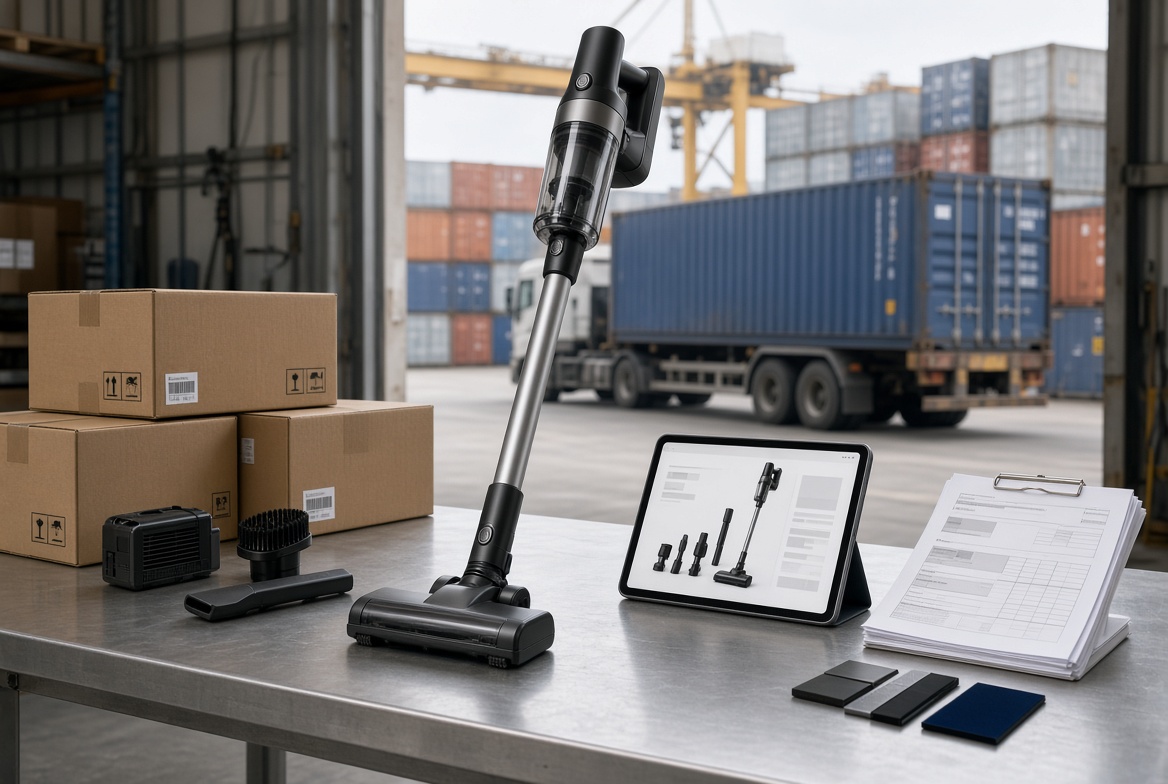
>> Step 6: Plan Logistics and Battery Transport Early
>> 1. How can I verify whether a factory's ISO certificate is still valid?
>> 2. What is a realistic MOQ for a private-label cordless vacuum?
>> 3. Which certifications are commonly needed for cordless vacuums sold in Europe?
>> 4. Why does a cordless vacuum's runtime fall sharply after several months?
>> 5. How can I prevent a supplier from changing materials after my sample is approved?
China remains one of the world's most important production bases for cordless vacuum cleaners, supported by mature supply chains for motors, lithium-ion battery packs, injection-molded housings, filtration systems, PCBA assemblies, chargers, and packaging. For importers, private-label brands, retailers, and e-commerce sellers, the right Chinese manufacturer can provide not only a finished product but also engineering support, compliance coordination, packaging customization, and reliable repeat production.
Market demand continues to favor cordless and stick-format cleaners because consumers value portability, multi-surface cleaning, compact storage, and lower barriers to everyday use. Recent market estimates place the global cordless vacuum cleaner market at approximately USD 10.05 billion in 2025, with continued growth expected through the next decade. China's broader residential vacuum manufacturing ecosystem is also substantial: one 2026 market assessment estimates China produced about 259 million vacuum units in 2024, reinforcing its role as the largest production hub.
However, selecting a cordless vacuum supplier is more complex than comparing suction-power claims or unit prices. Product reliability depends on the interaction of motor performance, battery safety, airflow engineering, brush-roll design, tooling quality, component consistency, and quality-control discipline. This article identifies 10 manufacturers and brands worth researching, with a buyer-focused perspective on their strengths, product directions, and suitability for different sourcing models.
> Important note: Production capacity, minimum order quantity, available certifications, and private-label availability can vary by model, destination market, tooling requirements, and annual purchase volume. Buyers should request current documentation directly from the manufacturer and independently verify every commercial claim before issuing a purchase order.
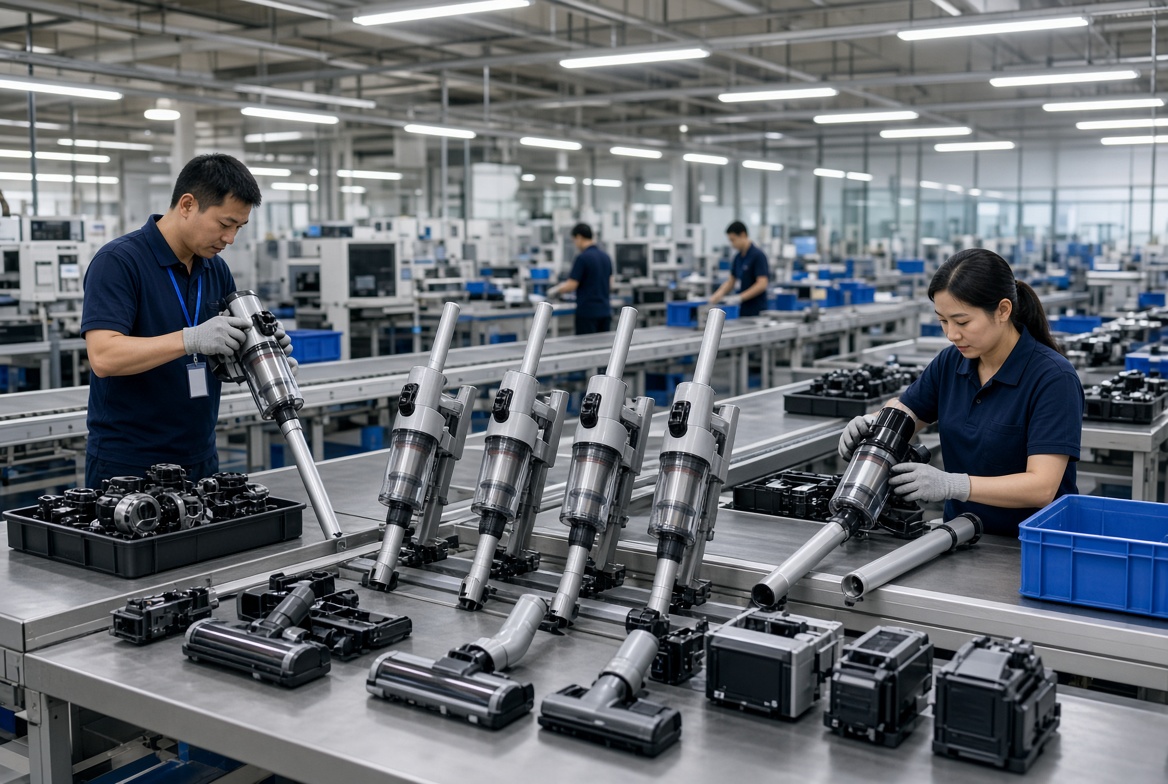
China's cordless vacuum supply base has developed around several interconnected manufacturing regions:
- Suzhou, Jiangsu: A major cluster for vacuum-cleaner engineering, high-speed motors, filtration systems, floor-care appliances, robotics, and final assembly.
- Ningbo and Cixi, Zhejiang: Strong in small household appliances, plastic molding, electrical components, export packaging, and port-connected international trade.
- Foshan and Shunde, Guangdong: Home to major appliance groups, broad consumer-appliance supply chains, and large-scale manufacturing infrastructure.
- Shenzhen and Dongguan, Guangdong: Important for electronics, battery-management systems, smart controls, charging technology, and cross-border e-commerce support.
Suzhou and Ningbo are frequently identified as particularly important vacuum-manufacturing centers because suppliers of BLDC motors, battery packs, HEPA filters, accessories, and final assembly can be sourced within relatively short distances. This geographic concentration can reduce component lead times, improve engineering coordination, and make factory audits more efficient for international buyers.
The advantage is not simply lower manufacturing cost. A well-managed supplier can help a buyer:
- Adapt a base platform into a private-label product.
- Develop new accessories, colors, packaging, and charging configurations.
- Localize plugs, manuals, labels, and compliance files.
- Balance performance targets with target retail pricing.
- Improve spare-parts planning for long-term after-sales support.
- Scale from small trial orders to larger seasonal or retail programs.
At the same time, China's manufacturing depth creates an important sourcing challenge: two suppliers may show visually similar cordless stick vacuums but use very different motor grades, battery cells, plastics, filter media, connectors, and inspection standards. A lower quotation is not automatically a lower total cost, but it can become one if product returns, damaged batteries, weak runtime, or inconsistent accessories affect your brand reputation.
This list is not a ranking based only on brand size, online visibility, or claimed suction power. It is designed for professional buyers who need to evaluate long-term supply capability.
The assessment considers the following practical dimensions:
| Evaluation Area | What Buyers Should Examine | Why It Matters |
|---|---|---|
| Manufacturing background | Years in operation, product focus, engineering depth, manufacturing location | Indicates whether vacuum cleaning is a core capability rather than an opportunistic category |
| Cordless-vacuum specialization | Stick, handheld, wet/dry, robot, multi-function, or commercial cleaning focus | Helps match supplier capability to your target product line |
| Product engineering | BLDC motor platform, cyclone design, battery architecture, brush-roll systems, noise control | Determines real-world cleaning performance and product differentiation |
| OEM/ODM support | Logo application, housing colors, molds, packaging, accessories, plug options, manuals | Critical for private-label and retail-brand programs |
| Quality management | Incoming-material inspection, in-process inspection, aging tests, drop tests, final inspection | Reduces the risk of inconsistent batches and post-sale claims |
| Compliance readiness | CE, RoHS, REACH, CB, EMC, LVD, UKCA, GS, KC, battery transport files | Necessary for legal market access and smoother import procedures |
| Supply stability | Component sourcing, production planning, communication speed, spare-parts support | Important for repeat orders and seasonal retail launches |
| Commercial fit | MOQ flexibility, tooling investment, price positioning, prototype response | Helps buyers avoid choosing a supplier that does not fit their stage of growth |
A credible supplier should welcome reasonable due diligence. That includes live video inspections, third-party factory audits, pre-shipment inspection, batch test reports, certificate checks, and sample comparisons against agreed specifications.
A cordless vacuum cleaner is a system product. Comparing only "Pa" suction values can lead to poor purchasing decisions because suction readings are influenced by testing methods, sealed-condition measurements, motor speed, air-path design, dust-bin geometry, filter loading, and nozzle construction.
Most competitive cordless stick vacuums use one of two motor approaches:
- Brushed DC motors: Generally lower cost and suitable for entry-level handheld or compact units. They may have lower efficiency, more wear-related limitations, and less headroom for premium performance.
- Brushless DC motors (BLDC): Better suited for mid-range and premium stick vacuums. They can support higher speed, improved efficiency, longer expected service life, and better electronic control.
Buyers should request more than an advertised motor RPM. Ask for:
- Rated input power and maximum power.
- Motor type and supplier information.
- Thermal-protection design.
- Continuous operation data.
- Noise-test method and measured decibel range.
- High-speed mode run-time under loaded conditions.
Battery quality is one of the largest drivers of customer satisfaction and warranty cost. A cordless vacuum with an attractive exterior but weak battery management will quickly create negative reviews.
Evaluate:
- Battery-cell brand, chemistry, and traceability.
- Nominal voltage and total watt-hour rating.
- Battery-management-system protection.
- Charge/discharge-cycle specifications.
- Charge time under real conditions.
- Replaceable versus integrated battery design.
- UN38.3 test documentation and transport-related battery paperwork.
Do not accept a runtime claim without clarifying the test mode. "Up to 60 minutes" may be measured using a non-motorized tool in low-power mode. A more meaningful request is runtime in Eco, Standard, and Max modes using both a basic nozzle and a powered floor head.
For household cordless vacuums, buyers should understand the difference between marketing phrases and measurable filtration performance.
A robust filtration system may include:
1. Primary cyclone or multi-cyclonic separation.
2. Stainless-steel mesh or pre-filter.
3. Washable foam or fabric pre-filter.
4. Fine particulate filter.
5. Sealed exhaust path, where applicable.
For premium positioning, ask the supplier whether it can provide test reports for filtration performance and whether the filter system remains effective after repeated washing and drying cycles. "HEPA-type" is not equivalent to a verified HEPA-grade filter. The final performance depends on both the filter medium and the sealing integrity of the full air path.
Material substitution is one of the least visible but most expensive risks in vacuum sourcing. Common materials may include:
- ABS: Often used for housings and structural components.
- PC/ABS: Useful where higher impact strength and improved heat resistance are needed.
- PP: Common in dust bins and internal molded parts.
- PA or reinforced nylon: Often used in stressed mechanical components.
- Aluminum alloy: Common for extension tubes because it balances weight, rigidity, and appearance.
- TPE/TPR: Used for seals, grips, wheels, and flexible details.
A quotation should define materials rather than simply stating "high-quality plastic." If the product will be sold in hot climates, under frequent use, or through major retail channels, buyers should also ask about UV aging, drop resistance, connector-cycle durability, and brush-head impact resistance.
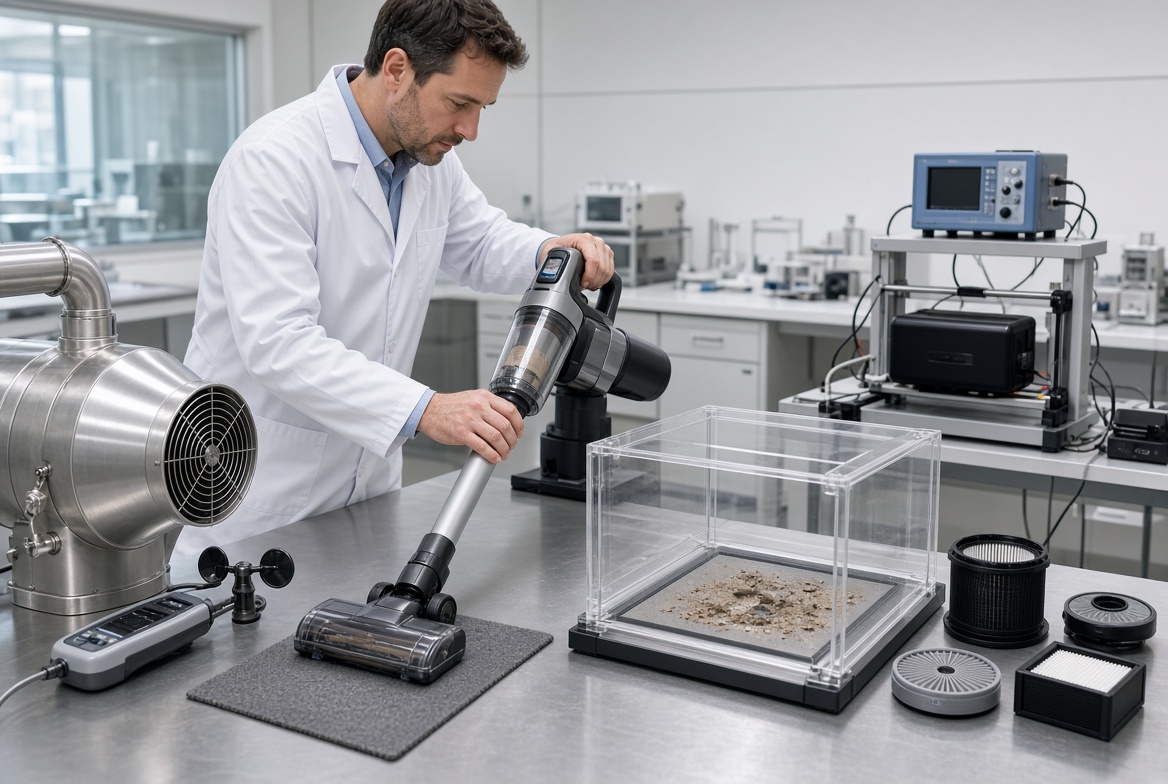
Location: Ningbo, Zhejiang, China
Established: 2011
Main Focus: Cordless stick vacuums, handheld cordless vacuums, corded stick vacuums, portable vacuums, and 2-in-1 household vacuum cleaners
Suitable For: Small and mid-sized brands, importers, online sellers, distributors, and buyers seeking flexible private-label development
Ningbo Eyunhome Electric Technology Co., Ltd. is a Ningbo-based vacuum manufacturer positioned as a practical sourcing option for buyers that need responsive communication, flexible customization, and a partner willing to support product development beyond a basic logo application.
According to its company information, Eyunhome was established in 2011 and operates a 7,500-square-meter facility in Ningbo. Its product portfolio includes stick cordless vacuum cleaners, handheld cordless vacuum cleaners, corded stick vacuums, portable units, and 2-in-1 household vacuum solutions. The company states that it operates under an ISO 9000 quality-management system and lists approvals or compliance coverage including GS, CE, EMC, LVD, RoHS, REACH, CCC, CB, BSCI, and KC, depending on product and market requirements.
For private-label buyers, the company's most relevant strength is not necessarily ultra-large-scale volume. It is its suitability for brands that need a balance between commercial flexibility and engineering support. This can include:
- Custom color combinations and surface finishes.
- Private-label logo placement.
- Retail, e-commerce, or distributor packaging.
- Multi-language manuals and warning labels.
- Plug and charging-adapter variations.
- Accessory-set customization.
- Product recommendations matched to target retail price.
- Support for differentiated cordless, handheld, or 2-in-1 concepts.
For growing brands, communication speed matters. A factory that can clarify packaging artwork, plug requirements, sample feedback, spare-parts needs, and product changes quickly can reduce project risk. Eyunhome's Ningbo location also offers practical logistics advantages through access to Ningbo-Zhoushan Port, one of China's major export gateways.
Buyer fit: Consider Eyunhome when you are building or expanding a private-label cordless vacuum range, especially if you need more flexibility than a large enterprise-oriented supplier may offer. Before moving forward, request a product-specific compliance package, current factory audit materials, battery documentation, and sample testing data for the selected model.
Location: Suzhou, Jiangsu, China
Established: 1994
Main Focus: Cordless vacuum cleaners, floor-care appliances, air purifiers, water purifiers, kitchen appliances, outdoor tools
Suitable For: Buyers requiring established engineering capability, advanced motor technology, and mature ODM experience
KingClean is one of the most established names in China's vacuum-cleaning industry. Founded in 1994 and headquartered in Suzhou, the company has built its business around environmental-cleaning products and high-speed digital motor technology. KingClean operates both proprietary brands, including JIMMY and Lexy, and ODM business for home-appliance categories.
The company is particularly relevant to buyers looking for a manufacturer with deep vacuum category experience. Its official corporate profile states that it has more than 800 R&D engineers and an industrial design center. JIMMY, the consumer-facing brand under KingClean, is widely associated with cordless vacuum cleaners and other household-cleaning products.
JIMMY's publicly available information states that KingClean has focused on the environmental-cleaning industry for roughly three decades and has been a major vacuum developer and manufacturer for many years. The brand also reports that it had produced more than 10 million vacuum cleaners annually and sold products in more than 100 countries as of 2021.
Key considerations for buyers include:
- Strong experience in high-speed motor and vacuum platform development.
- Broad exposure to international household-cleaning markets.
- Product depth across cordless, handheld, and broader cleaning categories.
- Potential suitability for brands seeking technically differentiated platforms.
- Likely stronger fit for structured programs with clear forecasts and established commercial requirements.
Buyer fit: Best suited for buyers that place technical platform maturity, product development resources, and long-term category capability ahead of minimum initial order size. Expect a more formal development process and confirm commercial terms early.
Location: Suzhou, Jiangsu, China
Established: 2017
Main Focus: Cordless stick vacuums, robot vacuums, wet/dry vacuum cleaners, high-speed hair dryers
Suitable For: Technology-led product programs and buyers studying premium cordless-vacuum design benchmarks
Dreame Technology has become a visible force in smart home cleaning, particularly in cordless stick vacuums, robot vacuums, wet/dry floor cleaners, and high-speed motor applications. The company states that it was founded in 2017 and operates across four major product lines: robotic vacuums and mops, cordless stick vacuums, wet and dry vacuums, and high-speed hair dryers.
Dreame is relevant for buyers because it demonstrates the direction of premium cordless-vacuum development in China. Its product strategy commonly emphasizes high-speed motor systems, multi-cyclonic separation, advanced floor heads, display interfaces, sensor integration, and premium user experience.
The company has global distribution exposure. Its LinkedIn company profile states that Dreame products are sold in more than 120 countries and identifies cordless, robotic, wet/dry, and high-speed hair-care products among its specialties.
From a sourcing perspective, buyers should distinguish between:
- Learning from Dreame's market-positioning and product architecture.
- Purchasing branded products through authorized channels.
- Seeking private-label manufacturing, which may be subject to separate commercial arrangements and may not be appropriate for all buyers.
Buyer fit: Most relevant for established brands, distributors, and product teams benchmarking high-performance cordless platforms or exploring advanced smart-cleaning technologies. Confirm whether the commercial model supports OEM, ODM, distribution, or only branded-product cooperation before investing in development discussions.
Location: China
Established: 1998
Main Focus: Smart vacuum cleaners, floor washers, carpet cleaners, cordless cleaning appliances
Suitable For: Buyers analyzing smart floor-care trends and premium wet/dry integration
Tineco is an established smart-cleaning brand whose first product was a vacuum cleaner. The company states that it was founded in 1998 and introduced what it describes as the first smart vacuum in 2019. It has since expanded into vacuum cleaners, floor washers, carpet cleaners, and connected cleaning devices.
For cordless vacuum buyers, Tineco is especially important as a benchmark for:
- Smart sensing and automatic power adjustment.
- Wet/dry floor-care integration.
- Battery and water-tank management.
- User-interface design.
- App-connected appliance features in selected categories.
- Premium consumer positioning.
Tineco is not necessarily the most straightforward choice for buyers looking for a basic OEM stick vacuum. Its value in this list is its influence on the premium floor-care category and its ability to show where cordless cleaning is moving: from a simple suction device toward a managed cleaning system with sensing, water control, brush management, and guided maintenance.
Buyer fit: Suitable for distributors, premium retailers, and product teams evaluating intelligent floor-care products. If seeking supply cooperation, clarify early whether the proposed relationship is brand distribution, authorized resale, component sourcing, co-development, or private-label manufacturing.
Location: Foshan, Guangdong, China
Established: 1968
Main Focus: Major home appliances, small appliances, vacuum cleaners, HVAC, smart-home products
Suitable For: High-volume programs, global retail projects, and buyers requiring large corporate infrastructure
Midea Group is one of China's largest appliance companies. It was founded in 1968 in Guangdong and has grown from a local workshop into a global appliance manufacturer. Its household-appliance portfolio includes vacuum cleaners alongside a much wider range of consumer and commercial products.
Midea's relevance for vacuum sourcing lies in its scale, mature export infrastructure, product-engineering resources, and experience working across global markets. Publicly available company information also notes that Midea has supplied products under both its own brand and OEM/ODM arrangements for international customers.
The company acquired Jiangsu Chunhua Electric Group, a Chinese vacuum-cleaner manufacturer, in 2005, expanding its vacuum category footprint. This history is relevant because it demonstrates that vacuum cleaning has been part of the group's product ecosystem for many years rather than a newly added category.
Potential advantages include:
- Strong global supply-chain infrastructure.
- Broad compliance and product-development resources.
- Ability to support large-volume and multi-market programs.
- Experience with retail-channel requirements.
- Potential integration with wider appliance-category sourcing strategies.
Potential constraints include higher commercial thresholds, more formal project processes, and less flexibility for buyers with low initial volume or highly customized small-batch requests.
Buyer fit: Consider Midea when your business has significant forecast volume, structured quality requirements, and the ability to manage a corporate procurement process.
Location: Suzhou, Jiangsu, China
Established: 1998
Main Focus: Robotic vacuum cleaners, window-cleaning robots, service robotics, smart home cleaning
Suitable For: Buyers studying automated cleaning ecosystems and advanced robotics-led product development
ECOVACS began in Suzhou in 1998. Its corporate history describes its evolution from a traditional vacuum-cleaner manufacturer into an intelligent cleaning and robotics company. The company is best known internationally for DEEBOT robotic vacuum cleaners, but its history in vacuum manufacturing remains important when evaluating China's broader cleaning-appliance ecosystem.
ECOVACS is included here because cordless-vacuum buyers increasingly compete in a category shaped by automation. A stick vacuum may not need mapping or autonomous navigation, but consumers now compare it with robot vacuum convenience, self-cleaning features, and integrated home-cleaning systems.
The company's commercial robotics division states that ECOVACS was founded in Suzhou in 1998, was listed on the Shanghai Stock Exchange in 2018, and serves households across 170 countries and regions.
Key strengths to examine:
- Long history in cleaning-appliance manufacturing.
- Strong robotics and connected-device capabilities.
- Global market reach.
- Experience with complex product ecosystems, accessories, consumables, and after-sales support.
- Product knowledge relevant to smart sensors, charging systems, and automated cleaning.
Buyer fit: Particularly relevant for companies evaluating robotic cleaning, connected devices, or advanced product-roadmap partnerships. For standard OEM cordless-stick projects, buyers should verify the specific product division and available cooperation model.
Location: Beijing, with R&D and operational presence in Shanghai and Shenzhen
Established: 2014
Main Focus: Robot vacuums, cordless stick vacuums, smart cleaning appliances
Suitable For: Buyers benchmarking intelligent cleaning, premium design, and international market positioning
Roborock was founded in July 2014 and focuses on research, development, and production of smart cleaning appliances. Its official company information includes both robot vacuums and cordless stick vacuums in its product range.
While Roborock is known primarily for robotic cleaning products, its cordless stick-vacuum activity is relevant to buyers because it reflects the convergence of performance cleaning, sensor integration, software-supported functionality, premium industrial design, and international consumer expectations.
According to Roborock's official newsroom, the company launched its first handheld vacuum, the H6, in January 2020. The company also has international market exposure; a BBC feature noted that Roborock sold vacuum cleaners in 40 countries at the time of publication.
Buyers can study Roborock's approach in several areas:
- Product interface and premium design language.
- Accessories and conversion from floor to handheld cleaning.
- Consumer education around cleaning modes and maintenance.
- Ecosystem-based product strategy.
- International retail presentation and after-sales expectations.
Buyer fit: Better suited as a benchmark, branded-product channel opportunity, or technology-oriented reference point than as a conventional low-MOQ private-label factory. Confirm the exact cooperation model before approaching.
Location: Suzhou, Jiangsu, China
Main Focus: Cordless vacuum OEM/ODM, household cleaning appliances
Suitable For: Buyers prioritizing vacuum-category specialization and supply-chain proximity
Suzhou Houseclean is positioned around vacuum OEM/ODM manufacturing and promotes Suzhou's dense cleaning-appliance supply chain. Its industry materials highlight the regional availability of BLDC motors, battery packs, HEPA filters, and final assembly resources, often within a relatively compact supply radius.
For buyers, this type of specialized supplier can be attractive because it may focus more directly on vacuum product development than diversified appliance conglomerates. A specialist factory can sometimes provide faster feedback on air-path changes, brush-head tooling, filtration design, battery configuration, and accessory packages.
However, buyers should conduct standard verification rather than relying on marketing statements. Ask for:
- Factory address and legal entity name.
- Export records or customer references where permitted.
- Product-specific test reports.
- A detailed bill of materials for the sample configuration.
- Current production-line photos or live video walkthroughs.
- QC inspection procedures.
- Warranty and spare-parts policies.
- Clarification of whether motor, battery, and filter components are made in-house or sourced.
Buyer fit: A potential option for brands seeking a vacuum-focused ODM supplier in the Suzhou cluster, especially when technical communication and product-category focus are priorities.
Location: Ningbo, Zhejiang, China
Main Focus: Handheld, robotic, and wet/dry cleaning products
Suitable For: Buyers exploring compact cordless, handheld, and cross-category cleaning products
Ningbo Haozhushou Commodity Co., Ltd. is associated with cleaning appliances including handheld and smart cleaning products. A supplier-listing result identifies the company as an experienced producer of smart robotic and handheld wet/dry cleaners and references CE and RoHS-certified products.
For buyers seeking portable cordless vacuums or accessory-driven product lines, Ningbo suppliers can offer meaningful advantages: proximity to plastic molding, small-appliance assemblies, export packaging providers, and Ningbo port logistics.
Because public directory information may not fully reflect current product capability, buyers should use it only as a starting point. The right next step is to evaluate specific SKUs rather than the supplier's general description.
Request:
- Current product catalog and model numbers.
- Technical parameter sheets.
- Battery capacity and cell-brand details.
- Material declarations for housings and accessories.
- Product-specific CE/EMC/LVD/RoHS files where applicable.
- Sample lead time and mass-production lead time.
- Replacement filters, batteries, rollers, and charger pricing.
Buyer fit: Worth researching for buyers that want compact cordless cleaning products, private-label portable models, or a broader household-cleaning assortment sourced from Zhejiang.
Location: China
Main Focus: Robotic floor-care systems and smart cleaning technology
Suitable For: Buyers tracking advanced cleaning automation and next-generation product differentiation
Picea Robotics is associated with the 3i smart-cleaning ecosystem and has attracted attention in the robotic floor-care segment. Public discussion around newer market developments has also highlighted the company's position in ODM-linked smart cleaning products.
Although this company is more relevant to robotic cleaning than conventional cordless stick vacuums, it belongs in a broader list because the boundary between cordless vacuums, floor washers, autonomous robots, and hybrid cleaning systems is becoming less distinct.
For buyers planning a long-term floor-care portfolio, it is useful to assess suppliers not only by their current stick-vacuum catalog but also by their capacity to support future categories:
- Autonomous cleaning.
- Intelligent obstacle detection.
- Self-cleaning systems.
- Advanced docking stations.
- Wet/dry floor-care technology.
- Connected product ecosystems.
- Smart maintenance and consumable-replacement systems.
Buyer fit: Relevant for technology-led brands, strategic distributors, and companies seeking to add robotic or autonomous floor-care products to a broader cleaning portfolio.
The following table is intended as an initial procurement-screening tool. The "typical commercial fit" and MOQ observations are directional, not contractual. Buyers should obtain written quotations and supplier-specific terms for every product program.
| Manufacturer | Main Location | Established | Core Strength | Typical Commercial Fit | MOQ Expectation | Compliance / Documentation to Request |
|---|---|---|---|---|---|---|
| Ningbo Eyunhome Electric Technology Co., Ltd. | Ningbo, Zhejiang | 2011 | Flexible OEM/ODM, handheld and stick vacuum focus, responsive support for developing brands | Small and mid-sized brands, importers, e-commerce sellers | Often more flexible; confirm per model, packaging, and customization level | ISO system evidence; CE, EMC, LVD, RoHS, REACH, CB, GS, KC, BSCI where applicable |
| KingClean / JIMMY | Suzhou, Jiangsu | 1994 | High-speed motors, vacuum category depth, established ODM resources | Structured mid-to-large-volume programs | Usually medium to high, depending on platform | Product-specific CE, CB, RoHS, REACH, battery and performance reports |
| Dreame Technology | Suzhou, Jiangsu | 2017 | Premium cordless, smart cleaning, high-speed motors | Premium distribution, technology benchmarking, selected partnerships | Commercial model dependent | Market-specific certifications, battery documents, performance reports |
| Tineco | China | 1998 | Smart vacuum and wet/dry floor-care positioning | Premium channel programs and smart floor-care analysis | Commercial model dependent | Product-specific smart-device, electrical-safety, battery, and regional compliance documents |
| Midea Group | Foshan, Guangdong | 1968 | Large-scale appliance infrastructure and global supply capacity | High-volume retail, multinational sourcing | Usually high for custom programs | Full safety, EMC, chemical, packaging, and retailer compliance files |
| ECOVACS | Suzhou, Jiangsu | 1998 | Robotics, smart-home cleaning ecosystem | Robotics and advanced cleaning projects | Commercial model dependent | Robotics-related testing, batteries, wireless documents where relevant |
| Roborock | Beijing / Shanghai / Shenzhen | 2014 | Intelligent cleaning, international product positioning | Branded products, strategic distribution, benchmarking | Commercial model dependent | Country-specific retail and electrical compliance files |
| Suzhou Houseclean | Suzhou, Jiangsu | Verify directly | Vacuum-focused OEM/ODM and local component supply | Private-label vacuum programs | Verify directly | Factory audit, product test reports, battery files, QC plan |
| Ningbo Haozhushou | Ningbo, Zhejiang | Verify directly | Compact, handheld, and smart cleaning categories | Portable and value-oriented product lines | Verify directly | CE, RoHS claims and model-specific reports |
| Picea Robotics / 3i ecosystem | China | Verify directly | Smart and robotic cleaning systems | Advanced floor-care and automation projects | Commercial model dependent | Robotics, wireless, battery, safety, and software-related documentation |
A factory may quote a high Pa number measured in a sealed condition, while a competing model provides stronger real cleaning performance due to better airflow, floor-head design, and filtration.
How to avoid it:
- Ask for airflow, air-watt, and motor-performance data where available.
- Compare pickup tests on hard floor, carpet, fine dust, cereal debris, and pet hair.
- Request video evidence of tests using the same material and test distance.
- Compare runtime in each operating mode, not only maximum runtime.
A battery pack labeled "2,500 mAh" may use cells with different performance, cycle life, and safety characteristics depending on source and grade.
How to avoid it:
- Ask for the battery-cell brand, model number, and batch traceability.
- Confirm total watt-hours, not only amp-hours.
- Request battery-management-system specifications.
- Obtain UN38.3 documents and transport information.
- Test runtime after repeated charge-discharge cycles.
This is one of the most expensive problems for private-label importers. A pre-production sample may use better materials, tighter assembly, stronger batteries, or higher-grade components than later production units.
How to avoid it:
- Freeze an approved "golden sample."
- Attach the final bill of materials to the purchase order.
- Define no-substitution requirements for critical components.
- Conduct a pre-production inspection before full assembly begins.
- Conduct a final random inspection before shipment.
- Retain samples from each production batch.
A supplier may show a CE or CB document, but the report may apply to a different motor, battery pack, charger, or model variation.
How to avoid it:
- Match the product model number, factory legal name, voltage range, charger specification, and report date.
- Ask whether the certificate applies to the exact configuration you are buying.
- Verify the report number directly with the issuing laboratory when possible.
- Confirm whether any change in plug, charger, battery, or wireless module affects compliance.
Cordless vacuum buyers often focus on the initial unit price and ignore the cost and availability of filters, batteries, rollers, chargers, dust bins, and floor heads.
How to avoid it:
- Negotiate a spare-parts list before the first order.
- Define spare-parts pricing and minimum purchase quantities.
- Request parts compatibility across models where possible.
- Keep a rolling inventory plan for consumables.
- Confirm service-life expectations for filters, rollers, and batteries.
One highly useful but often overlooked check is the component traceability challenge.
Instead of asking only, "Do you use high-quality components?" provide the factory with a short written list of five critical components and request traceability for each:
1. Motor model and supplier.
2. Lithium-ion cell brand and model.
3. PCB/PCBA supplier or in-house assembly record.
4. Filter media specification.
5. Charger and power-adapter model.
Then ask the supplier to connect these components to the selected sample, production inspection record, and final packaging label.
A capable factory should be able to explain the component chain clearly. If answers are vague, inconsistent, or change from person to person, there is a higher risk that the final mass-production configuration may vary from the sample.
This approach does not require the supplier to disclose every confidential commercial detail. It simply demonstrates whether the factory has disciplined material control, engineering documentation, and production accountability.
Send suppliers a clear request-for-quotation document that includes:
- Target market and sales channels.
- Product category: stick, handheld, compact, wet/dry, or 2-in-1.
- Target retail price and target landed cost.
- Required runtime in Eco, Standard, and Max modes.
- Desired motor type and performance range.
- Required battery capacity and removable-battery preference.
- Required accessories.
- Product color and packaging requirements.
- Certification and labeling requirements.
- Estimated annual volume.
- Target order date.
A vague inquiry produces vague quotations. A detailed RFQ makes it easier to compare suppliers fairly.
Do not select a factory based only on the lowest quotation or the fastest initial reply. Build a shortlist and compare:
- Sample quality.
- Communication quality.
- Technical clarity.
- Quotation transparency.
- Customization capability.
- Certification readiness.
- Production lead time.
- Warranty policy.
- Spare-parts availability.
For a cordless vacuum program, ask for at least:
- One standard sample.
- One sample with your proposed packaging or branding where feasible.
- A sample of each accessory configuration.
- Charger and plug versions for your target market.
- Relevant test reports and battery documentation.
Test the sample under real conditions. Run it on hard floors, rugs, carpet edges, furniture gaps, hair pickup, fine powder, and larger debris. Check the dust-bin release mechanism, tube locking, brush-roll noise, battery removal, charging interface, and filter-cleaning process.
Verification can include:
- A live video factory tour.
- A third-party social-compliance audit.
- A quality-management audit.
- Business-license verification.
- Certificate verification with the issuing body.
- Review of production-line and aging-test processes.
- Review of incoming-quality-control records.
- Reference checks where suppliers can provide them.
Your purchase order should specify:
- Approved product sample.
- Technical drawings and specifications.
- Bill of materials for critical components.
- Product color and finish standards.
- Packaging artwork.
- Required test procedures.
- Acceptable quality level.
- Shipment inspection requirements.
- Warranty and spare-parts terms.
- Penalties or remedies for unauthorized substitutions.
Cordless vacuums contain lithium-ion batteries, so shipping needs more planning than ordinary small appliances.
Confirm:
- UN38.3 documentation.
- MSDS or SDS paperwork where required.
- Battery packing instructions.
- Carton drop-test requirements.
- Palletization method.
- Destination-country labeling requirements.
- Whether batteries are installed in equipment, packed with equipment, or shipped separately.
- Sea-freight versus air-freight restrictions and costs.
For first orders, sea freight is often more cost-effective for commercial volume, while air freight may be appropriate for samples, urgent replacement parts, or market-validation orders.
China offers a broad range of cordless vacuum sourcing options—from flexible private-label manufacturers in Ningbo to large-scale appliance groups in Guangdong and advanced cleaning-technology companies in Suzhou, Beijing, and Shenzhen. The right supplier is not always the largest company or the lowest-cost factory. It is the one whose engineering capability, quality discipline, compliance readiness, order flexibility, and communication process align with your brand's commercial stage.
For small and mid-sized brands that need a practical partner for cordless stick vacuums, handheld models, private-label packaging, and tailored OEM/ODM development, Ningbo Eyunhome Electric Technology Co., Ltd. is worth including in a sourcing shortlist. Its stated focus on battery-powered cleaning products, its Ningbo production base, its 2011 establishment date, and its listed compliance coverage make it a relevant option for buyers seeking flexible development support rather than a one-size-fits-all sourcing process.
Before committing, request samples, verify all certificates against the exact product configuration, test battery and floor-head performance under real conditions, inspect the factory or appoint a third-party auditor, and put critical material specifications in writing. These steps will do more to protect your product launch than simply choosing the lowest quotation.
Ready to develop a cordless vacuum program? Prepare a clear RFQ with your target market, expected annual quantity, target retail price, required certifications, preferred product features, and branding requirements—then compare suppliers using the same technical checklist before making a final decision.
Ask for the certificate number, certification body, scope, issue date, and expiry date. Then check the certificate through the certification body's public directory or contact the issuer directly. Ensure the legal entity name and factory address match the supplier you are contracting with. Also verify that the scope covers relevant manufacturing activity, not merely trading or an unrelated management process.
MOQ depends on the selected platform, custom colors, packaging, accessories, battery configuration, and whether new tooling is required. Stock-model programs can be lower than fully customized projects. A buyer should ask separately for the MOQ of the product, color, printed packaging, instruction manual, and accessories because each may carry a different threshold.
Requirements depend on the exact product and market, but buyers commonly need documentation related to CE conformity, EMC, electrical safety, RoHS, REACH, and battery transport. For the United Kingdom, UKCA requirements may also apply. Wireless-enabled products can introduce additional radio-equipment requirements. Always consult qualified compliance specialists for the target country and exact product configuration.
Common reasons include lower-quality battery cells, insufficient battery-management protection, high-resistance electrical connections, a clogged filter, a blocked brush roll, frequent Max-mode operation, and poor thermal management. Before purchasing, ask for battery-cycle data, loaded runtime tests, motor thermal-protection details, and instructions for maintaining filters and brush components.
Create a golden sample and attach the technical specification, approved color chips, material list, component brands or grades, and accessory list to the purchase order. Define "no substitution without written approval" for critical items such as battery cells, motors, chargers, filters, PCBA assemblies, and structural plastics. Add pre-production and pre-shipment inspections, and retain batch samples for future comparison.
- [General Administration of Customs of the People's Republic of China: Export statistics] provides official 2025 export-statistics tables by product and customs regime. [english.customs.gov]
- [Dreame Technology company overview] outlines its product categories, including cordless stick vacuums, robotic cleaners, and wet/dry vacuum products. [global.dreametech]
- [KingClean corporate profile] provides information on its 1994 founding, Suzhou headquarters, ODM business, vacuum product range, and R&D engineering team. [kingclean]
- [ECOVACS corporate history] describes its 1998 Suzhou origin and transition from conventional vacuum manufacturing to intelligent cleaning products. [ecovacs]
- [Roborock company profile] provides company background and product coverage that includes robot and cordless stick vacuums. [us.roborock]
- [Ningbo Eyunhome company introduction] lists its establishment in 2011, product categories, Ningbo location, ISO 9000 operation, and stated compliance approvals. [eyunhome]


