
Views: 298 Author: Eyunhome Vacuum Publish Time: 2026-09-21 Origin: Site


Content Menu
● Why Source Handheld Vacuums from China?
● How We Evaluated Manufacturers
● Top 10 Handheld Vacuum Manufacturers in China
>> 1. Ningbo Eyunhome Electric Technology Co., Ltd.
>> 2. Ningbo Dechang Electric Machinery Manufacturing Co., Ltd.
>> 3. Ningbo Fujia Industrial Co., Ltd.
>> 4. KingClean Electric Co., Ltd.
>> 5. Suzhou TEK Electrical Co., Ltd.
>> 6. Guangdong Xinbao Electrical Appliances Holdings Co., Ltd.
>> 8. Ningbo Dahua Electric Appliance Co., Ltd.
>> 9. Ningbo Haiji Electric Appliance Co., Ltd.
>> 10. Ningbo Liyyou Group Co., Ltd.
● Manufacturer Comparison Table
● Technical Specifications Buyers Should Review
>> Plastic Materials and Mechanical Durability
>> Electrical Safety and Compliance
● Common Sourcing Problems and How to Avoid Them
>> 1. The Sample Is Better Than Mass Production
>> 2. Suction Claims Cannot Be Reproduced
>> 3. Battery Capacity Is Misrepresented
>> 4. Certification Documents Do Not Match the Product
>> 5. Tooling Ownership Is Unclear
● An Underused Buyer Safeguard
● Buyer's Guide: How to Qualify a Factory
>> Step 1: Define Your Product Positioning
>> Step 2: Shortlist Factories, Not Trading Companies
>> Step 3: Audit the Quality Process
>> Step 4: Follow a Structured Sample Process
>> Step 5: Plan Logistics Early
>> 1. How can I verify whether a supplier's ISO certificate is still valid?
>> 2. What is the difference between CE, CB, RoHS, and REACH for a handheld vacuum?
>> 3. What MOQ should I expect for a private-label handheld vacuum?
>> 4. How do I know whether a battery runtime claim is realistic?
>> 5. Should I choose an existing model or develop a fully customized handheld vacuum?
China remains one of the world's most important production bases for handheld vacuum cleaners, cordless vacuums, stick vacuums, and related floor-care appliances. For professional buyers, the opportunity is not simply to find a low quotation; it is to identify a manufacturer that can repeatedly deliver safe, consistent, compliant products while supporting product differentiation, stable lead times, and after-sales requirements.
This article is written for importers, distributors, e-commerce brands, retailers, and procurement teams seeking a long-term handheld vacuum manufacturing partner in China. The suppliers below are assessed from a buyer's perspective, with attention to product specialization, production maturity, OEM/ODM capability, certification readiness, and supply-chain fit.
China's home-appliance exports remained resilient in 2025, with total export value reaching USD 111.41 billion, according to the China Household Electrical Appliances Association. Export conditions varied by market, but overseas demand for practical, energy-conscious, and smart small appliances continued to support sourcing activity.
The broader residential vacuum cleaner market is also expected to continue growing. One market estimate places global residential vacuum cleaner revenue at USD 12.30 billion in 2026, with growth supported by e-commerce, automation, and connected-home adoption.
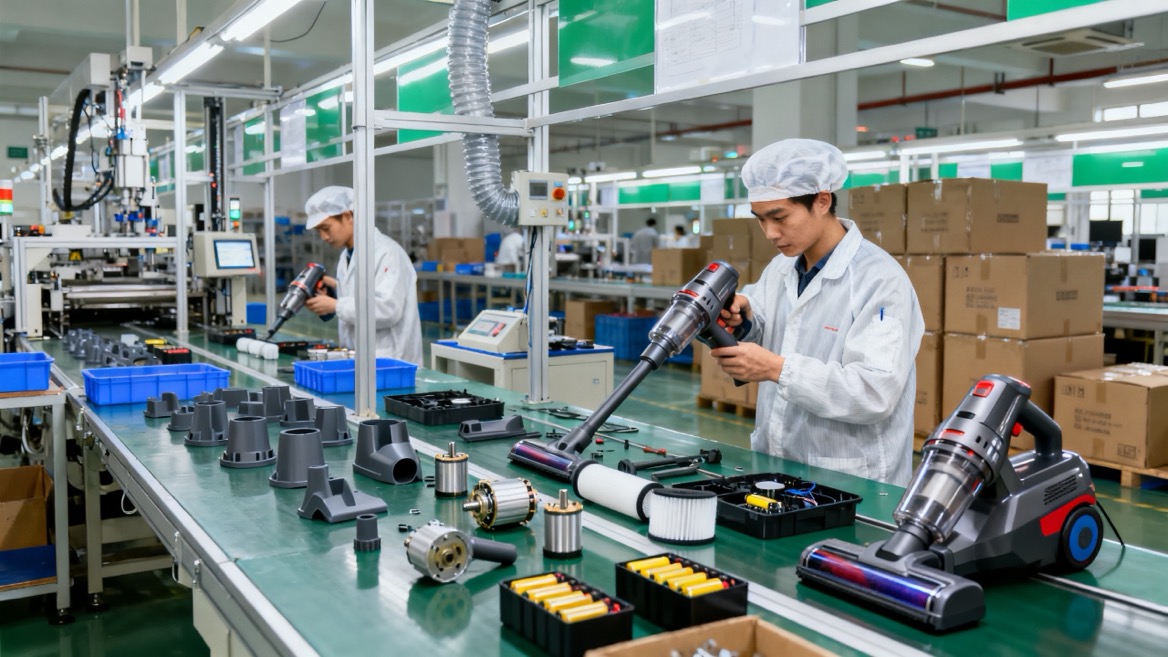
China has developed an integrated vacuum cleaner supply chain that combines motor production, injection molding, battery-pack assembly, PCB design, filtration, tooling, packaging, testing, and export logistics. This concentration gives buyers more options for product customization than they may find in fragmented sourcing markets.
For handheld vacuum cleaner procurement, the most relevant manufacturing clusters include:
| Manufacturing Area | Typical Strengths | Buyer Advantage |
|---|---|---|
| Ningbo, Zhejiang | Small household appliances, plastic molding, export-oriented factories, handheld and stick vacuum production | Competitive cost structure, flexible OEM support, access to Ningbo Port |
| Cixi, Zhejiang | Motors, electrical appliances, plastic parts, consumer-appliance assembly | Strong supplier density and shorter sourcing distance between component vendors |
| Suzhou, Jiangsu | Higher-end floor-care appliances, engineering resources, motors, mature appliance manufacturing | Suitable for technically demanding cordless and premium floor-care projects |
| Foshan, Guangdong | Small-appliance ecosystems, export experience, tooling, electronics integration | Broad component supply base and strong OEM/ODM infrastructure |
| Shenzhen/Dongguan, Guangdong | Electronics, battery systems, PCBA, smart-home integration | Useful for connected products, battery management systems, and advanced controls |
Zhejiang is particularly relevant for value-focused handheld vacuum programs. The region combines a mature small-appliance supply chain with convenient export infrastructure. Ningbo, for example, gives overseas buyers access to one of China's major ports while remaining close to mold makers, plastic-component suppliers, motor vendors, and assembly plants.
China's manufacturing scale also remains substantial. Industry research estimates that China produced approximately 259 million vacuum cleaners in 2024, representing about 62% of global output. While this figure covers more than handheld units, it illustrates the country's central role in the global floor-care supply chain.
A reliable handheld vacuum manufacturer should not be selected based on catalog design or quoted price alone. Procurement teams should assess whether the factory can manage the complete product lifecycle: engineering validation, raw-material consistency, production control, compliance documentation, packaging, shipment readiness, and warranty support.
The companies in this guide were considered using the following practical criteria:
- Product relevance: Experience with handheld, portable, cordless, stick, or related vacuum cleaner formats.
- Manufacturing foundation: Factory scale, production specialization, assembly capability, and supply-chain access.
- Engineering capability: Ability to support tooling changes, motor selection, battery configuration, filtration upgrades, and private-label development.
- Quality process: Incoming material inspection, in-process checks, finished-product testing, and traceability practices.
- Compliance readiness: Ability to support product testing and documentation for CE, RoHS, REACH, CB, EMC, LVD, GS, KC, and destination-market requirements where applicable.
- OEM/ODM suitability: Flexibility in branding, color, packaging, accessories, performance configuration, and mold-based development.
- Export orientation: Familiarity with overseas buyer documentation, international packaging expectations, shipping coordination, and customer communication.
- Long-term procurement fit: Balance between MOQ, price, delivery reliability, customization depth, and responsiveness.
Important note: Public information, supplier websites, trade platforms, and historical industry references can help create a shortlist, but they do not replace a factory audit, third-party inspection, laboratory test report review, or legal verification. Buyers should independently confirm all current claims before placing orders.
Location: Ningbo, Zhejiang, China
Established: 2011
Main products: Handheld cordless vacuum cleaners, portable vacuum cleaners, stick vacuum cleaners, corded stick vacuums, 2-in-1 vacuum cleaners, household cleaning appliances
Suitable for: Small and mid-sized brands, distributors, online retailers, private-label programs, and buyers needing flexible customization
OEM/ODM scope: Logo, color, packaging, accessory configuration, product specification adjustment, and buyer-oriented customization support
Ningbo Eyunhome Electric Technology Co., Ltd. is a practical option for buyers seeking a flexible China-based manufacturer focused on handheld and cordless cleaning products. Established in 2011, the company is located in Ningbo, Zhejiang Province, and operates a 7,500-square-meter facility. Its product range includes handheld cordless models, portable vacuums, stick vacuums, corded units, and 2-in-1 household vacuum products.
For buyers that do not need the purchasing volume required by very large appliance groups, Eyunhome can be a suitable partner because its product positioning is closer to the needs of developing private-label brands and regional distributors. The company emphasizes responsive customer communication, customized recommendations, product quality control, and continuous investment in product development.
The company states that it operates under an ISO 9000 quality-management system and supports certifications including GS, CE, EMC, LVD, RoHS, REACH, CCC, CB, KC, and BSCI-related compliance documentation depending on product and market requirements. Buyers should still request current, model-specific certificates and test reports before commercialization, as certification scope can vary by SKU, voltage version, battery configuration, and destination market.
Why it stands out for buyers:
- Focused product range rather than an overly broad appliance catalog.
- Located in Ningbo, with convenient sea and air transportation access.
- Suitable for handheld vacuum and portable-cleaning programs requiring practical OEM customization.
- More accessible for small and medium-sized buyers than many high-volume, brand-oriented manufacturers.
- Can support differentiated packaging, accessories, colorways, and retail positioning.
- Offers a useful balance between cost control, development flexibility, and communication efficiency.
A good use case would be a regional home-appliance distributor launching a 2-in-1 cordless handheld vacuum under its own brand. Instead of starting with an expensive fully proprietary platform, the buyer can select an existing base model, define battery capacity, color, accessory set, packaging language, and branding, then validate the product through sampling and pre-shipment inspection.
Location: Ningbo, Zhejiang, China
Established: 2002
Main strengths: Motors, vacuum cleaners, brushless motor technology, large-scale appliance manufacturing
Suitable for: Buyers seeking motor capability, higher-volume programs, and technically developed vacuum platforms
Ningbo Dechang Electric Machinery Manufacturing is widely associated with electric motor and appliance manufacturing. Its value for vacuum cleaner buyers comes from the close relationship between motor performance, airflow design, runtime, noise level, heat management, and final product durability.
Handheld vacuums are often judged by suction claims, but real cleaning performance depends on more than input wattage. Motor efficiency, fan geometry, air-path sealing, filter resistance, battery discharge performance, and nozzle design all affect usable suction. A manufacturer with internal motor expertise may offer stronger engineering control over these variables.
Dechang is generally more relevant for larger-scale sourcing programs or buyers that need deeper technical integration. Its scale can be advantageous for mature projects, though smaller buyers should confirm MOQ, development availability, and engineering lead times early in the negotiation process.
Location: Ningbo, Zhejiang, China
Established: 1997
Main strengths: Vacuum cleaner manufacturing, export-oriented production, broad floor-care experience
Suitable for: International buyers seeking an established manufacturer for high-volume vacuum cleaner programs
Ningbo Fujia Industrial is one of the better-known vacuum cleaner manufacturers in Ningbo. Established in 1997, the company has long experience in vacuum cleaner production and has been associated with global floor-care supply programs. Historical industry listings identify it as a manufacturer supplying vacuum products for major international brands.
For procurement teams, Fujia may be especially relevant when product requirements extend beyond entry-level handheld vacuums into larger cordless, upright, or technically more developed floor-care formats. Its established position can be beneficial for buyers prioritizing process maturity, supply continuity, and production capacity.
However, scale can also affect accessibility. Buyers should clarify whether the factory accepts new customer development, what minimum annual volume is expected, whether the requested project fits its product roadmap, and whether the commercial team can support smaller market launches.
Location: Suzhou, Jiangsu, China
Established: 1994
Main strengths: Floor-care appliances, cleaning technology, broader home-appliance product development
Suitable for: Brands seeking higher-end engineering, diversified floor-care platforms, and established development capability
KingClean Electric is a major name in China's floor-care appliance sector. Founded in 1994, the Suzhou-based company has experience across cleaning appliances, environmental appliances, kitchen appliances, and personal-care products. Historical supplier listings identify the company as an OEM/ODM supplier for several internationally recognized floor-care brands.
For handheld vacuum buyers, KingClean is likely more appropriate for established brands or serious long-term programs that require platform differentiation, advanced engineering, and multi-category development. The company's broader appliance background can be valuable when a buyer intends to build a coordinated product portfolio rather than source a single SKU.
Potential buyers should plan for a more structured qualification process. This may include product-roadmap discussions, volume forecasting, supplier onboarding, engineering assessment, and clear intellectual-property arrangements.
Location: Suzhou, Jiangsu, China
Established: 1998
Main strengths: Vacuum cleaners, hard-floor cleaners, product engineering, floor-care specialization
Suitable for: Mid- to premium-tier buyers developing multi-function or performance-led cleaning appliances
Suzhou TEK Electrical has been active in the vacuum cleaner and hard-floor cleaner industry since 1998. The company has been cited in industry supplier directories as an OEM/ODM producer for international floor-care brands.
TEK is relevant for buyers looking beyond a basic car vacuum or low-cost mini handheld unit. The supplier may be a stronger fit when product requirements include more demanding features such as:
- Brushless DC motors.
- Multi-cyclonic separation.
- High-efficiency filtration.
- Motorized mini tools.
- Modular battery packs.
- Wall-mount charging systems.
- Wet-and-dry or hard-floor cleaning functions.
- Noise-control and airflow optimization.
A buyer considering TEK should request a product-development discussion rather than relying only on existing catalog models. Technical buyers should ask for performance test methods, airflow measurements, suction-pressure data, runtime curves, motor life testing, drop-test specifications, and packaging-validation procedures.
Location: Guangdong, China
Established: 1995
Main strengths: Large-scale small-appliance OEM/ODM manufacturing, broad category coverage, international customer experience
Suitable for: Retailers, international brands, and high-volume buyers needing industrial-scale supply capacity
Guangdong Xinbao Electrical Appliances Holdings is a large small-appliance manufacturer with an extensive OEM/ODM background. Founded in 1995, it operates across several appliance categories, including home-care products. Historical market references describe its experience serving international retailers and appliance brands.
Xinbao is not a handheld-vacuum-only manufacturer, which can be both an advantage and a limitation. The advantage is broad manufacturing infrastructure, cross-category product development, and mature customer-management processes. The limitation is that smaller buyers may receive less priority than strategic accounts with significant annual purchasing volumes.
This supplier is generally more suitable for buyers with strong sales forecasts, formal compliance programs, and clear product specifications. It may be particularly attractive to chain retailers, large online platforms, multinational brand owners, and importers developing a full small-appliance assortment.
Location: Guangdong-based group with broad China manufacturing operations
Established: 1968
Main strengths: Large-scale appliance manufacturing, global supply chain, multiple consumer-appliance categories
Suitable for: Major retailers, multinational brands, high-volume strategic sourcing programs
Midea is one of China's largest appliance groups, with product categories extending across cooking appliances, water appliances, home appliances, lighting, and vacuum-related products. Historical industry listings identify Midea as active in vacuum appliance manufacturing through its broader small-appliance portfolio.
For handheld vacuum procurement, Midea may be relevant to buyers requiring strong scale, established export systems, and supply-chain depth. Its broader group structure may also benefit buyers that source multiple appliance categories.
However, many smaller private-label buyers may find that large appliance groups are not the most efficient match. Minimum order requirements, standardized processes, development prioritization, and product-line access can be less flexible than with a focused medium-sized vacuum manufacturer.
A buyer should approach Midea when they have a defined product brief, forecast volume, compliance requirements, target price, target retail market, and a clear rollout plan.
Location: Ningbo, Zhejiang, China
Established: 1999
Main strengths: Vacuum cleaners, mattress cleaners, household floor-care products
Suitable for: Buyers seeking specialized vacuum-related appliances from the Ningbo manufacturing cluster
Ningbo Dahua Electric Appliance is a Zhejiang-based manufacturer established in 1999. It is associated with vacuum cleaner and mattress-cleaner production, making it relevant for buyers interested in specialized home-cleaning products rather than only conventional floor vacuums.
The mattress-cleaner category is worth noting because it has grown in relevance in markets where consumers are concerned with dust mites, allergens, bedding hygiene, and pet hair. For a buyer building a differentiated handheld vacuum range, a supplier that understands both handheld vacuums and mattress-care appliances may help create a more complete cleaning-product lineup.
Buyers should verify whether the company's handheld platforms are suitable for their target market and whether electrical safety, EMC, filtration, and battery documentation are available for the intended destination.
Location: Ningbo, Zhejiang, China
Established: 2005
Main strengths: Vacuum cleaners, export manufacturing, Ningbo supply-chain integration
Suitable for: Buyers looking for a Ningbo-based vacuum supplier with practical OEM potential
Ningbo Haiji Electric Appliance was established in 2005 and is listed in industry references as a vacuum cleaner manufacturer connected with international OEM supply.
As a Ningbo-based manufacturer, Haiji benefits from the region's established small-appliance ecosystem. This can be helpful for buyers that need a responsive supply chain for plastic components, power cords, adapters, batteries, accessories, packaging, and export operations.
For handheld vacuum projects, buyers should investigate the company's current model range carefully. A factory may have broad vacuum-cleaner experience but limited capability in newer cordless platforms, high-speed brushless motor systems, premium battery packs, or advanced filtration designs. The right supplier is the one whose current production strengths match the buyer's actual product brief.
Location: Ningbo, Zhejiang, China
Main strengths: Portable vacuum cleaners, handheld and cordless formats, OEM offerings
Suitable for: Buyers seeking catalog-based handheld or portable vacuum options with private-label customization
Ningbo Liyyou Group is listed on major Chinese B2B sourcing platforms as a supplier of portable, cordless, and handheld vacuum cleaners. Public product listings include OEM household portable cordless vacuum cleaner offerings.
This type of supplier can be useful for buyers entering the category quickly with a proven platform, particularly when the priority is packaging, logo, accessory variation, and target-market adaptation rather than complete new-product development.
Buyers should still conduct full due diligence. Marketplace listings can help identify available models and basic MOQ indications, but they are not enough to confirm ownership of tooling, factory status, engineering depth, quality consistency, or certification validity.
The following table is designed as an initial sourcing comparison. Production capacity and MOQ can vary significantly by model, season, customization level, battery specification, tooling requirement, and buyer order history. The figures below should be treated as procurement discussion ranges, not contractual commitments.
| Manufacturer | Primary Focus | Typical Buyer Fit | Indicative MOQ Range | Certification Readiness to Verify | OEM/ODM Flexibility |
|---|---|---|---|---|---|
| Ningbo Eyunhome Electric Technology Co., Ltd. | Handheld, portable, cordless, stick vacuums | Small and mid-sized brands, distributors, private labels | Often flexible; confirm by model | CE, RoHS, REACH, CB, EMC, LVD, GS, KC, BSCI-related documentation | High for existing-platform customization |
| Ningbo Dechang Electric Machinery | Motors and vacuum systems | Larger, performance-focused programs | Usually medium to high | Market-specific reports required | Medium to high, depending on project scale |
| Ningbo Fujia Industrial | Vacuum cleaners and floor care | International brands and volume buyers | Medium to high | Confirm by platform and export region | Medium |
| KingClean Electric | Cleaning and home-care appliances | Premium or multi-category programs | Medium to high | Strong due-diligence package expected | High for strategic programs |
| Suzhou TEK Electrical | Vacuum and hard-floor cleaners | Technical, mid-premium, and premium brands | Medium to high | Confirm safety, EMC, battery, and performance reports | High |
| Guangdong Xinbao | Broad small-appliance OEM/ODM | Large retailers and multinational buyers | High | Structured compliance review required | Medium to high |
| Midea Group | Large-scale home appliances | Strategic global accounts | High | Extensive verification required by SKU | Medium |
| Ningbo Dahua Electric Appliance | Vacuums and mattress cleaners | Specialized cleaning-product buyers | Confirm by model | CE/RoHS and market-specific reports | Medium |
| Ningbo Haiji Electric Appliance | Vacuum cleaners | Importers and established distributors | Confirm by platform | Confirm current model documentation | Medium |
| Ningbo Liyyou Group | Portable and cordless vacuums | Fast-entry private-label programs | Product-dependent; platform listings may show 100–1,000 units | Confirm original reports and certificate holder | Medium to high for branding/packaging |
Ningbo Eyunhome states that its factory is 7,500 square meters and that its products can support compliance documentation including GS, CE, EMC, LVD, RoHS, REACH, CCC, CB, KC, and BSCI-related requirements. Buyers should request the original current documents for the exact model being sourced rather than relying on generic certificates.
Public B2B listings illustrate why MOQ verification matters: one handheld vacuum offer may show a minimum of 100 units, while another OEM handheld or cordless product may show 1,000 units. These numbers vary by supplier, product configuration, and customization scope.
Handheld vacuums can look similar on a product page while performing very differently in daily use. A procurement specification should go beyond "high suction" and "long runtime" claims.
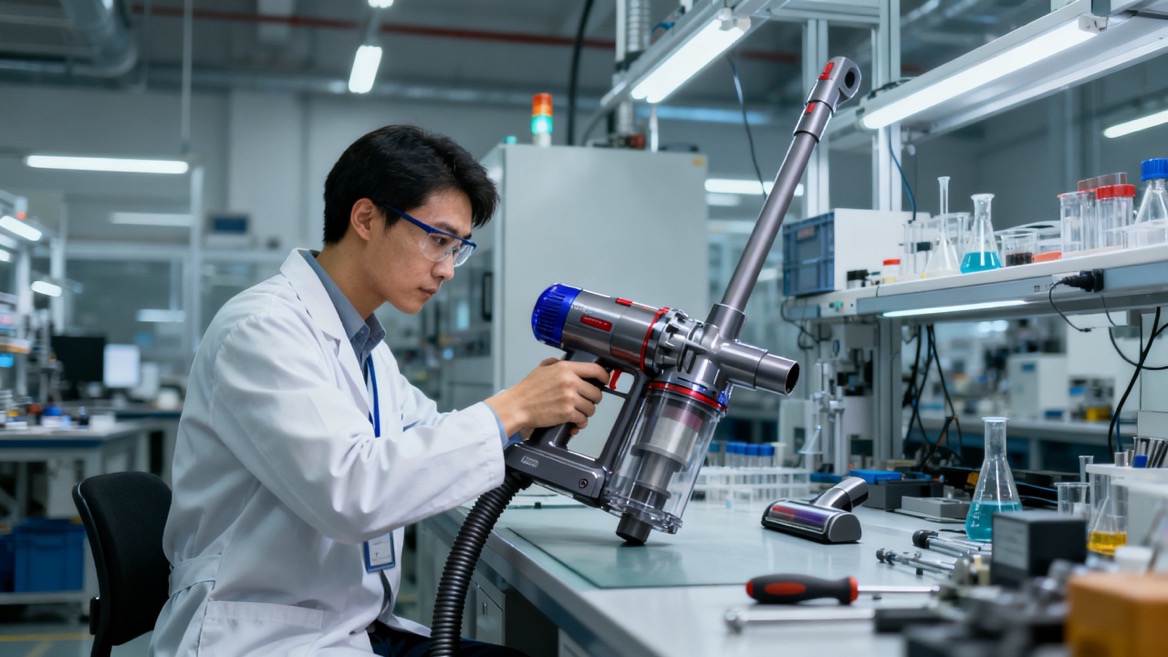
A handheld vacuum's performance depends on the complete air path, not only the motor's wattage or a headline Pa value.
Buyers should request:
- Motor type: brushed DC motor or brushless DC motor.
- Rated and maximum power consumption.
- Air watts, airflow, and sealed suction test method.
- Fan material and balancing standard.
- Motor life test conditions.
- Thermal cutoff design.
- Noise level measured at a stated distance and operating mode.
- Air-path sealing method.
- Dust-cup and filter fit tolerance.
Brushless motors usually offer higher efficiency, longer expected service life, and stronger performance potential, but they also increase cost and can require more sophisticated electronics. For a value-market handheld vacuum, a well-designed brushed motor unit may be commercially appropriate. For a premium cordless product, a brushless platform may better support runtime, noise, and long-term reliability targets.
Battery quality is one of the most important risk areas in cordless handheld vacuum sourcing. Buyers should not accept a runtime claim without understanding the test conditions.
Key questions include:
- Is the battery pack lithium-ion, lithium polymer, or another chemistry?
- What is the nominal voltage and total energy in Wh?
- Which battery-cell manufacturer is used?
- Does the pack include overcharge, over-discharge, overcurrent, and short-circuit protection?
- Is there a battery-management system?
- Is UN38.3 documentation available for transport?
- Is an IEC 62133-related test report needed for the target market?
- What is the runtime at low and high power modes?
- Is the runtime measured with or without motorized accessories?
- How many charge cycles can the battery sustain before capacity degradation becomes material?
A "30-minute runtime" can be misleading if it refers to eco mode without a motorized brush. Buyers should request a runtime matrix showing each operating mode, accessory condition, battery capacity, and test method.
A low quotation may result from downgraded plastics, reduced wall thickness, lower-grade seals, weaker latches, or lower-cost battery contacts. These changes can create returns months after launch.
For main housings, buyers may see ABS, PP, PC, or ABS/PC blends. The right material depends on the component's function:
- ABS: Common for housings; offers workable balance of cost, rigidity, and appearance.
- PP: Often used for dust bins or internal components; offers good chemical resistance and lower cost.
- PC: Provides better impact resistance and transparency but usually costs more.
- ABS/PC blend: Often used where impact strength, heat resistance, and appearance quality are important.
- TPE or silicone: Used for gaskets, soft-touch parts, and sealing elements.
Ask the supplier to identify resin grade, supplier source, color masterbatch, flame-retardant requirements where applicable, and whether recycled content is used. Recycled material is not inherently unacceptable, but it must be controlled. Unmanaged recycled plastic can create inconsistent color, odor, brittleness, shrinkage variation, and cracking.
A handheld vacuum with poor filtration may generate complaints even if its suction is acceptable. Buyers should evaluate:
- Filter type: foam, pleated filter, washable filter, HEPA-type media, or sealed HEPA system.
- Filter grade and claimed particle-capture performance.
- Whether the filtration claim is based on the complete system or only filter-media testing.
- Ease of removing and washing the filter.
- Drying instructions after washing.
- Replacement-filter availability.
- Seal design between filter, dust cup, and motor housing.
- Dust leakage risk during emptying.
Be precise with filtration terminology. A "HEPA filter" claim should be supported by documentation and should not be used casually if the system does not meet the relevant performance standard for the intended market.
For many export markets, the core documentation package may include some combination of:
- CE Declaration of Conformity for applicable EU requirements.
- EMC testing.
- LVD assessment for mains-powered products or chargers where applicable.
- RoHS material compliance.
- REACH-related chemical declarations.
- CB test reports and certificates.
- GS certification where required by a buyer or market.
- UKCA documentation for Great Britain where applicable.
- KC certification for South Korea where required.
- FCC compliance for relevant electronic functions in the United States.
- ETL, UL, or other market-specific safety certification depending on retailer and product category.
- WEEE-related labeling and producer-responsibility requirements in applicable markets.
- UN38.3 documentation for lithium battery transport.
A supplier's general statement that it has "CE certification" is insufficient. Certification is product-specific. A test report can become invalid for your product if you change the battery, adapter, motor, PCB, plastic material, charger, power cord, or critical safety component.
This is one of the most common risks in private-label sourcing. The approved sample may use a stronger motor, better battery cells, thicker plastic, or a different filter from the mass-production version.
How to reduce the risk:
- Seal a golden sample after approval.
- Create a signed product specification sheet.
- Include bill-of-material requirements for critical components.
- Define acceptable alternatives in writing.
- Conduct pre-production inspection before mass assembly.
- Conduct final random inspection before shipment.
- Require approval for any engineering change.
Some handheld vacuum listings use peak theoretical measurements or unverified Pa values. The displayed number may not reflect cleaning performance at the nozzle.
How to reduce the risk:
- Request the test standard and test fixture.
- Compare air watts, airflow, and sealed suction together.
- Test debris pickup using a repeatable protocol.
- Compare performance with the supplied filter installed.
- Test both new and partially loaded filters.
- Evaluate low and high power modes separately.
A battery label may show an attractive capacity figure that does not match the actual usable energy or battery-cell quality.
How to reduce the risk:
- Request the battery pack's rated Wh, not only mAh.
- Confirm the cell configuration, such as 3S1P or 4S1P.
- Request cell-brand information and batch traceability.
- Review UN38.3 documents.
- Conduct runtime testing on samples.
- Include a capacity tolerance requirement in the purchase contract.
A factory may share a report for a similar model rather than the exact product configuration you will sell.
How to reduce the risk:
- Check model number, applicant name, manufacturer name, test date, voltage, charger, and battery details.
- Verify that the report covers the final configuration.
- Confirm that the factory has permission to use the report.
- Use an independent laboratory where retailer requirements are strict.
- Treat certificates as a starting point for verification, not final proof.
If you fund a new mold, but ownership is not written into the tooling agreement, you may have difficulty moving the tool or controlling its use later.
How to reduce the risk:
- Sign a tooling agreement before payment.
- Identify each mold by part number and cavity number.
- Specify ownership, maintenance, storage, and transfer rights.
- State whether the supplier may use the mold for other customers.
- Include end-of-project procedures for tool release.
One of the most useful but rarely discussed safeguards is to request a critical-component lock list before final sample approval.
A typical purchase order may define color, logo, packaging, quantity, and product model. That is not enough. The components most likely to affect reliability are often invisible after assembly.
A critical-component lock list should identify parts that cannot be changed without written approval, such as:
- Motor model and supplier.
- Battery cell brand, cell model, and pack configuration.
- Charger model and safety certification.
- PCB revision and protection parameters.
- Filter media grade.
- Main housing resin grade.
- Overheat-protection component.
- Dust-cup latch material.
- Key gasket material.
- Power-switch supplier.
- Motorized-brush PCB and connector type.
This document protects both sides. The buyer gains better consistency, while the supplier gains a clear reference when purchasing components and managing production substitutions.
For example, if a supplier changes from a 2,000 mAh branded lithium-ion cell to a lower-grade cell of the same labeled capacity, the vacuum may still turn on and pass a superficial inspection. Yet customers may experience shorter runtime, higher heat, faster capacity loss, and more warranty claims. A critical-component lock list makes that substitution visible and contractually controlled.
Before contacting suppliers, clarify the market you are entering.
Your product brief should include:
- Target retail price.
- Target landed cost.
- Sales channels.
- Target country or region.
- Intended customer segment.
- Required certifications.
- Corded or cordless design.
- Target runtime.
- Battery capacity.
- Motor type.
- Dust-bin capacity.
- Required accessories.
- Packaging language.
- Warranty expectation.
- Expected annual volume.
A low-price car vacuum for promotional retail and a premium cordless handheld vacuum for a specialty e-commerce brand are different projects. They need different motors, battery packs, plastics, quality targets, and suppliers.
Trading companies can be useful for consolidation or sourcing support, but buyers should know whether they are dealing directly with the manufacturer.
Ask the supplier:
- Are you the legal manufacturer shown on the test report?
- Can you provide the factory address and business license?
- Do you own the production lines?
- Which processes are in-house?
- Which components are outsourced?
- Can we conduct a video audit or third-party audit?
- Can you show current production of related models?
- Can you provide a factory layout and quality-control flow chart?
For direct factory sourcing, it is important to distinguish between a company that assembles products and a company that controls engineering, component sourcing, quality systems, and production planning.
A credible factory should be able to explain its quality-control process in detail.
Look for:
- Incoming Quality Control for motors, cells, plastic components, chargers, filters, and PCBs.
- In-Process Quality Control during assembly.
- Functional testing of each completed unit.
- Hi-pot or electrical safety tests where applicable.
- Charging and discharge checks for cordless products.
- Noise checks.
- Appearance inspection.
- Drop tests or packaging tests.
- Aging tests.
- Final Quality Control before packing.
- Outgoing Quality Assurance before shipment.
- Traceability for major components and production lots.
Ask for photos or videos of the test stations. A supplier that can clearly explain test limits, defect categories, sampling plans, and corrective-action procedures is more likely to have a controlled manufacturing process.
Avoid making a purchase decision from one informal sample. A better sequence is:
1. Request an existing sample for initial performance evaluation.
2. Provide a written specification and required modifications.
3. Receive a revised pre-production sample.
4. Test performance, safety, noise, fit, finish, runtime, and packaging.
5. Approve the golden sample in writing.
6. Confirm critical component specifications.
7. Approve artwork, packaging, manuals, and carton marks.
8. Conduct pre-production inspection.
9. Conduct during-production inspection for large orders.
10. Conduct final random inspection before balance payment.
Do not rush the sample stage. Most preventable product failures originate in unclear specifications, not in final inspection.
Handheld cordless vacuums may contain lithium batteries, which require special shipping consideration.
Key logistics questions include:
- Is the battery shipped installed in the equipment?
- Are UN38.3 test documents available?
- Is the battery under applicable watt-hour thresholds?
- Does the product require dangerous-goods handling?
- Is the supplier using tested export packaging?
- What are the carton dimensions and gross weight?
- How many units fit in a 20-foot, 40-foot, or 40-foot high-cube container?
- Is the product shipped by sea, air, rail, or courier?
- Who is responsible under the agreed Incoterm?
- Are spare batteries included, and how are they packed?
Ningbo-based suppliers can offer logistical advantages because of proximity to Ningbo-Zhoushan Port, one of China's major international shipping gateways. This can help streamline container planning for buyers sourcing from Zhejiang.
The right handheld vacuum manufacturer in China is not necessarily the largest factory or the supplier with the lowest initial quote. The better long-term choice is the manufacturer that can meet your product requirements consistently, communicate clearly, document compliance properly, control critical components, and support your business as it grows.
For buyers seeking a flexible supplier for handheld and cordless vacuum projects, Ningbo Eyunhome Electric Technology Co., Ltd. is worth considering as a practical partner for private-label programs, especially where responsive communication, product customization, and support for small to medium-sized brands matter. The company's Ningbo location, established handheld vacuum focus, 7,500-square-meter facility, ISO 9000 quality-management operation, and stated range of compliance support make it a relevant factory to include in an initial supplier shortlist.
Before placing an order, request the current product catalog, technical specification sheet, exact compliance documents, sample quotation, MOQ breakdown, quality-control checklist, production lead time, and packaging options. A structured evaluation at the beginning can prevent expensive quality disputes after the products arrive in your market.
Ask for the full certificate, including the certificate number, issuing body, scope, factory address, issue date, and expiry date. Then verify it through the certification body's public database or by contacting the issuing body directly. Confirm that the certified company name and factory address match the legal manufacturer, not only a trading company or related entity.
Also review the certification scope. An ISO 9001 certificate covering "trading of household appliances" does not demonstrate that the company operates a manufacturing quality-management system for vacuum cleaners.
They cover different areas:
- CE is a conformity marking used for applicable product requirements in the European Economic Area.
- CB is an international electrical-product certification scheme that can support national certification applications in participating markets.
- RoHS restricts certain hazardous substances in electrical and electronic equipment.
- REACH concerns chemical substances and may affect product materials, coatings, plastics, and declarations for substances of very high concern.
A supplier may have documents for each category, but the buyer must verify that the reports apply to the exact model, battery, charger, and target-market configuration.
MOQ varies by product platform and customization level. For catalog models with only logo and packaging changes, the MOQ may be lower. Public marketplace listings show examples ranging from approximately 100 pieces for some handheld offers to 1,000 pieces for other OEM models.
For a new color, custom tooling, exclusive accessories, new battery configuration, or dedicated packaging line, MOQ is usually higher. Instead of asking only "What is your MOQ?", ask the supplier to separate the requirement into product MOQ, color MOQ, packaging MOQ, accessory MOQ, and tooling MOQ.
Request a runtime test table, not a single advertised number. The table should show battery voltage, capacity in Wh, operating mode, accessory used, test condition, and measured runtime. Then independently test several samples.
For example, a supplier may state "30 minutes runtime," but the result could be measured on low mode without a motorized brush. If your retail listing will promote runtime, your claim should match the actual product configuration and test method.
Choose an existing platform when speed, lower risk, and lower investment are more important than total exclusivity. This approach is often suitable for market testing, distributor programs, and smaller brands.
Choose a new platform when you have a clear product gap, expected volume, engineering resources, and a long-term commercialization plan. Full customization can create stronger differentiation, but it requires tooling investment, longer lead times, more testing, and detailed ownership agreements.
For many mid-sized buyers, a hybrid approach works well: start from an existing proven platform, then customize the motor configuration, battery, accessories, color, packaging, filter system, and user experience.
- China Household Electrical Appliances Association: [China's Home Appliance Industry in 2025: Performance Overview] [en.cheaa]
- Hong Kong Trade Development Council: [Mainland Robot Vacuum Brands Set to Clean Up in Global Markets] [research.hktdc]
- Statista: [Revenue of the Vacuum Cleaner Industry Worldwide] [statista]
- Ningbo Eyunhome Electric Technology: [Company Introduction] [eyunhome]
- Market context: [Residential Vacuum Cleaners Market] [mordorintelligence]


