
Views: 298 Author: Eyunhome Vacuum Publish Time: 2026-09-28 Origin: Site


Content Menu
>> Product specifications worth defining first
● Ten Manufacturers to Evaluate
>> 1. Ningbo Eyunhome Electric Technology Co., Ltd.
>> 2. Ningbo Jinlong Electric Appliance Co., Ltd.
>> 3. Suzhou Houseclean Electric Appliance Co., Ltd.
>> 4. Suzhou E-Clean Electric Appliance Co., Ltd.
>> 5. Ningbo Aiyu Technology Co., Ltd.
>> 6. Wuwei (Ningbo) Intelligent Technology Co., Ltd.
>> 7. Suzhou AZA Clean Electric Technology Co., Ltd.
>> 8. Ningbo Nandi Electric Co., Ltd.
>> 9. Ningbo Baofumei Technology Co., Ltd.
● Buyer's Guide: From RFQ to Shipment
>> Write a testable specification
>> Follow a controlled sample sequence
>> Avoid the quiet component substitution
>> Protect the delivery and landed-cost plan
● FAQs
>> 1. How can I check whether a supplier's ISO 9001 certificate has expired or been suspended?
>> 2. Is a CE-marked sample enough to sell the finished vacuum in the EU?
>> 3. Does the EU's vacuum power limit apply to every corded stick?
>> 4. How can we detect a motor or filter change between the sample and the shipment?
>> 5. Should we choose the supplier with the highest stated annual capacity?
China offers a broad sourcing base for lightweight corded stick vacuums, particularly around Ningbo in Zhejiang and Suzhou in Jiangsu. For a professional buyer, however, a nearby motor supplier or an attractive factory tour is not enough. The right long-term partner must be able to reproduce an approved sample, document the exact configuration being shipped, and support replacement parts after the first order.

A lightweight corded stick vacuum is more specific than a "vacuum cleaner." A supplier may have substantial cordless production yet no suitable corded platform, or may advertise a compact handheld model that does not work well as a floor-cleaning stick. This shortlist therefore prioritizes evidence of relevant products, followed by the capabilities needed to manufacture them consistently.
| Screening dimension | What a buyer should request | Why it matters |
|---|---|---|
| Product relevance | A current corded stick model, specification sheet, and working sample | Establishes that the factory can supply the requested format, not merely a related vacuum |
| Engineering support | Drawings, change-control process, tooling options, and named technical contact | Shows whether an OEM request can be implemented without uncontrolled substitutions |
| Quality control | Incoming-material checks, in-process records, final inspection plan, and traceability | Reduces the gap between a polished sample and a repeat production batch |
| Delivery capability | Line schedule, realistic monthly allocation, component lead times, and recovery plan | A stated annual capacity does not guarantee space for a particular order |
| Market compliance | Model-specific reports, technical documentation, and destination-market review | A certificate for a different model, motor, or plug is not sufficient evidence |
| Commercial fit | MOQ by SKU and color, tooling charges, spare-parts terms, and warranty procedure | Determines whether a supplier suits a growing brand as well as a large importer |
China's supplier depth is visible in adjacent industry reporting, but broad market figures should not be mistaken for corded-stick demand. Grand View Research estimated China's *commercial* vacuum-cleaner market at USD 86.5 million for 2025 and reported that corded products represented 77.6% of that market's revenue in 2024. Those figures describe commercial vacuums across multiple product types—not the export market for lightweight household corded sticks. They nevertheless explain why continuous-operation models remain relevant alongside cordless designs.
"Lightweight" needs a measurement method. Ask suppliers to state the complete usable weight with tube, floor head, empty dust cup, filter, and cord—not just the handheld motor unit. Also define whether the advertised suction figure is measured at a sealed inlet, at the floor head, or elsewhere. Motor input in watts and suction pressure in kPa answer different questions; neither alone proves cleaning performance.
For the housing and tube, specify material grades and measurable requirements rather than accepting terms such as "premium ABS." For example, an RFQ can name the proposed housing resin, require evidence of consistent incoming material, and set acceptance tests for latch strength, tube fit, and visible defects. For an EU-bound model, request documentation addressing applicable electrical safety, electromagnetic compatibility, and substance restrictions. The European Commission states that the manufacturer must perform the conformity assessment, prepare the technical file, issue the EU declaration of conformity, and affix the CE marking; a CE logo alone does not complete that process.
One distinction is especially important for this category: the European Commission identifies hand-held and cordless stick vacuums among exclusions from its vacuum ecodesign rules, while mains-operated vacuum cleaners are generally in scope. A corded, stick-shaped product should not be treated as excluded simply because its name contains "stick." Confirm the particular design's classification before approving EU claims. The former EU vacuum energy-label regulation was annulled, so buyers should not request a current label under that scheme.
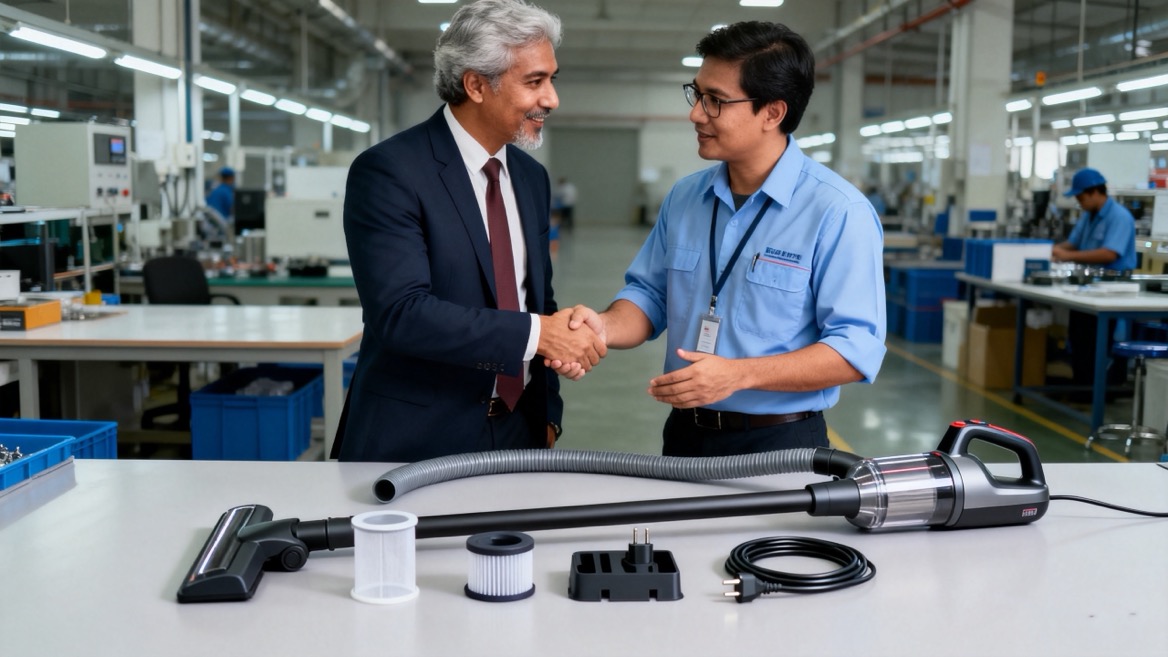
The table separates company-wide capacity from capacity reserved for corded sticks. Unless explicitly stated otherwise, a published annual figure covers a broader vacuum portfolio. "Not published" means a buyer should obtain a written quotation or factory confirmation; it is not an estimate of zero capability.
| # | Manufacturer and likely fit | Published capacity | Published MOQ | Publicly stated compliance |
|---|---|---|---|---|
| 1 | Ningbo Eyunhome — configurable corded and handheld platforms for growing brands | 7,500 m² facility; unit output not published | Not published | Company states an ISO 9000-based system and lists CE, RoHS, REACH, CB, and other approvals; verify model scope |
| 2 | Ningbo Jinlong — corded-stick development involving housing or mold customization | 68,000 m² facility; unit output not published | Not published | Request current model-specific documents |
| 3 | Suzhou Houseclean Electric Appliance — established corded-stick platforms and lower-volume OEM discussions | Company states 1 million units/year across its range | 200–500 units for standard OEM platforms; confirm corded SKU | Company states ISO 9001, BSCI, and product-compliance packages |
| 4 | Suzhou E-Clean Electric Appliance — corded and handheld programs with published factory output | Company states 1 million vacuums/year across its range | Confirm by model and customization | Company lists CB, GS, CE, RoHS, EMC, and REACH |
| 5 | Ningbo Aiyu Technology — broad vacuum assortment for multi-category buyers | Product-specific output not established here | Not published | Company states ISO 9001, BSCI, and multiple product approvals |
| 6 | Wuwei (Ningbo) Intelligent Technology — corded and 2-in-1 designs with engineering support | 10,000 m² facility; unit output not published | Not published | Company lists CE, RoHS, REACH, and CB approvals |
| 7 | Suzhou AZA Clean Electric Technology — larger-scale cleaning-appliance development; check current corded configuration | Company states 1.8 million units/year across its range | Not published | Company states ISO 9001 and BSCI; request reports for the proposed corded model |
| 8 | Ningbo Nandi Electric — advertised 400 W corded-stick models for a focused RFQ | Not verified | Not verified | Request factory and model documents |
| 9 | Ningbo Baofumei Technology — advertised corded handheld/stick designs | Not verified | Not verified | Request factory and model documents |
| 10 | Peakvac, Suzhou — corded-vacuum sourcing and OEM discussions; verify the producing entity | Not verified | Model-dependent; confirm in writing | Request documents tied to the proposed factory and SKU |
Published company descriptions and listings support the shortlist, but the figures above have not been independently audited for this article. In particular, a facility's total output must not be read as its available capacity for one lightweight corded stick model.
Founded: 2011. Location: Ningbo, Zhejiang. Main markets: The company invites cooperation across countries and regions but does not publish a sufficiently specific market breakdown on its introduction page. OEM/ODM scope to discuss: Appearance, accessories, packaging, and model-level changes, subject to engineering confirmation.
Eyunhome is a practical first conversation for small and mid-sized brands that want to develop a corded model without losing access to a broader handheld and cordless assortment. Its published introduction describes a 7,500 m² operation, engineering and quality processes, and support for customer-specific product suggestions. That makes its likely advantage configuration flexibility and direct project communication, rather than a publicly proven claim to the largest production volume or lowest MOQ. Buyers should request a named engineering contact, a written modification list, and a production schedule to test that fit.
Its gives purchasers a concrete starting platform: Eyunhome lists 600 W input, a 450 ml dust cup, multi-cyclone filtration, a motorized floor brush, and optional accessory configurations. The page states suction of at least 16 kPa but does not specify the measurement location. Ask for the complete assembled weight, cord length, applicable test reports, and a production sample before describing it as a lightweight retail product.
Eyunhome describes an ISO 9000-based quality system and lists a range of product approvals on its company page. Those statements are a starting point for document review, not proof that every P10M configuration holds every listed approval. Its founding date, portfolio, and stated willingness to discuss tailored solutions make it relevant to a value-conscious brand; actual MOQ, lead time, communication speed, and after-sales terms belong in a signed quotation.
Founded: Not clearly established on the reviewed company pages. Location: Yuyao, Zhejiang. Main markets: The company identifies Europe, the Americas, Oceania, Africa, and Asia. OEM/ODM scope: Custom mold engineering, prototyping, appliance development, and product manufacturing.
Jinlong stands out when a buyer needs more than a logo and color change. It describes an integrated appliance and precision-mold operation and publishes a 68,000 m² facility figure. Its is specified at 600 W, 0.8 L dust capacity, a 5 m cord, and 1.9 kg net product weight. The flexible joint is a meaningful feature to evaluate for under-furniture cleaning, although its durability and production consistency still require testing.
Ask Jinlong to distinguish an existing-platform change from a buyer-owned mold project. Confirm tooling ownership, permitted use of the design for other customers, replacement-cavity costs, and the test plan for any altered joint or housing. Its site does not establish a corded-stick MOQ or dedicated production allocation for this comparison.
Founded: 2017, according to the company. Location: Suzhou, Jiangsu. Main markets: The company states that it serves more than 60 markets and identifies EU and North American exports. OEM/ODM scope: Branding and accessories on existing platforms, plus custom-design projects with separate minimums.
Houseclean publishes a covering several 400–800 W platforms. Its FAQ gives a comparatively usable starting point for buyers: 200–500 units for standard OEM models, while full ODM projects are listed from 1,000 units. Those are company-stated terms across its platforms; obtain an MOQ specifically for the selected corded SKU, plug, color, and carton.
The company also states annual capacity of approximately 1 million vacuums and an ISO 9001-certified facility. For a repeat-order program, request a line-capacity schedule and review how it handles incoming motors, cord sets, final electrical checks, and replacement filters. A published factory-wide capacity is useful context, but a buyer's reserved slot is the operational number that matters.
Founded: 2014. Location: Suzhou, Jiangsu. Main markets: Its company information establishes export activity, but a reliable destination-market breakdown was not available in the reviewed materials. OEM/ODM scope: Corded and cordless vacuum development and manufacturing; confirm the depth of mechanical customization by project.
E-Clean presents itself as a combined development, production, sales, and service business. Its site states three production lines and annual output capacity of 1 million vacuum cleaners, alongside testing equipment and a list of product approvals. Listings for wired handheld/stick products make it relevant to this RFQ, but buyers should confirm the exact currently produced model, rather than treating every marketplace listing as an active factory program.
This supplier may suit an importer comparing several corded price points. Request a live sample drawn from ordinary stock, model-specific documentation, and a production-line visit. Published output, where self-reported, should be checked against the line schedule and the number of models competing for it.
Founded: A precise legal-entity year is not established on the reviewed company introduction; it describes 11 years of manufacturing experience. Location: Ningbo, Zhejiang, with an earlier Suzhou origin stated by the company. Main markets: Europe and Southeast Asia, according to its site. OEM/ODM scope: A broad cleaning-appliance portfolio that includes corded sticks, cordless sticks, carpet cleaners, and floor-care products.
Aiyu is worth evaluating when a distributor wants several vacuum categories from one commercial relationship. Its states ISO 9001 and BSCI credentials and describes controls from material receipt through finished-product inspection. These are useful questions for an audit, not substitutes for the current certificates and inspection records of the contracted factory.
Because the site also describes a wider manufacturing group and multiple facilities, establish which legal entity will invoice, which plant will assemble, and which entity appears on the product documentation. Obtain a capacity and MOQ quotation for the exact corded stick, rather than applying group-level statements to a single SKU.
Founded: 2020. Location: Ningbo, Zhejiang. Main markets: The company states that it exports to more than 100 countries, without a detailed market split on its home page. OEM/ODM scope: Development from drawings or samples, private labeling, engineering, manufacturing, logistics, and after-sales support.
Wuwei shows corded handheld and 2-in-1 upright products within a wider household-cleaning range. It also states a 10,000 m² factory area and describes laboratory and inspection equipment. Those characteristics make it a candidate for buyers considering a convertible handheld-to-stick format, provided the proposed configuration has the required floor head, reach, weight, and cord management.
Ask for a complete sample built with the export-market cord set. Then confirm whether the final product uses an existing approved electrical design or requires fresh testing after changes to its motor, controls, or plug. The published facility area does not establish a model-specific MOQ or output rate.
Founded: Late 2009, according to its company profile. Location: Suzhou, Jiangsu. Main markets: The company names Europe, North America, Australia, and Southeast Asia among its export regions. OEM/ODM scope: Regional voltage and plug configurations, branding, appearance, and product development.
AZA describes a 10,000 m² facility and annual capacity of 1.8 million cleaning appliances. It has substantial published information on engineering, molding, and quality systems. Its current profile, however, emphasizes cordless sticks and other cleaning products more strongly than a clearly documented lightweight corded-stick platform. Buyers should therefore request a current corded SKU, production sample, and the report set for that exact configuration before treating it as a direct substitute for the corded-focused suppliers above.
AZA is potentially relevant to a brand planning a broader cleaning range over time. For this particular purchase, the gate remains simple: verify the corded product first; evaluate company-wide scale second.
Founded: Not verified in the reviewed materials. Location and main markets: Confirm directly with the contracting entity. OEM/ODM scope: Establish by RFQ; public listings identify 400 W corded-stick products.
Nandi belongs on an early-stage shortlist because its product listings match the requested form factor more closely than a generic "household vacuum" advertisement. Yet the available listings do not establish production capacity, MOQ by variation, current management-system certification, or export destinations. Treat it as a qualification candidate, not a pre-approved manufacturer. Request a business license, factory address, live production evidence, and two samples from the proposed model before comparing its quotation with fully documented suppliers.
Founded: A supplier listing describes manufacturing activity since 2009; verify the legal-entity registration date. Location: Ningbo, Zhejiang, as identified in its supplier name. Main markets: Not established in the reviewed listing. OEM/ODM scope: Listings indicate corded handheld/stick configurations; confirm the available customization and factory role directly.
Baofumei may be useful for a buyer exploring a compact, convertible design, but a marketplace profile cannot answer whether the advertised unit is a current production model or whether the seller owns the assembly line. Ask to inspect the product's complete weight and floor-head configuration. Require documentation linking the quoted model to the business license, factory, test reports, and shipment documents.
Founded: The company describes itself as established in 2012. Location: Suzhou, Jiangsu. Main markets: Its site states exports across numerous countries, including markets in Asia, Europe, and North America. OEM/ODM scope: It advertises corded and cordless vacuums alongside branding, packaging, and product-configuration services.
Peakvac is useful in a sourcing comparison because its portfolio includes corded products and it discusses OEM work. It also describes itself in different places as an integrated industry-and-trade business and a distributor or service provider. That distinction matters to a procurement manager: confirm the actual producer of the quoted lightweight corded stick, the entity responsible for quality claims, and the factory named in any audit. Its presence here reflects relevant sourcing capability, not an assumption that every advertised model is made on a Peakvac-owned line.
A disciplined RFQ gives suppliers the same technical and commercial brief. Without one, apparent price differences often reflect different motors, cord sets, filters, accessories, or inspection obligations.
State the destination country, operating voltage and frequency, plug type, intended floor surfaces, complete assembled weight limit, cord length, dust-cup volume, accessory set, and retail-packaging requirements. Identify whether you need an existing-platform OEM product or a new-tool ODM design. For a claimed filtration grade, request evidence for both the filter material and the assembled product's leakage performance; a capable filter cannot compensate for an unsealed housing.
Set an agreed method for performance measurements. A useful sample sheet records input power, airflow, suction pressure at defined locations, noise under a defined test setup, complete weight, and performance before and after a controlled dust-loading exercise. The European Commission cautions that higher input power does not necessarily mean better cleaning performance.
1. Baseline sample: Buy the supplier's standard unit and record its model, bill of materials, weight, electrical configuration, performance, and defects.
2. Modified sample: Approve every requested change in writing, including plug, cord, tube, floor head, filter, color, and packaging.
3. Golden sample: Seal and identify the final approved unit; attach its specification, component list, and accepted test results to the purchase agreement.
4. Pre-production check: Compare the first units made with production tooling and production-sourced components against the golden sample.
5. Shipment inspection: Sample the completed order against the same acceptance plan and verify that carton labels and model numbers match the compliance paperwork.
These are recommended purchasing controls, not claims that every supplier above follows this exact sequence.
A particularly costly failure can occur after a sample passes: the production vacuum keeps the same external shell, while the factory changes a motor, cord set, plug, filter media, or sealing gasket to protect its margin or work around a parts shortage. A brief power-on check may not reveal the change. It can show up later as extra weight, hotter operation, weaker loaded-filter performance, cord failure, or documentation that no longer matches the shipped unit.
The prevention method is a controlled bill of materials with approved component makers or equivalent technical specifications. Require written approval before substitutions, retain a golden sample, inspect component markings during production, and repeat targeted electrical and performance tests after any approved change. This is especially important when several purchase orders share the same outward-facing model number.
Another avoidable mistake is buying a "lightweight" product based on handheld-unit weight. Require the weight of the complete machine as used on the floor and, where relevant, the weight a user actually holds during cleaning. A model can pass a headline weight target yet feel tiring because the balance point is high or the floor head drags.
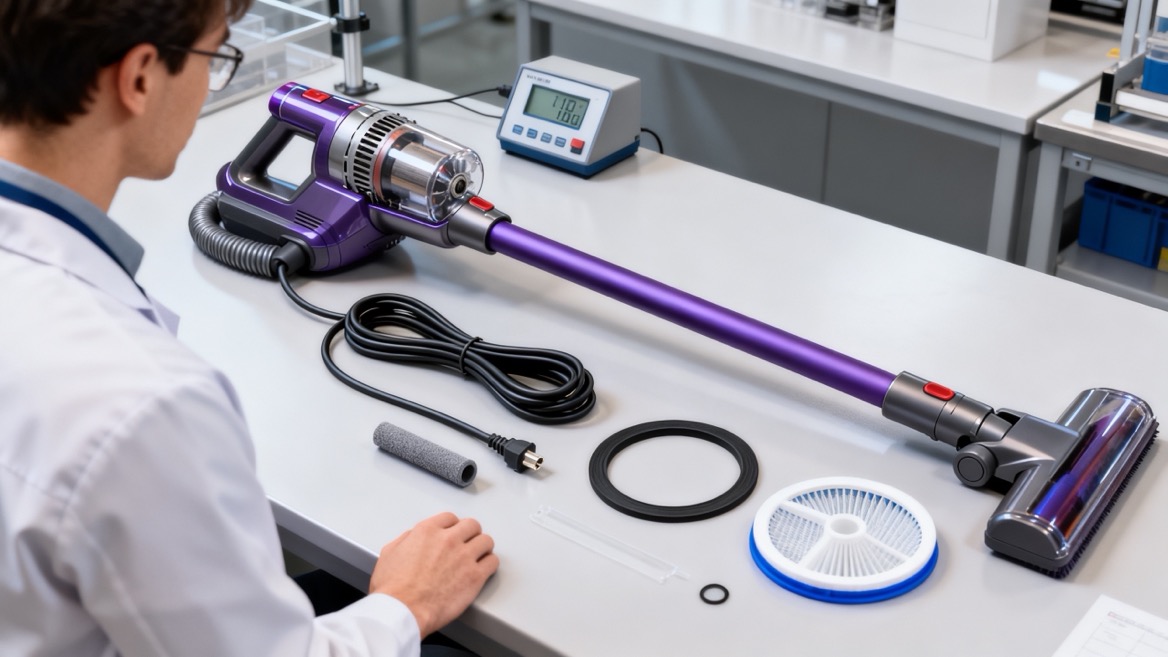
Ask suppliers to quote MOQ separately for each model, color, plug, retail box, and accessory kit. Confirm whether a mixed container reduces any of those minimums and which components have the longest replenishment time. Before placing an order, agree on the named shipping term and port, carton dimensions and gross weight, spare-parts quantities, inspection timing, and who provides the documents required by the destination market.
Calculate landed cost using the approved packed configuration, not the first sample carton. A revised floor head or protective insert can alter carton size and freight economics even when the factory unit price stays unchanged. Set a date for production completion that leaves time for inspection and correction before the vessel booking.
A strong shortlist is one that becomes easier to eliminate as evidence arrives. Start with suppliers that can show an active corded-stick model, then compare complete-machine weight, sample-to-production controls, model-specific documentation, available production slots, and after-sales parts terms. Request equivalent quotations from several factories before weighing unit price.
For buyers building a cost-conscious corded range, Ningbo Eyunhome Electric Technology Co., Ltd. offers a relevant first RFQ: its published P10M platform and broader vacuum portfolio give engineering and purchasing teams something concrete to assess. Send Eyunhome your target market, assembled-weight limit, order forecast, customization brief, and required documents; ask for a configured sample and a written quotation before making a supplier commitment.
Request the complete certificate, including the legal company name, certified site, scope, certificate number, issuing body, and validity dates. Check the accredited-certification record using the route described by ISO—its referenced certification database or direct contact with the issuing or accreditation body. Confirm that the assembling factory, not only a sales office or affiliated company, falls within the certificate's scope. ISO itself does not issue certificates.
No. Request the declaration of conformity, technical file details, and relevant reports for the finished model and configuration. Check that the model identifier, motor, cord set, plug, and safety-critical components match the units you will import. The European Commission places conformity assessment and documentation responsibilities on the manufacturer; markings or voluntary certificates alone do not replace them.
Do not decide from the product name alone. The European Commission says mains-operated vacuum cleaners are generally within its ecodesign scope, while it lists hand-held and cordless stick vacuums among exclusions. A convertible corded stick needs a classification review against its actual design and intended use. Also, do not request an EU vacuum energy label under the annulled former labeling regulation.
Lock the approved bill of materials and require a change notice before any substitution. During production, compare sampled component labels, dimensions, electrical ratings, and filter construction with the approved records. Re-test performance under the same conditions used for the golden sample; a different test setup can conceal a meaningful difference.
Not automatically. A factory-wide number may include cordless units, other vacuum types, and output already committed to existing customers. Ask for the proposed line, allocated monthly volume, component lead times, peak-season schedule, and a remedy if delivery slips. For a developing brand, a credible allocation and responsive engineering contact may be more valuable than a much larger headline capacity.
- [European Commission: Vacuum cleaners and ecodesign scope]. [energy-efficient-products.ec.europa]
- [European Commission: CE marking responsibilities]. [single-market-economy.ec.europa]
- [European Commission: RoHS Directive]. [environment.ec.europa]
- [ISO: How to verify accredited certification]. [iso]
- [China Customs: Trade statistics portal]. Use the relevant product classification and reporting period rather than treating all vacuum exports as corded sticks. [english.customs.gov]
- [Grand View Research: China commercial vacuum-cleaner market report]. Its commercial-market figures are context, not a measurement of this household product niche. [grandviewresearch]


