
Views: 299 Author: Eyunhome Vacuum Publish Time: 2026-11-03 Origin: Site


Content Menu
● 80,000 RPM vs 120,000 RPM Vacuum Motors: Quick Comparison
● How Vacuum Motor Speed Affects Suction and Airflow
>> RPM, Pressure, and Airflow Measure Different Things
>> Why 50% More RPM Does Not Guarantee 50% Better Cleaning
● Cleaning Performance: Which Motor Removes More Dirt?
>> Hard Floors and Everyday Debris
>> Carpets, Upholstery, and Pet Hair
>> Performance as the Dustbin and Filter Load
● Battery Runtime and Energy Efficiency
>> Higher RPM Does Not Automatically Mean Shorter Runtime
>> Compare Runtime at Equivalent Cleaning Performance
● Noise, Heat, and Motor Durability
>> Noise Requires More Than One Decibel Number
>> Thermal Management Can Limit Sustained Performance
>> RPM Alone Cannot Predict Service Life
● A Practical Insight: Compare at the Same Operating Point
● A Second Insight: Separate Peak Claims from Continuous Output
● OEM/ODM Selection: A Six-Step Validation Process
>> 1. Define the Intended Cleaning Task
>> 2. Request Complete Motor-Fan Data
>> 3. Build Comparable Prototypes
>> 5. Validate Comfort and Reliability
>> 6. Review Commercial Readiness
● Which Motor Should Your Vacuum Project Choose?
>> Is a 120,000 RPM vacuum motor better than an 80,000 RPM motor?
>> Can RPM be converted directly into suction pressure?
>> Does a higher-speed vacuum motor always use more electricity?
>> Which motor speed is better for cordless vacuum cleaners?
>> Are 120,000 RPM motors always brushless?
>> What should buyers request before approving a motor?
Choosing between 80,000 RPM vs 120,000 RPM vacuum motors is not simply a question of buying the faster option. A 120,000 RPM motor rotates 50% faster, but that does not automatically mean 50% better cleaning, stronger usable suction, or better value.
For importers, appliance brands, and distributors, the real decision involves airflow, pressure, battery demand, noise, durability, and production cost. My starting point for evaluating either motor is straightforward: performance should be demonstrated in the complete vacuum cleaner, not inferred from a speed specification.
This guide explains the engineering differences and provides a practical selection framework for upright, handheld, corded, and cordless vacuum cleaner projects.

RPM means revolutions per minute. It describes rotational speed—not cleaning effectiveness, electrical efficiency, or motor lifespan.
The table below identifies evaluation priorities rather than guaranteed differences between every product.
| Comparison factor | 80,000 RPM vacuum motor | 120,000 RPM vacuum motor |
|---|---|---|
| Rotational speed | 80,000 revolutions per minute | 120,000 revolutions per minute |
| Suction and airflow | Depend on impeller and system design | Also depend on impeller and system design |
| Compact-product potential | Must be assessed against packaging targets | Higher speed can support compact motor-fan designs |
| Battery runtime | Cannot be predicted from RPM alone | Cannot be predicted from RPM alone |
| Noise | Requires complete-appliance testing | Requires particular attention to tonal noise and vibration |
| Thermal management | Depends on load, losses, and cooling | High-speed losses require careful evaluation |
| Service life | Requires endurance evidence | Requires endurance evidence |
| Purchase cost | Obtain a configuration-specific quotation | Assess the complete system premium |
| Best selection basis | Verified cleaning performance at target cost | Verified additional value at target cost |
Neither speed is inherently "entry-level" or "premium." Those labels require supporting product evidence.
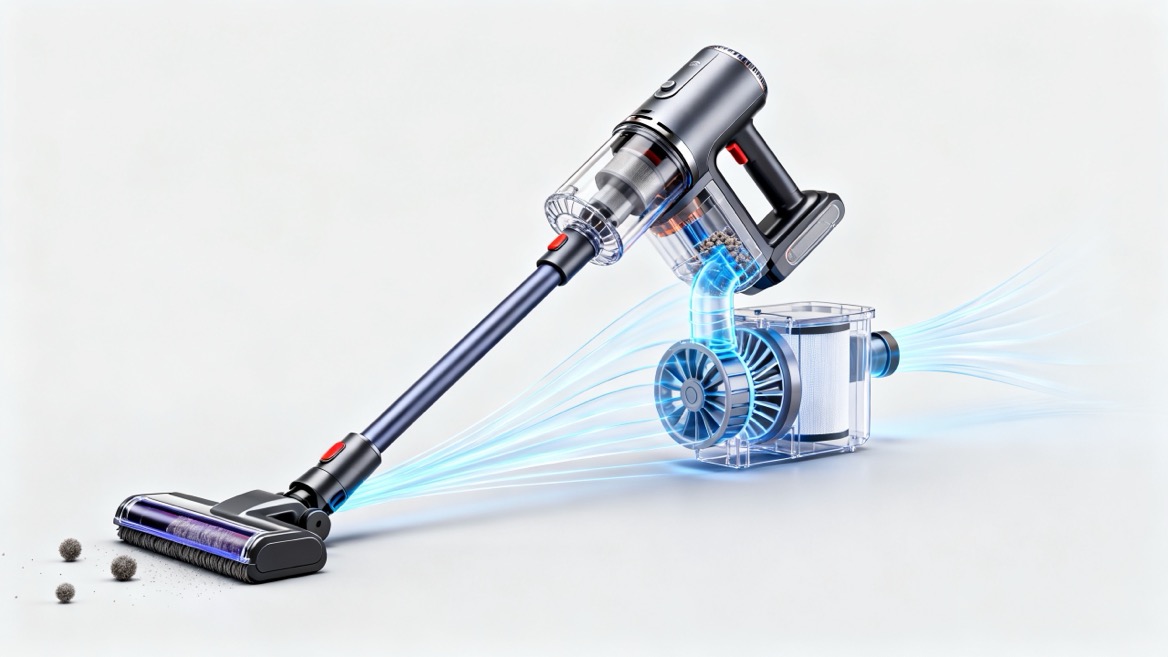
A vacuum motor drives an impeller that creates a pressure difference and moves air through the appliance.
Three measurements help explain the result:
- Pressure difference, commonly reported in pascals or kilopascals, describes the pressure developed across a restriction.
- Airflow, measured in liters per second or cubic feet per minute, describes how much air moves.
- Air watts describe pneumatic power by combining pressure difference and airflow at the same operating point.
For compatible SI units:
Air watts=Pressure difference in Pa×Airflow in m3/s
A crucial qualification: maximum sealed suction and maximum unrestricted airflow occur under different conditions. Multiplying those two headline numbers does not produce a valid air-watt figure.
For buyers, my recommendation is to request a pressure–airflow curve and identify where the assembled vacuum actually operates.
Fan affinity laws provide a useful theoretical comparison. For the same impeller geometry, constant air density, and comparable operating conditions:
- Airflow scales approximately with rotational speed.
- Pressure scales approximately with speed squared.
- Shaft power scales approximately with speed cubed.
Increasing speed from 80,000 to 120,000 RPM gives a speed ratio of 1.5. Under those assumptions, the theoretical ratios are:
| Parameter | Theoretical ratio |
|---|---|
| Airflow | 1.5× |
| Pressure | 2.25× |
| Shaft power | 3.375× |
These are engineering scaling relationships, not predictions for two unrelated vacuum motors. Different impeller diameters, efficiencies, restrictions, and high-speed flow effects can materially change the outcome.
The practical lesson is that increasing speed can raise power demand much faster than airflow.
For hard-floor cleaning, nozzle geometry, debris clearance, airflow, and sealing can matter as much as motor selection.
A poorly designed inlet may push larger particles forward instead of admitting them. More motor speed does not necessarily fix that problem.
An 80,000 RPM design that meets pickup targets may therefore be the better commercial choice when additional speed produces little measurable benefit.
Carpet cleaning adds another variable: mechanical agitation.
Brush design, brush speed, nozzle contact, airflow, and pressure must work together. A higher-speed motor cannot compensate automatically for ineffective agitation or a poorly matched floor head.
For pet-hair products, evaluate both pickup and brush maintenance. Hair removal from upholstery and hair wrapping around the brush are different problems.
I would compare the two motor options using the intended production nozzle—not a bare motor demonstration.
A clean-filter demonstration shows only one operating condition.
As resistance changes, the motor-fan system moves to a different operating point. The resulting performance depends on its pressure–airflow characteristics, controls, and air path.
Test with:
1. A clean filter and empty bin.
2. A defined dust load.
3. A partially filled dustbin.
4. Filters conditioned using a documented procedure.
This reveals whether initial performance remains useful during realistic cleaning.
Battery runtime depends on usable battery energy and total electrical demand.
That demand includes the suction motor, powered brush, electronics, and other loads. A 120,000 RPM motor may draw more power in one configuration, but RPM alone cannot establish the difference.
A smaller, well-designed high-speed motor may also operate efficiently at a specified duty point. The complete system must be measured.
Comparing one vacuum in maximum mode with another in economy mode is misleading.
A stronger purchasing method is to compare:
- Runtime with the same powered attachment.
- Pickup performance at the tested setting.
- Battery capacity and test conditions.
- Performance as battery charge decreases.
- Any automatic power reduction during operation.
For cordless vacuum motor selection, "minutes per charge" is incomplete without knowing what cleaning performance those minutes deliver.
For corded products, battery capacity disappears from the equation, but electrical input, heat, and continuous operation remain relevant.
Vacuum noise includes airflow noise, motor tones, vibration, brush noise, and enclosure resonance.
Higher rotational speed can shift tonal characteristics, but it does not establish that every 120,000 RPM vacuum will be louder than every 80,000 RPM model.
Compare appliances using the same measurement method, operating mode, attachment, and surface.
Also listen for whistles and high-frequency tones. Two products with similar overall sound levels can create noticeably different user experiences.
Electrical and mechanical losses generate heat. Motor engineering guidance identifies speed-dependent iron losses and bearing considerations as important constraints in high-speed operation.
The relevant question is not simply whether a motor reaches 120,000 RPM. It is whether the appliance sustains its intended output without unacceptable temperatures or repeated power reduction.
Request temperature and performance records covering the intended duty cycle, along with documented protection behavior.
Bearing design, rotor balance, contamination protection, cooling, and assembly quality all influence durability.
Avoid unsupported statements such as "80,000 RPM motors last longer" or "120,000 RPM motors are more reliable."
Instead, request:
- Endurance-test conditions and sample quantities.
- Operating hours and start-stop cycles.
- Acceptance criteria.
- Failure descriptions.
- Post-test performance measurements.
Evidence from the actual motor and appliance configuration matters more than a generic lifespan claim.
One of the most useful procurement improvements is an equal-output comparison.
First, establish the pressure and airflow required by the intended vacuum design. Then compare how each motor-fan system delivers that combination.
For example, a product team might define a target of 12 kPa at 15 L/s. These are illustrative specification values, not measured results for either motor.
At that operating point:
12,000×0.015=180 air watts
Now compare electrical input, temperature, noise, and stability while delivering that output.
This approach answers a better question than "Which motor spins faster?" It asks, "Which system delivers our required result with the most acceptable compromises?"
Do not apply the target to every product category. A compact handheld cleaner and a full-size upright may need different operating points.
A motor may reach its advertised speed only under particular voltage, load, or control conditions.
Before accepting a specification, establish whether the quoted RPM represents:
- No-load speed.
- Loaded operating speed.
- A temporary boost setting.
- A continuously available setting.
The distinction also matters for advertised suction and runtime.
The 2026 edition of IEC 62885-2 covers performance measurements for both mains-operated and cordless household dry vacuum cleaners. Buyers should identify the edition and test conditions used rather than relying on a standard number alone.
A comparable report should state the attachment, operating mode, battery condition, and measurement location.
Specify surfaces, debris types, attachments, product weight, runtime, and target retail positioning.
Avoid starting with an RPM requirement unless the application already justifies it.
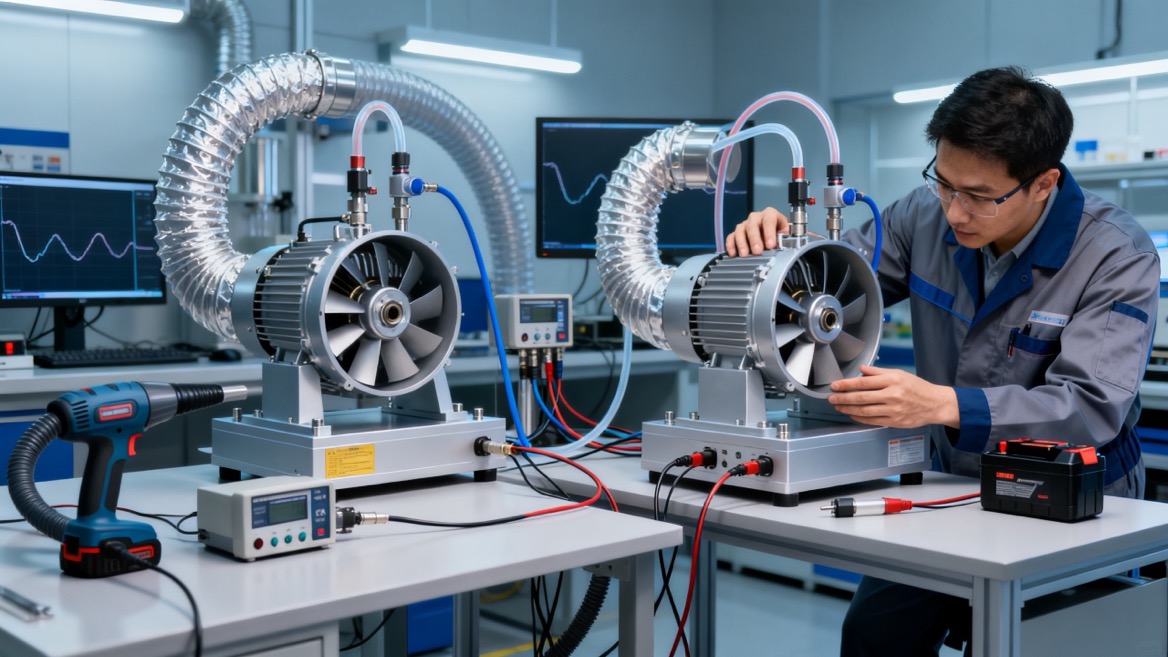
Ask for speed under load, input power, pressure–airflow curves, dimensions, operating voltage, and thermal limits.
Confirm whether measurements cover the bare motor-fan assembly or the finished appliance.
Use equivalent filters, nozzles, and air paths where practical.
Where configurations differ, document those differences rather than attributing every result to motor speed.
Evaluate hard floors, carpets, edges, and relevant hair or debris tasks.
Air-performance testing and surface-cleaning testing answer related but different questions. Both are useful.
Check temperature, noise, handling, filter maintenance, battery behavior, and endurance.
A product that performs well briefly may still disappoint during a complete cleaning session.
Assess component availability, production consistency, service parts, warranty arrangements, and applicable destination-market requirements.
Motor selection should support a dependable product launch, not merely an attractive specification sheet.
An 80,000 RPM motor is a sensible candidate when the assembled appliance meets cleaning, comfort, and durability targets at an acceptable total cost.
A 120,000 RPM motor deserves consideration when higher-speed operation provides a verified benefit, such as meeting a demanding output target within a compact design.
Neither option should be approved solely on speed.
Ningbo Eyunhome Electric Technology Co., Ltd. provides upright, handheld, corded, and cordless vacuum cleaner solutions with OEM/ODM services, production support, and after-sales support.
For your next project, share your target market, cleaning tasks, desired runtime, product dimensions, and price positioning with Eyunhome. Request a configuration proposal and agree on sample-validation criteria before committing to either motor speed.
Not automatically. It rotates faster, but better cleaning depends on the impeller, airflow path, filtration, nozzle, and controls. Compare measured pickup and complete-appliance performance.
No. There is no universal RPM-to-kPa conversion. Impeller geometry, diameter, air density, restrictions, and operating conditions affect the relationship.
No. Different designs cannot be ranked by RPM alone. Compare measured electrical input at equivalent pressure, airflow, and cleaning performance.
Either can work. The better option meets the required cleaning performance, weight, runtime, temperature, and noise targets within the available battery and budget.
RPM is not a motor-type designation. Confirm the motor architecture, controller requirements, and operating limits directly from the supplier's technical documentation.
Request motor-fan curves, loaded speed, input power, thermal data, endurance evidence, noise results, and finished-product cleaning tests with clearly documented conditions.
1. AMCA International — "Derivation of the Fan Laws." Technical basis for the airflow, pressure, and shaft-power scaling relationships and their assumptions. [amca]
2. AMCA International — "Pressures in a Ventilation and Fan System." Explains pressure relationships and the role of a fan in maintaining airflow against system resistance. [amca]
3. International Electrotechnical Commission — "IEC 62885-2:2026: Surface cleaning appliances—Part 2: Dry vacuum cleaners for household or similar use—Methods for measuring the performance." Defines the scope of household dry-vacuum performance measurements. [webstore.iec]
4. SGS — "Vacuum Cleaner Testing." Identifies relevant air-performance, carpet-cleaning, hard-floor-cleaning, filtration, and emissions test methods. [sgs]
5. maxon — "maxon EC motor." Explains high-speed balancing, bearing considerations, and speed-dependent motor losses. [maxongroup]
6. Testfakta — "How We Test—Vacuum Cleaners." Describes laboratory evaluation of pickup, battery performance, noise, filtration, and usability. [testfakta]


