
Views: 298 Author: Eyunhome Vacuum Publish Time: 2026-10-29 Origin: Site


Content Menu
● Brushless vs Brushed Vacuum Cleaner Motors at a Glance
● How Brushed and Brushless Vacuum Motors Work
>> Brushed Motors Use Mechanical Commutation
>> Brushless Motors Use Electronic Commutation
● Suction Power and Cleaning Performance: Which Motor Wins?
>> Why Higher Wattage Does Not Guarantee Better Cleaning
● Efficiency and Battery Runtime in Cordless Vacuum Cleaners
>> Compare Runtime at Useful Cleaning Performance
● Motor Lifespan, Maintenance, and Reliability
>> Brushless Does Not Mean Maintenance-Free
● Noise, Heat, and User Comfort
● Purchase Price vs Total Ownership Cost
● Which Motor Type Fits Your Vacuum Cleaner Range?
>> Cordless Stick and Handheld Vacuums
● A Practical Sample-Testing Protocol for OEM/ODM Buyers
>> Step 1: Define the Cleaning Task
>> Step 2: Normalize Test Conditions
>> Step 3: Measure the Complete Appliance
>> Step 4: Evaluate Performance After Loading
>> Step 5: Confirm Production Consistency
● Evidence Buyers Should Request Before Placing an Order
● Developing Your Vacuum Cleaner with Eyunhome
>> Is a Brushless Vacuum Cleaner Always Better?
>> Does a Brushless Motor Provide Stronger Suction?
>> Do Brushed Vacuum Motors Need Replacement Brushes?
>> How Much Longer Does a Brushless Vacuum Motor Last?
>> Are Brushless Vacuum Cleaners Quieter?
>> Which Motor Should an OEM Vacuum Brand Choose?
Choosing a brushless motor vs brushed motor vacuum cleaner involves more than comparing price or advertised suction. The motor affects efficiency, maintenance, speed control, and product cost. However, cleaning performance also depends on the fan, airflow path, floor head, filtration, and battery system.
At Ningbo Eyunhome Electric Technology Co., Ltd., we help businesses develop upright, handheld, corded, and cordless vacuum cleaner solutions through OEM/ODM services. Our approach to motor selection starts with the intended customer, cleaning task, and target price—not the assumption that one technology suits every product.
For most performance-focused cordless projects, brushless technology is the stronger starting point. For price-sensitive products, a well-engineered brushed system can still deliver practical value. The deciding factor is validation: measured performance from the complete vacuum cleaner.

| Comparison | Brushless Motor Vacuum Cleaner | Brushed Motor Vacuum Cleaner |
|---|---|---|
| Current switching | Electronic commutation | Mechanical brushes and commutator |
| Efficiency potential | Generally higher with suitable motor and controller design | Brush friction and contact losses reduce efficiency |
| Motor wear | No carbon brushes to replace | Brushes and commutator wear during operation |
| Speed control | Flexible electronic control | Depends on motor architecture and controller |
| Initial cost | Usually higher | Often lower |
| Noise | Removes brush-contact noise; other noise remains | Brush contact adds a noise source |
| Service considerations | Bearings, electronics, cooling, and connections | Brushes, commutator, bearings, and cooling |
| Typical purchasing priority | Runtime, compactness, controllability | Affordability and established designs |
These are design tendencies, not guaranteed results. A poorly integrated brushless vacuum can underperform a well-designed brushed model.
A brushed motor transfers current through brushes contacting a rotating commutator. This mechanical switching keeps the motor turning.
In vacuum cleaners, the motor drives an impeller that creates a pressure difference and moves air through the cleaning system.
An important distinction: "brushed" does not always mean a small brushed DC motor. Many traditional corded vacuum cleaners use brushed universal motors, while battery-powered products can use brushed DC motors. Their electrical characteristics differ, so buyers should request the actual motor architecture.
A brushless DC motor, commonly called a BLDC motor, replaces mechanical commutation with electronic switching. A controller energizes the windings in sequence to rotate the rotor.
Removing brushes eliminates one source of friction and wear. Electronic control also gives designers greater flexibility over operating speed.
However, brushless does not mean friction-free or maintenance-free. Bearings still wear, and controllers, connectors, and insulation remain vulnerable to heat and electrical stress.
Also distinguish the suction motor from the brush-roll motor. A vacuum advertised with a brushless suction motor may use another motor type in its floor head.
A brushless motor can support an efficient, compact suction system, but it does not automatically produce better floor cleaning.
Three measurements deserve separate attention:
- Input power: electrical power consumed.
- Suction pressure: the pressure difference generated.
- Airflow: the volume of air moving through the system.
Air power combines pressure and airflow at a defined operating point. A high sealed-suction figure alone does not establish strong debris pickup, because airflow approaches zero under a fully sealed condition.
Two vacuums consuming the same electrical power can produce different cleaning results. Motor efficiency, impeller design, duct restrictions, air leakage, and filter resistance all influence how much useful performance reaches the floor.
Likewise, a powerful suction unit can disappoint on carpet if the floor head has poor agitation or sealing.
My recommendation when reviewing a specification sheet is simple: treat motor figures as supporting information, then ask for whole-machine pickup results.
For meaningful comparisons, use the same surface, debris, operating mode, attachment, and filter condition.
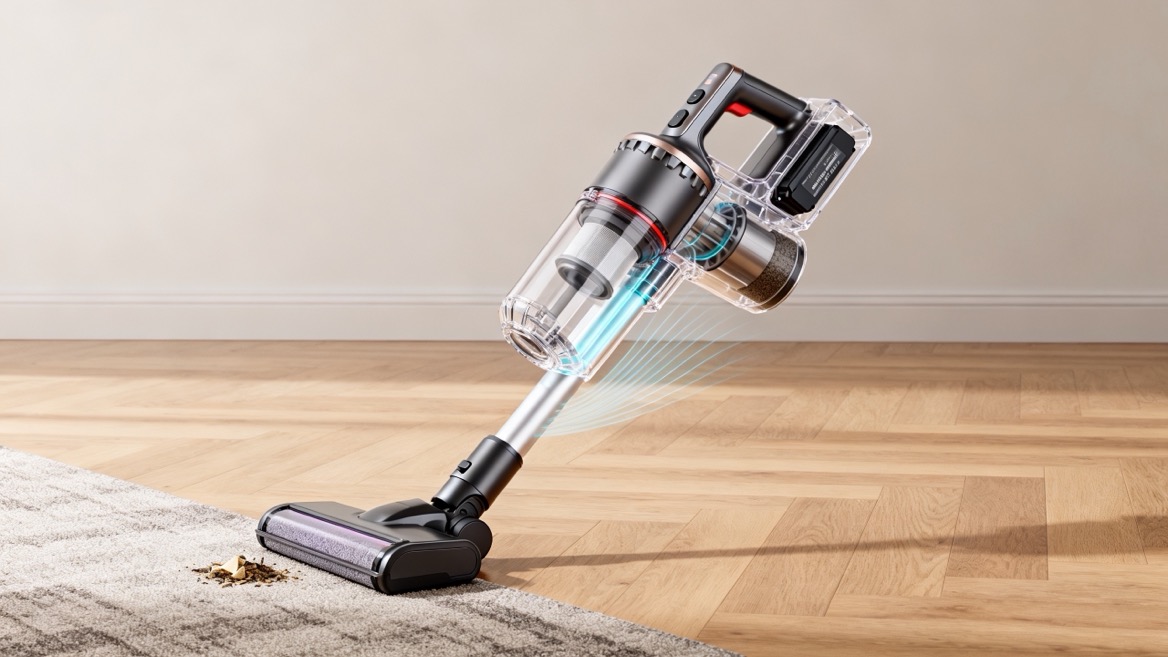
Brushless technology is particularly attractive when battery capacity, weight, and runtime must be balanced.
Eliminating brush-contact losses can improve motor efficiency. However, controller losses, operating speed, cooling, and motor loading still affect the final result.
Avoid applying a generic efficiency percentage to every vacuum cleaner. Figures from unrelated motor applications do not establish the efficiency of a finished appliance.
A long runtime is not necessarily valuable if the vacuum operates at insufficient power for its intended task.
Ask suppliers to report:
- Runtime with the powered floor head attached.
- Runtime in each cleaning mode.
- Pickup performance in those same modes.
- Battery capacity in watt-hours.
- Charging time and battery replacement options.
Battery capacity in amp-hours alone is incomplete without voltage.
For sourcing decisions, compare runtime at an agreed cleaning-performance level. This helps prevent an energy-saving setting from appearing superior merely because it delivers weaker cleaning.
Brushless motors remove brush and commutator wear from the maintenance equation. That is a meaningful advantage, especially where motor access is difficult.
Nevertheless, there is no universal lifespan multiplier that buyers should apply to all vacuum cleaners.
Service life depends on bearing quality, cooling, operating temperature, dust protection, speed, duty cycle, and manufacturing consistency.
Both motor types require a healthy airflow system. Users must empty the dust container, clean or replace filters as instructed, clear obstructions, and remove hair from the brush roll.
Restricted airflow can reduce cleaning performance and increase thermal stress.
For brushed models, confirm whether brushes are serviceable. Some assemblies allow replacement; others are intended to be replaced as complete motor units.
For brushless models, ask about controller availability and whether the motor and controller must be replaced together. Lower routine motor maintenance does not automatically mean cheaper repairs.
Brushless motors eliminate brush-contact noise, but the complete vacuum may still be loud.
Other sound sources include:
- High-speed airflow and exhaust turbulence.
- Impeller geometry and balance.
- Brush-roll contact with flooring.
- Housing vibration and structural resonance.
Therefore, "brushless" should not be presented as a guarantee of quiet operation.
Compare acoustic results using the same method, operating mode, and accessories. Different measurement distances or reporting conventions can make figures misleading.
Heat also requires system-level evaluation. An efficient motor can still overheat if cooling is inadequate, filters become restricted, or the controller operates outside its intended conditions.
Brushed designs often offer a lower entry cost. Brushless designs generally require additional control electronics and integration work.
However, the lowest component price does not always produce the lowest ownership cost.
For brands and distributors, consider:
| Cost Area | Questions to Ask |
|---|---|
| Initial product cost | What motor, controller, and battery configuration is included? |
| Warranty exposure | What evidence supports reliability expectations? |
| Repair cost | Can individual components be replaced? |
| Spare parts | How long will essential parts remain available? |
| Customer support | Are troubleshooting instructions clear? |
| Product positioning | Does the performance justify the retail price? |
Treat projected savings cautiously. Without model-specific failure data and service costs, ownership-cost comparisons remain estimates rather than established results.
Brushless motors are a strong starting point when the brief prioritizes runtime, low weight, compact packaging, and controllable suction.
For entry-level handheld products intended for short cleaning sessions, brushed motors may still meet the brief at a more accessible price.
A brushed universal motor can remain commercially relevant where continuous mains power, familiar construction, and competitive pricing matter.
A brushless alternative should justify its additional integration cost through measurable benefits—not terminology alone.
For demanding use, evaluate the specified duty cycle, cooling system, serviceability, and applicable safety requirements.
Do not assume that a household vacuum becomes suitable for commercial cleaning simply because it contains a brushless motor.
A useful comparison begins with a written test plan rather than two impressive specification sheets.
Specify flooring, debris, cleaning duration, target weight, and intended customer.
A lightweight handheld vacuum for furniture requires different compromises from a carpet-focused upright.
Use consistent surfaces, debris quantities, attachments, filter conditions, and environmental conditions. For cordless models, control battery charge and conditioning.
Record the exact operating mode rather than relying on labels such as "standard" or "maximum."
Compare pickup, runtime, noise, handling, and temperature behavior alongside airflow and pressure measurements.
Laboratory air-performance results describe controlled conditions; they should not be substituted for actual floor-cleaning results.
Repeat agreed measurements after controlled dust loading. This reveals how filtration and airflow management affect performance beyond a clean-filter demonstration.
Use a laboratory-approved procedure. Do not improvise blocked-inlet or overheating tests.
Approve the motor, controller, battery, filters, and floor head as a coordinated configuration.
Require review before substitutions. A component change can affect performance, thermal behavior, noise, or compliance evidence.
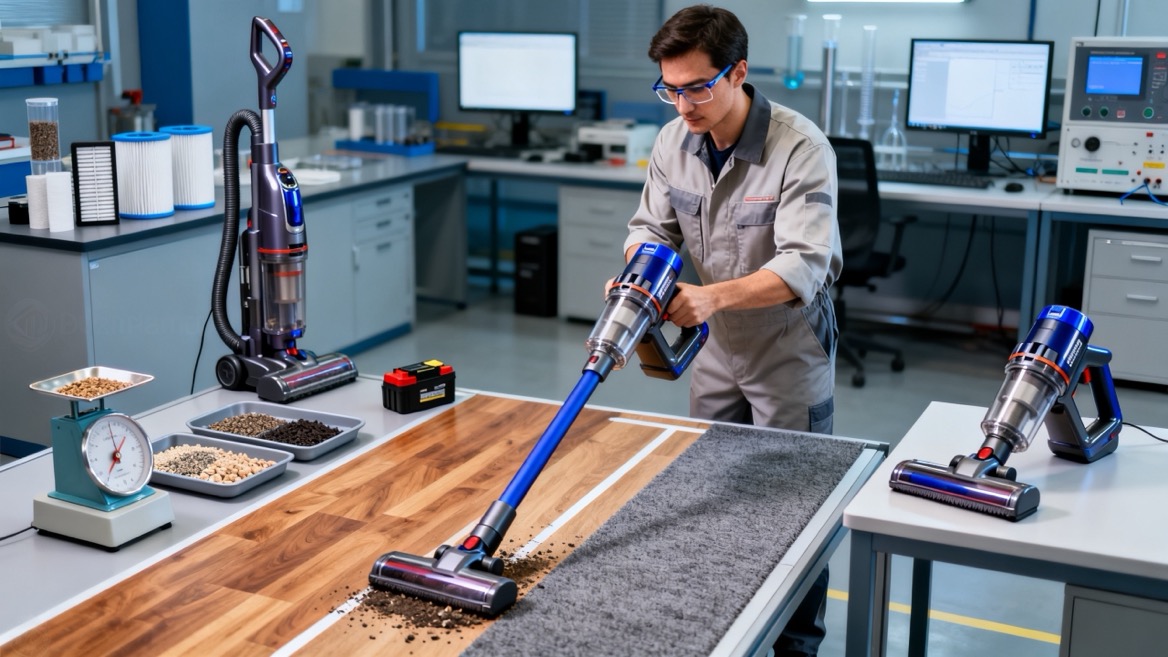
As of 2026, IEC 62885-2 covers performance measurement for mains-operated and cordless dry household vacuum cleaners, with additional cordless requirements in Annex D.
Performance testing and safety evaluation serve different purposes. Neither should be treated as a substitute for the other.
Request documentation identifying:
1. The exact tested model and configuration.
2. The test method and edition.
3. Operating modes and accessories.
4. Measured results and acceptance criteria.
5. Applicable safety documentation for the destination market.
6. Approved component specifications and change-control procedures.
A certificate or report should be traceable to the product being purchased. A similar-looking model is not sufficient evidence.
Ningbo Eyunhome Electric Technology Co., Ltd. provides upright, handheld, corded, and cordless vacuum cleaner solutions with OEM/ODM services, stable production, and after-sales support.
For a productive development discussion, share your target market, retail price, flooring applications, runtime expectations, preferred weight, and service requirements.
We can then discuss the motor configuration and product platform against that brief. Model-specific performance, production arrangements, and documentation should be confirmed during quotation and sample approval.
Contact Eyunhome with your product requirements to begin a specification-led comparison of suitable vacuum cleaner solutions.
No. Brushless technology offers advantages in efficiency potential, control, and brush-related maintenance. Overall value still depends on cleaning performance, construction, price, and support.
Not automatically. Suction depends on the motor's operating point, impeller, airflow path, leakage, and filtration. Compare complete appliances under equivalent conditions.
Some do, but not all designs support practical brush replacement. Confirm the service procedure and spare-parts availability before ordering.
There is no reliable universal answer. Removing brushes eliminates one wear mechanism, but bearings, cooling, electronics, and operating conditions still determine service life.
They eliminate brush-contact noise, but airflow, floor heads, and housing vibration can dominate overall sound. Request comparable acoustic measurements.
Start with the customer requirement. Brushless often suits performance-focused cordless products; brushed systems can suit cost-sensitive designs. Approve the choice through sample testing and commercial evaluation.
1. [Monolithic Power Systems — "Brushless Vs Brushed DC Motors: When and Why to Choose One Over the Other"]. Engineering explanation of commutation, brush wear, control, efficiency tendencies, noise, and cost differences. [monolithicpower]
2. [Texas Instruments — "Cordless Vacuum Cleaner Design Resources"]. Application-specific guidance on efficient, compact motor drives, battery management, motor control, and protection. [ti]
3. [ASTM International — ASTM F558-21: "Standard Test Method for Measuring Air Performance Characteristics of Vacuum Cleaners"]. Defines controlled air-performance measurements and explicitly distinguishes laboratory air power from performance during actual cleaning. Its stated scope includes series universal motor appliances; applicability must be checked before using it for other architectures. [astm]
4. [International Electrotechnical Commission — IEC 62885-2:2026]. Performance measurement framework for mains-operated and cordless dry household vacuum cleaners, including additional cordless requirements in Annex D. [webstore.iec]
5. [International Electrotechnical Commission — IEC 60335-2-2:2026]. Safety requirements covering household and similar vacuum cleaners, including battery-operated appliances. Destination-market adoption and applicable editions require project-specific confirmation. [webstore.iec]
6. [International Electrotechnical Commission — IEC 60335-2-69:2021]. Safety requirements for commercial wet and dry vacuum cleaners, illustrating why commercial suitability requires more than a particular motor type. [webstore.iec]


