
Views: 294 Author: Eyunhome Vacuum Publish Time: 2026-10-03 Origin: Site


Content Menu
● Cordless Vacuum vs Commercial Vacuum Cleaner: The Main Differences
● Cleaning Performance: Look Beyond Suction Numbers
>> Floor Heads and Debris Matter More Than Marketing Labels
>> Match the Machine to the Cleaning Task
● Battery Runtime vs Corded Operation
>> Compare Working Runtime, Not the Maximum Claim
>> When Corded Operation Makes More Sense
● Filtration, Dust Disposal, and Indoor Air Quality
>> Check the Complete Filtration System
● Durability, Maintenance, and Warranty Coverage
>> Inspect the Parts Most Likely to Need Attention
● Total Cost of Ownership: A Practical Small-Business Example
● Three Small-Business Scenarios
>> Boutique or Small Retail Store
● A Six-Step Vacuum Evaluation Before You Buy
● OEM/ODM Vacuum Cleaner Solutions from Eyunhome
>> Is a cordless vacuum suitable for a small business?
>> Are all commercial vacuum cleaners corded?
>> Does a commercial vacuum always have stronger suction?
>> Can a cordless vacuum replace a commercial vacuum cleaner?
>> Should a small business choose a bagged or bagless vacuum?
>> What should private-label buyers request from a manufacturer?
Choosing between a cordless vacuum and a commercial vacuum cleaner for small businesses comes down to cleaning workload, not simply suction power. A cordless vacuum offers convenient movement and quick deployment. A commercial vacuum cleaner is designed for professional cleaning requirements, which may include longer operating sessions, larger debris capacity, and serviceable components.
However, these categories overlap: a commercial vacuum cleaner can also be cordless. The practical comparison is usually between a lightweight, household-style cordless vacuum and a machine specifically intended for professional use.
From a manufacturer's perspective, my starting point would be workload. How long must the machine clean, what must it collect, and how expensive is an interruption? This guide explains how small-business owners, distributors, and private-label buyers can turn those questions into a practical purchasing specification.
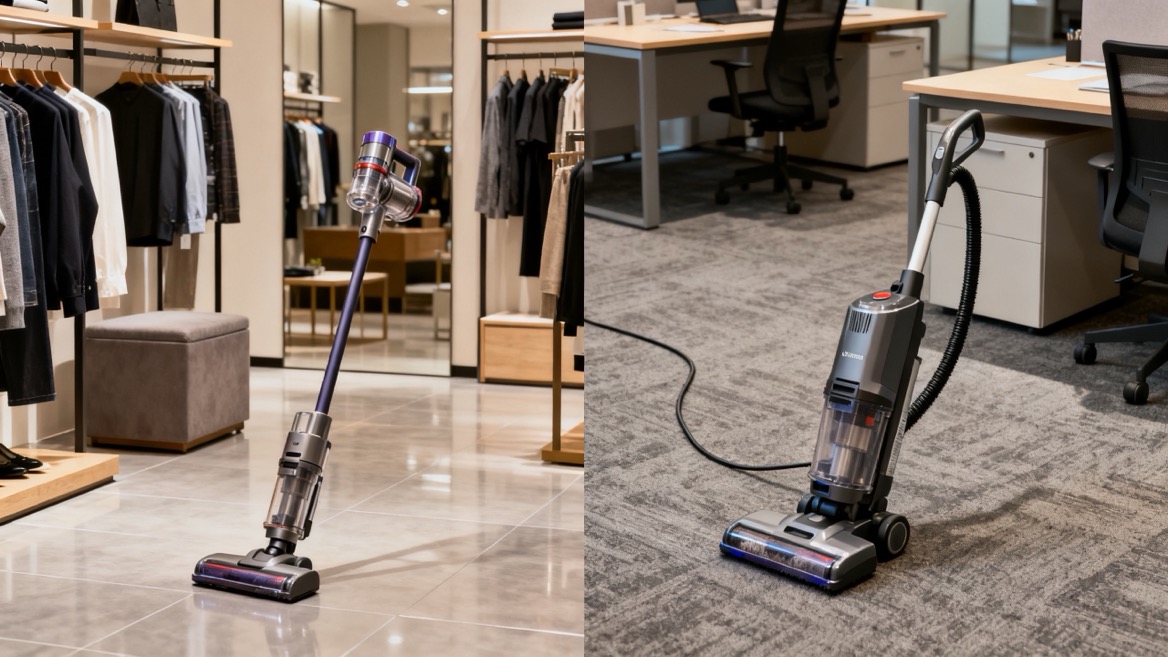
"Cordless" describes the power source. "Commercial" describes the intended application. Neither term alone guarantees cleaning performance, durability, or suitability for your premises.
For this comparison, "cordless vacuum" means a typical lightweight stick or handheld model. "Commercial vacuum cleaner" means equipment explicitly intended for professional cleaning, whether corded or battery-powered.
| Comparison factor | Typical lightweight cordless vacuum | Purpose-designed commercial vacuum cleaner |
|---|---|---|
| Primary role | Quick pickups and shorter cleaning sessions | Repeated professional cleaning tasks |
| Power supply | Rechargeable battery | Mains power or rechargeable battery |
| Operating time | Limited by battery, mode, and attachments | Corded operation avoids charging; cordless models require battery planning |
| Debris capacity | Often compact; verify usable capacity | May offer larger bags or containers |
| Maneuverability | Convenient around furniture and stairs | Depends on upright, canister, or backpack design |
| Maintenance | Often involves emptying bins and cleaning filters | May prioritize replaceable wear parts and service access |
| Purchase decision | Convenience and suitable pickup performance | Productivity, serviceability, and lifecycle cost |
| Business suitability | Depends on intended-use instructions and warranty | Confirm the model’s specific professional applications |
Treat these as purchasing tendencies, not universal specifications. A well-engineered commercial cordless vacuum may combine portability with professional serviceability.
A vacuum cleaner's advertised wattage or suction pressure does not tell you how effectively it cleans your floor.
Practical pickup depends on the complete system: airflow, floor-head design, brush agitation, seals, filtration, and the debris being collected.
A boutique with hard flooring and occasional dust has different requirements from an office with carpeted corridors. A salon adds hair wrapping and brush maintenance to the equation.
When comparing a cordless vacuum vs commercial vacuum cleaner, test both on your actual flooring. Look for:
- Debris remaining after one controlled pass.
- Hair wrapped around the brush.
- Scattering of larger particles.
- Difficulty reaching edges and corners.
- Performance as the bag or container fills.
The best vacuum cleaner for a small business is the one that completes the required task consistently—not the one with the largest isolated specification.
A compact cordless vacuum can be useful for entrance debris, upholstery, stairs, and small storage areas.
For carpet-heavy premises, prioritize suitable brush action and verified pickup. For mixed flooring, check whether employees can switch surfaces without complicated adjustments.
Do not assume a commercial dry vacuum can collect liquids, construction dust, or hazardous materials. Those applications require equipment specifically designed and approved for the task.
Battery runtime changes with operating mode, battery capacity, attachments, and cleaning conditions.
A useful professional example illustrates the difference. Kärcher lists approximately 22 minutes in power mode and 50 minutes in its economy mode for the BVL 5/1 Bp with a 36 V/6.0 Ah battery. These figures describe that particular configuration, not every commercial cordless vacuum.
The lesson is straightforward: an "up to" runtime figure is not a reliable estimate for every cleaning task.
Ask suppliers to identify:
- The battery used for the claim.
- The operating mode.
- Whether the relevant powered attachment was running.
- Charging time and replacement battery availability.
- Runtime under your intended cleaning conditions.
A removable battery helps only when a charged spare is available and swapping is practical.
A corded commercial vacuum cleaner avoids battery charging interruptions. That can be valuable during scheduled cleaning of multiple rooms or larger carpeted areas.
However, the cable introduces outlet changes, routing decisions, and storage requirements. In occupied spaces, employees must manage the cable so it does not obstruct customers or colleagues.
Compare the entire cleaning route. Faster movement may favor cordless equipment; longer uninterrupted sessions may favor a corded machine.
Filtration deserves attention in offices, hospitality settings, and customer-facing businesses.
The U.S. Environmental Protection Agency describes HEPA filtration as theoretically removing at least 99.97% of airborne particles measuring 0.3 microns. However, filter efficiency and complete-machine containment are different questions.
A high-efficiency filter cannot compensate for air leaking around it.
Ask whether the machine is designed to direct its exhaust through the intended filtration stages. Request relevant test documentation when filtration is a purchasing priority.
Also examine routine maintenance:
- Does emptying the container release visible dust?
- Can employees remove the bag without spilling debris?
- Are replacement filters readily available?
- Must washable filters dry completely before reuse?
- Do the instructions explain inspection and replacement intervals?
Bagged disposal can simplify handling, but bagged construction alone does not prove superior filtration. Likewise, "bagless" does not automatically mean poor containment.
For regulated cleanup, use task-specific requirements rather than assuming an ordinary business vacuum is suitable.
A business purchase should include a realistic service plan.
Commercial suitability is not established by appearance, motor wattage, or the word "professional" on packaging. Confirm the manufacturer's intended applications, operating limitations, and warranty conditions.
Some products intended for household use may have restrictions on business use. Obtain written clarification before buying.
For a cordless stick vacuum, inspect the battery release, brush bearings, bin latch, wand connections, and charging interface.
For commercial equipment, also assess the hose, wheels, cable management, bag installation, and access to replaceable components.
Ask the supplier for:
1. A spare-parts list with prices.
2. Expected parts availability.
3. Maintenance instructions.
4. Warranty coverage for the intended business use.
5. Repair procedures and typical turnaround arrangements.
Repairability matters because a small broken component should not automatically require replacing the entire machine.
Purchase price is only one part of operating cost. Cleaning labor, consumables, batteries, repairs, and downtime can change the result.
The following illustration uses assumptions, not measured product performance.
Suppose one vacuum costs $250 and takes 25 minutes to complete a daily cleaning route. Another costs $550 and completes the same route to the same standard in 18 minutes.
Assume:
- 250 cleaning days per year.
- A loaded labor cost of $18 per hour.
- Seven minutes saved per cleaning day.
That time difference equals approximately 29.2 hours annually, worth $525 in labor. The $300 purchase-price difference would be recovered in approximately 143 cleaning days.
This does not prove that commercial equipment always saves money. The calculation changes if the faster machine requires extra maintenance, batteries, or consumables.
Use your own timed trial and apply this framework:
Annual operating cost = cleaning labor + consumables + maintenance + battery replacement + downtime costs.
Compare purchase price plus operating costs over the same ownership period.
These scenarios are decision examples, not customer case studies.
A shop with hard floors, fixtures, and scattered entrance debris may benefit from a lightweight cordless vacuum for quick cleaning between customer visits.
Choose an easy-to-store model with suitable hard-floor pickup. Verify that its runtime covers the route and its warranty permits the intended use.
An office requiring extended after-hours cleaning may favor a commercial upright or canister vacuum.
Prioritize carpet pickup, edge access, capacity, and straightforward maintenance. Compare corded and professional cordless options through a timed route rather than assuming one is automatically faster.
A café may need rapid dry-crumb pickup. A salon must consider hair removal and brush wrapping. A guesthouse needs tools for floors, stairs, and upholstery.
A two-machine approach can be practical: one unit for scheduled cleaning and a smaller cordless vacuum for spot work. Buy both only if the workflow justifies the extra maintenance and storage.
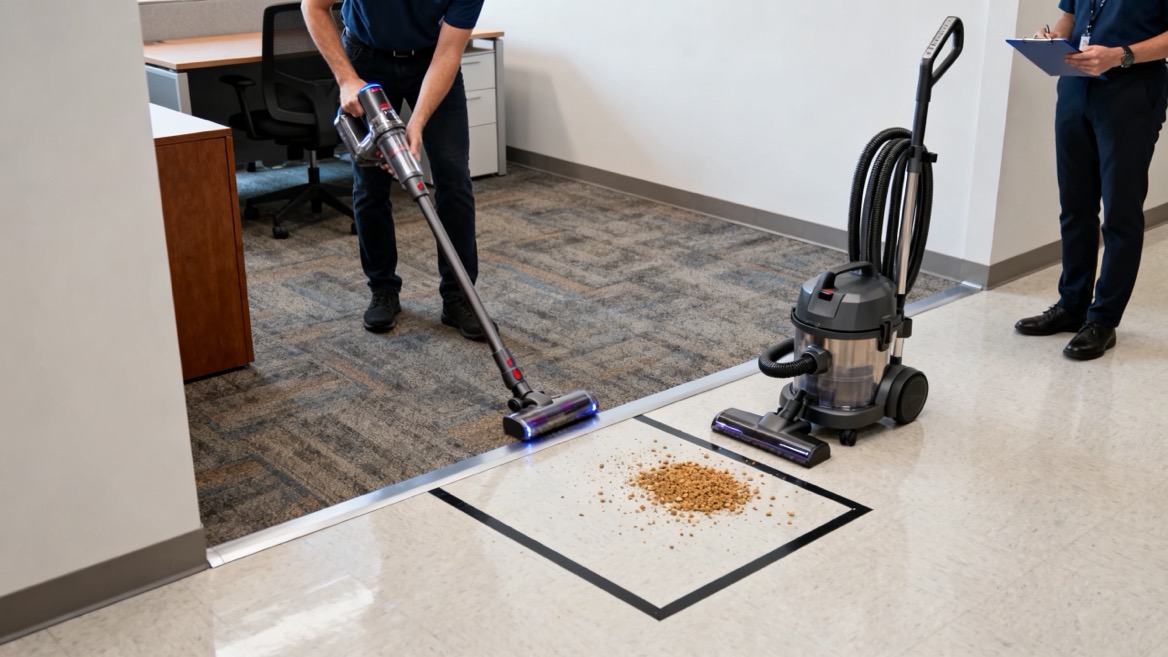
A repeatable trial provides more useful evidence than a demonstration on an unusually clean floor.
1. Define the route. Record flooring, stairs, furniture, outlets, and typical debris.
2. Set an acceptance standard. Decide what satisfactory cleaning looks like.
3. Test under comparable conditions. Use the same route, operator, debris, and cleaning standard.
4. Record total task time. Include setup, outlet changes, emptying, and battery swaps.
5. Check operator experience. Note grip comfort, pushing effort, access, and perceived noise.
6. Review maintenance afterward. Inspect hair wrapping, filter access, debris disposal, and cleaning time.
For battery-powered models, record charge remaining and the operating mode. Repeat the trial rather than relying on one favorable result.
Document the outcome in a simple scorecard. Weight the criteria around your business priorities instead of treating every feature as equally important.
For distributors and brands serving small businesses, the opportunity is to develop products around clearly defined workloads.
Based on its stated business scope, Ningbo Eyunhome Electric Technology Co., Ltd. offers upright, handheld, corded, and cordless vacuum cleaner solutions, alongside OEM/ODM services, production support, and after-sales assistance.
A useful development brief should specify:
- Target users and cleaning environments.
- Floor types and typical debris.
- Required working runtime or cable arrangement.
- Filtration and disposal requirements.
- Accessories and replaceable wear parts.
- Target market documentation.
- Packaging, manuals, warranty, and service expectations.
Do not position a household platform as commercially suitable without confirming its intended use and validating the relevant requirements.
Contact Eyunhome with your target market, cleaning workload, preferred product format, and projected order volume. Request a model-specific proposal, sample evaluation plan, and spare-parts support outline before finalizing your vacuum cleaner program.

Yes, when its intended use, pickup performance, runtime, and warranty match the task. It can be particularly useful for short cleaning routes and spot work. Validate suitability through a practical trial.
No. Commercial cordless vacuum cleaners are available in formats including backpack and upright designs. Compare the specific model's runtime, capacity, filtration, and maintenance requirements.
No. The commercial label does not establish a universal suction ranking. Compare actual cleaning performance, relevant test conditions, and the complete floor-head system.
It can if it meets the full workload and intended-use requirements. For longer cleaning routes, confirm battery availability, charging arrangements, and service support before replacing existing equipment.
Choose according to dust handling, consumable costs, maintenance, and employee preferences. Examine the complete filtration system and disposal process rather than relying on the bagged or bagless label.
Request samples, model-specific specifications, intended-use documentation, applicable compliance evidence, test conditions, warranty terms, and spare-parts plans. Agree on measurable acceptance criteria before approving production.
1. [Kärcher — Battery-Powered Dry Vacuum Cleaners]. Professional cordless product formats, application examples, and configuration-specific runtime information. [kaercher]
2. [Kärcher — BVL 5/1 Bp Battery-Powered Backpack Vacuum]. Basis for the 22-minute power-mode and 50-minute economy-mode example using a 36 V/6.0 Ah battery; also provides charging and battery-platform information. [karcher]
3. [Kärcher — Battery-Powered Upright Brush-Type Vacuum Cleaners]. Evidence that commercial cordless upright designs exist, with professional floor-cleaning applications. [kaercher]
4. [U.S. Environmental Protection Agency — What Is a HEPA Filter?]. Source for the 99.97% filtration figure and 0.3-micron particle-size explanation. [epa]
5. [U.S. Environmental Protection Agency — What Should I Look for When Purchasing a HEPA Vacuum?]. Supports the distinction between filter efficiency and sealed-machine containment. Its regulatory discussion concerns lead-renovation cleanup, not ordinary office cleaning. [epa]


