
Views: 264 Author: Eyunhome Vacuum Publish Time: 2026-10-24 Origin: Site


Content Menu
● Fast-Charging Cordless Vacuum vs Standard Charging: Key Differences
● What Published Cordless Vacuum Charging Times Actually Show
>> Compare Equivalent Charging Conditions
● How Fast Charging Works in a Cordless Vacuum
>> Why Partial-Charge Performance Deserves Attention
● Does Faster Charging Improve Suction or Runtime?
>> Look Beyond Battery Capacity Alone
● Fast Charging, Battery Life, and Temperature
>> What Buyers Should Ask About Battery Durability
● Fast Charging vs a Spare Battery: Which Reduces Downtime More?
>> Illustrative Cleaning-Schedule Comparison
● A Practical Sample-Testing Protocol for Importers
>> Step 1: Define the Intended Cleaning Job
>> Step 2: Record the Baseline
>> Step 3: Measure Full Recharge and Short-Break Recovery
>> Step 4: Repeat After Representative Use
>> Step 5: Review More Than the Average
● Total Ownership Cost: What the Charging Label Leaves Out
● Choosing the Right OEM/ODM Charging Strategy
>> Build a Clear Development Brief
● Final Recommendation and Next Step
>> Is a fast-charging cordless vacuum worth the extra cost?
>> How long do standard cordless vacuums take to charge?
>> Does fast charging always shorten battery life?
>> Is a spare battery better than faster charging?
>> Can I use a more powerful charger to charge faster?
>> What should importers verify before advertising fast charging?
A fast-charging cordless vacuum offers a clear advantage over standard charging models when cleaning cannot wait: less time connected to a charger. However, shorter charging time does not automatically mean stronger suction, longer runtime, or better battery life. For homeowners, distributors, and private-label brands, the better choice depends on cleaning frequency, battery design, replacement costs, and how quickly the machine must return to work.
My recommendation is to prioritize readiness rather than charging speed alone. A well-designed standard-charging vacuum with a removable spare battery may suit frequent cleaning better than a faster-charging model with one fixed battery.
This comparison explains the technical differences, practical trade-offs, and purchasing checks that matter when selecting a cordless vacuum or developing an OEM/ODM product range.
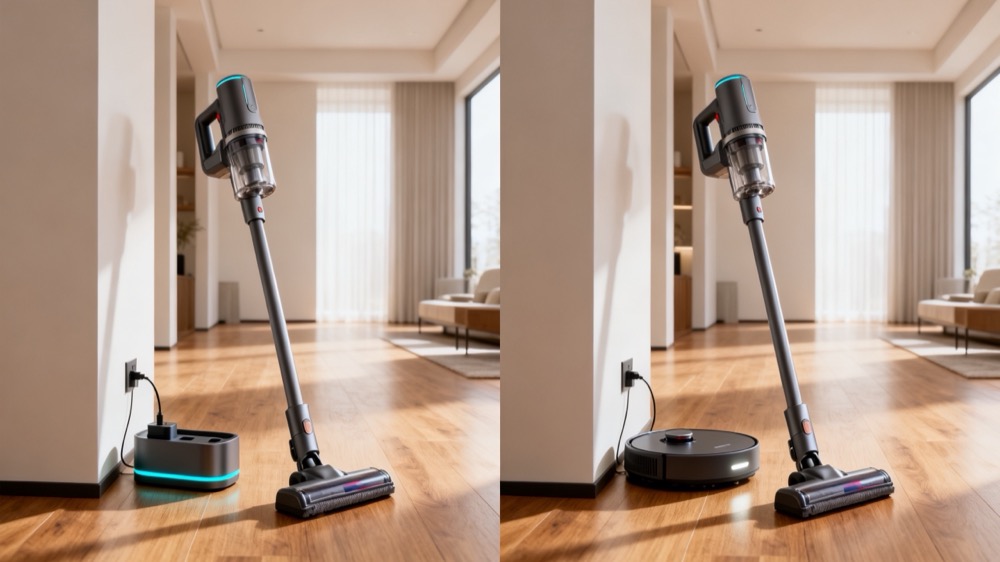
"Fast charging" should describe a measurable improvement against a stated benchmark. It should not be treated as a universal charging-time category.
A smaller battery can recharge quickly simply because it stores less energy. Likewise, a headline describing charging to 80% cannot be compared directly with another product's full-charge time.
| Comparison factor | Fast-charging cordless vacuum | Standard charging model |
|---|---|---|
| Main advantage | Shorter recharge intervals under specified conditions | Suitable for scheduled charging between cleaning sessions |
| Charging architecture | May require higher-power charging and compatible cells | May use a lower charging rate |
| Cleaning performance | Must be assessed separately from charging speed | Must be assessed separately from charging speed |
| Battery longevity | Depends on cells, charging controls, temperature, and use | Also depends on cells, controls, temperature, and use |
| Best-fit situation | Repeated cleaning with limited recharge windows | Daily cleaning followed by a long charging window |
| Alternative to consider | Removable batteries and independent charging | A second battery can reduce immediate downtime |
| Evidence to request | Full-charge and partial-charge test results | Full-charge results and realistic runtime tests |
The important comparison is not simply "fast versus slow." It is how much useful cleaning each system delivers within the user's available time.
Manufacturer information provides useful reference points, although it does not establish a single industry-wide standard.
Examples include:
- Dyson's V11 support information states that a full charge can take up to 4.5 hours.
- LG's US vacuum guidance says most CordZero models recharge in approximately four to five hours.
- Samsung lists a 3.5-hour charging time for its Jet 85.
These examples show why buyers should compare specific models rather than rely on category labels. A 3.5-hour charge is shorter than a 4.5-hour charge, but that difference alone does not reveal which machine offers better overall value.
Battery capacity, cleaning mode, floorhead, and usable runtime may differ. The published figures above are manufacturer statements, not results from a controlled head-to-head test.
Before accepting a cordless vacuum charging-time claim, ask:
1. What battery percentage marks the starting point?
2. Does the measurement end at 80%, an indicated "full," or completed charging?
3. Was the battery cool or recently used?
4. Which charger and battery capacity were tested?
5. What ambient temperature was maintained?
Without these details, an attractive charging claim can conceal an unequal comparison.
Lithium-ion charging commonly follows a constant-current stage and a constant-voltage stage.
During the first stage, the charger supplies controlled current while battery voltage rises. Once the voltage limit is reached, charging current decreases as the battery approaches full charge.
This explains an important limitation: doubling charging current does not necessarily halve the complete charging time. The final charging stage still takes time.
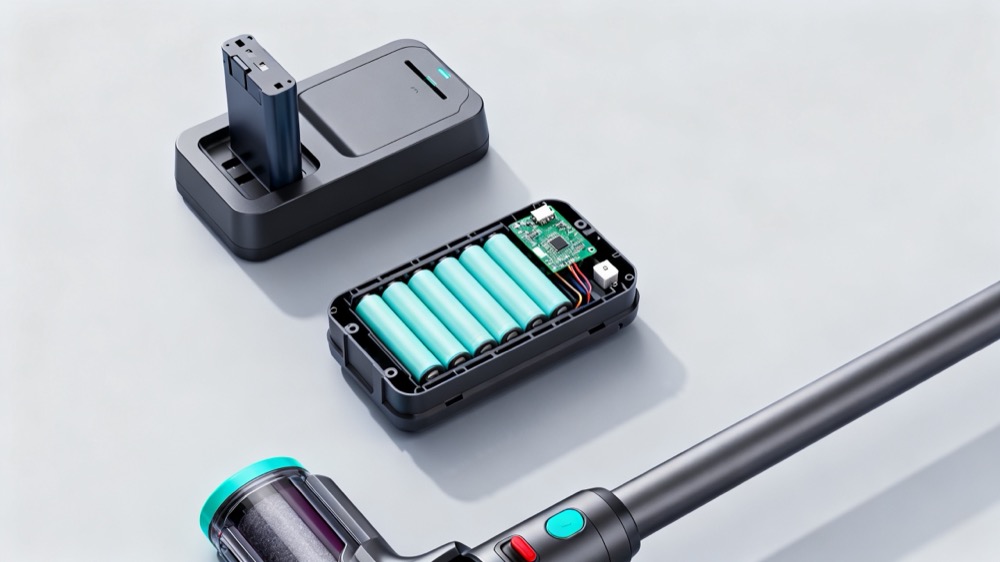
For many users, the practical question is not "How quickly can I reach 100%?" It is "Can I finish the remaining room after a short break?"
A useful product specification would therefore report:
- Full recharge time.
- Charge gained during a defined short interval.
- Cleaning runtime available after that interval.
- The cleaning mode and attachment used.
For example, "runtime after a 30-minute recharge" can be more informative than an isolated fast-charging label. However, that claim requires testing; it should never be inferred from full-charge time alone.
Charging speed does not establish cleaning performance.
A fast-charging cordless vacuum may offer strong pickup, but that must be demonstrated independently. The same applies to standard charging models.
When assessing cleaning ability, compare:
- Debris pickup on the intended surfaces.
- Performance with the supplied powered floorhead.
- Runtime in normal and maximum-power modes.
- Handling around furniture and stairs.
- Dustbin access and routine maintenance.
A long runtime measured with a non-powered attachment may not represent whole-home floor cleaning.
Battery energy is commonly expressed in watt-hours. Where nominal voltage and amp-hour capacity are available, approximate energy is calculated by multiplying them.
However, stored energy is not a direct runtime guarantee. Motor demand, operating mode, attachments, and system controls affect how that energy translates into cleaning time.
From a purchasing perspective, I would request runtime under a defined cleaning setup before assigning value to either battery capacity or charging speed.
It is too simplistic to say that fast charging always damages batteries—or that standard charging always guarantees longer life.
Research comparing lithium-ion cells found that the effect of faster charging on cycle life depended strongly on cell materials and internal design. Charging current, voltage, and thermal conditions all influenced the outcome.
That research was not a cordless-vacuum product comparison. Its relevant lesson is narrower: battery performance must be evaluated as an engineered system.
For an OEM/ODM project, request:
- Cell specifications and permitted charging conditions.
- The charging profile used in the finished product.
- Battery temperature measurements during charging.
- Capacity-retention results after repeated cycles.
- Clear definitions of cycle count and end-of-test capacity.
A claim such as "long-life battery" has limited purchasing value without test conditions.
Also distinguish battery warranty coverage from the appliance warranty. Ask whether replacement packs will remain available and how customers can identify compatible parts.
Dyson advises allowing a recently used battery to cool before recharging to help preserve battery life.
This highlights a practical distinction: advertised charging time may not equal the total interval between finishing one cleaning session and starting another.
For evaluation purposes:
Total recovery time = any required cooling delay + charging time.
A realistic test should include charging immediately after representative cleaning, following the manufacturer's operating instructions.
A spare battery can provide immediate additional runtime if it is charged, compatible, and ready to install.
That can be more useful than waiting for a single battery to recharge. However, two batteries do not automatically create uninterrupted operation.
LG's Canadian guidance gives a useful example: charging one depleted battery takes approximately four hours, while charging two depleted batteries can take approximately eight hours on the arrangement described.
Buyers should therefore establish whether a dock charges batteries simultaneously or sequentially.
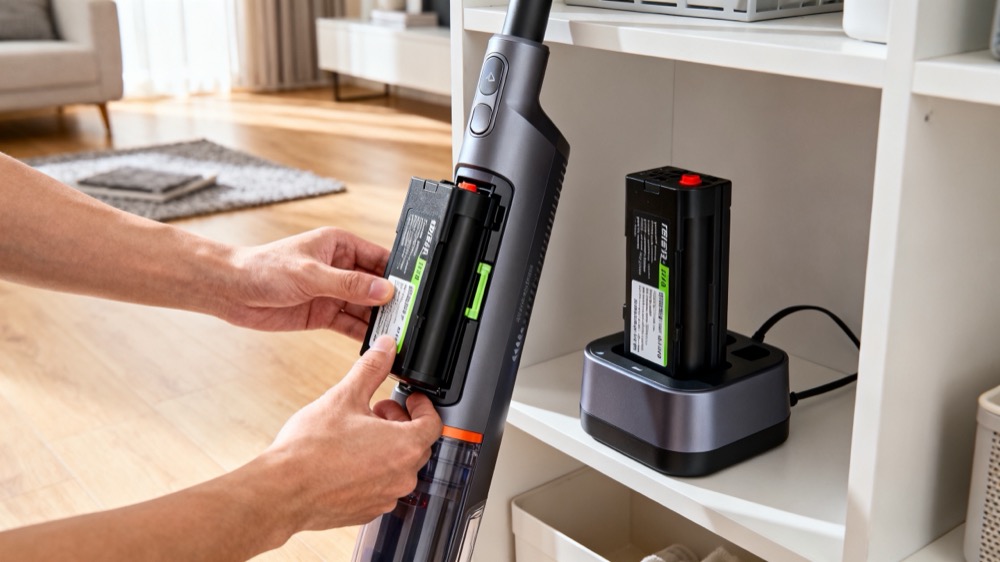
Consider a hypothetical household that needs two 20-minute cleaning sessions separated by a short break.
- A single-battery model may need enough initial runtime for both sessions.
- A fast-charging model may help if the break restores sufficient usable runtime.
- A two-battery model may allow an immediate swap.
- A standard-charging model may still be adequate if one full battery completes both sessions.
These are planning scenarios, not measured product results.
The lesson is to map the cleaning schedule before choosing the charging system.
One of the most useful ways to compare fast-charging and standard charging models is to test the same customer journey.
The following protocol is a proposed purchasing method, not a formal certification procedure.
Specify the surface, attachment, operating mode, and required cleaning duration.
A lightweight handheld vacuum for quick crumbs has different requirements from a cordless upright-style machine used across several rooms.
Use the supplied charger. Record battery identification, ambient temperature, starting charge indication, and whether the battery has cooled.
Keep these conditions consistent across samples.
Record both complete charging time and usable runtime after a fixed charging interval.
Do not assume that twice the charging interval produces twice the runtime.
Run the cleaning task, then follow the specified recharging procedure.
Record any delay before charging begins and any charging interruptions.
Repeat the test and examine variation between samples.
For a commercial launch, consistency matters. A charging claim should reflect documented, repeatable performance rather than the best result from one sample.
A fast-charging cordless vacuum should earn its price through a meaningful user benefit.
Evaluate the complete ownership package:
| Cost or service factor | Question to ask |
|---|---|
| Initial purchase | What is included in the quoted configuration? |
| Battery replacement | Is the pack replaceable, and what does it cost? |
| Spare battery | Is an additional charger required? |
| Charging accessories | Are replacement docks and adapters available? |
| Maintenance | Which filters and wear parts need replacement? |
| After-sales support | How are charging faults diagnosed and resolved? |
Do not assume standard charging always costs less. Product positioning, accessories, and battery capacity can outweigh differences in charging electronics.
For distributors, a clear explanation of charging indicators and compatible accessories can also make the product easier to support.
For private-label brands, charging speed should follow the target customer's routine.
A practical range might separate products by use case:
- Occasional household cleaning: prioritize straightforward operation and dependable scheduled charging.
- Frequent short cleanups: evaluate useful runtime recovered during short breaks.
- Larger cleaning tasks: assess battery energy, realistic runtime, and spare-pack options.
- Shared-use settings: examine charging logistics and confirm that the product is approved for the intended duty.
These are positioning options, not evidence that every platform suits every application.
Ningbo Eyunhome Electric Technology Co., Ltd. provides upright, handheld, corded, and cordless vacuum solutions, supported by OEM/ODM services, production support, and after-sales assistance.
For a charging-focused development discussion, provide:
- Target market and intended customer.
- Expected cleaning duration and frequency.
- Preferred battery-removal arrangement.
- Target full-charge and short-break recovery performance.
- Required accessories, documentation, and support arrangements.
Treat fast charging as a capability to verify during development—not a feature to assume across all models.
Choose a fast-charging cordless vacuum when shorter recharge windows solve a genuine cleaning problem and supporting tests demonstrate the benefit.
Choose a standard charging model when its runtime already completes the task and charging can happen between uses. Consider removable batteries when immediate recovery matters more than full-charge speed.
To develop a suitable product range, contact Ningbo Eyunhome Electric Technology Co., Ltd. with your target market, cleaning requirements, expected order volume, and charging priorities. Request a model-specific specification, sample evaluation plan, and OEM/ODM proposal before finalizing performance claims.
It can be when frequent cleaning creates short recharge windows. If one charge already covers the day's cleaning, faster charging may provide little additional value.
The manufacturer examples discussed here range from approximately 3.5 to five hours. Exact charging time depends on the model and stated test conditions.
No. Its effect depends on cell design, charging controls, temperature, and operating conditions. Request product-specific durability evidence rather than relying on a universal claim.
A charged spare can provide an immediate restart. However, check its cost, compatibility, charging arrangement, and whether replacement packs remain available.
Do not substitute a charger simply because its connector fits. Use the charger specified or explicitly approved for the vacuum and battery system.
Verify the starting and ending charge levels, battery capacity, charger specification, temperature, full-charge time, and runtime recovered after a defined charging interval.
- [Dyson — V11 Absolute: Charging the Machine]. Source for the stated full-charge time of up to 4.5 hours. [support.sa.dyson]
- [LG USA — Cordless Stick Vacuum Cleaners]. Source for the general four-to-five-hour charging guidance and selected dual-battery configurations. [lg]
- [Samsung — Jet 85 Product Specifications]. Source for the listed 3.5-hour charging time. [samsung]
- [Battery University — BU-409: Charging Lithium-ion]. Technical background on constant-current/constant-voltage charging, current tapering, and partial versus complete charging. [batteryuniversity]
- [HAL Research Archive — Comparison of the Impact of Fast Charging on the Cycle Life of Three Lithium-ion Cells]. Research supporting the discussion of cell-dependent aging and the influence of current, voltage, and temperature; not a vacuum-specific test. [hal]
- [Dyson — Vacuum Battery Care]. Source for the advice to let the machine cool after use before recharging. [dyson]
- [LG Canada — Charging Vacuum Cleaner Battery]. Source for the approximately four-hour single-battery and eight-hour two-battery charging example. [lg]


