
Views: 294 Author: Eyunhome Vacuum Publish Time: 2026-10-31 Origin: Site


Content Menu
● High-Speed Brushless Motor vs Standard Motor Cordless Vacuum: Quick Comparison
● How the Two Cordless Vacuum Motor Types Work
>> Conventional Brushed Motors: A Simpler Electrical Design
>> High-Speed Brushless Motors: Electronic Commutation
● Suction Performance: Why Higher RPM Does Not Automatically Win
>> Motor Speed Is Not Cleaning Power
>> Compare Pressure, Airflow, and Pickup Together
● Efficiency and Battery Runtime: Compare Equal Cleaning Output
>> Brushless Efficiency Creates Potential, Not a Runtime Guarantee
>> A Practical Battery Calculation
>> Read "Up To" Runtime Claims Carefully
● Durability, Maintenance, and Ownership Cost
>> Brushless Removes Brush Wear, Not Every Failure Mode
>> Compare Support Costs, Not Just Purchase Prices
>> Brushless Does Not Mean Silent
>> Thermal Performance Depends on the Whole Design
>> Weight Distribution Matters Alongside Motor Size
● An Important Industry Insight: Controller Design Can Change the Result
● A Practical Six-Step Cordless Vacuum Comparison Protocol
>> 1. Define the Cleaning Task
>> 2. Normalize the Test Conditions
>> 3. Measure Suction and Pickup Separately
>> 4. Repeat With a Partially Loaded System
>> 5. Monitor Runtime and Temperature Together
>> 6. Verify the Applicable Test Method
● Which Motor Should Your Product Range Use?
>> Choose High-Speed Brushless for Performance-Led Positioning
>> Consider Conventional Brushed Motors for Cost-Led Simplicity
>> Build Separate Specifications for Separate Market Segments
● Develop Your OEM/ODM Vacuum Project With Ningbo Eyunhome
>> Is a Brushless Cordless Vacuum Always Better?
>> Does Higher Motor RPM Mean Stronger Suction?
>> Will a Brushless Motor Increase Battery Runtime?
>> Are Standard Brushed Motors Suitable for Handheld Vacuums?
>> Which Specifications Should an Importer Request First?
A high-speed brushless motor vs standard motor cordless vacuum comparison should begin with one practical question: which design delivers the cleaning performance your customers need at a commercially viable cost? High-speed brushless motors offer advantages in power density, speed control, and the elimination of brush wear. Conventional brushed motors can still suit simpler, price-sensitive products.
However, motor technology alone does not determine cleaning quality. Battery capacity, airflow, filtration, floorhead design, and electronic controls all influence the finished vacuum.
For importers, distributors, and private-label brands, the best choice is therefore a system-level decision. This guide explains the differences, separates meaningful specifications from headline claims, and provides a practical framework for developing a cordless vacuum range.
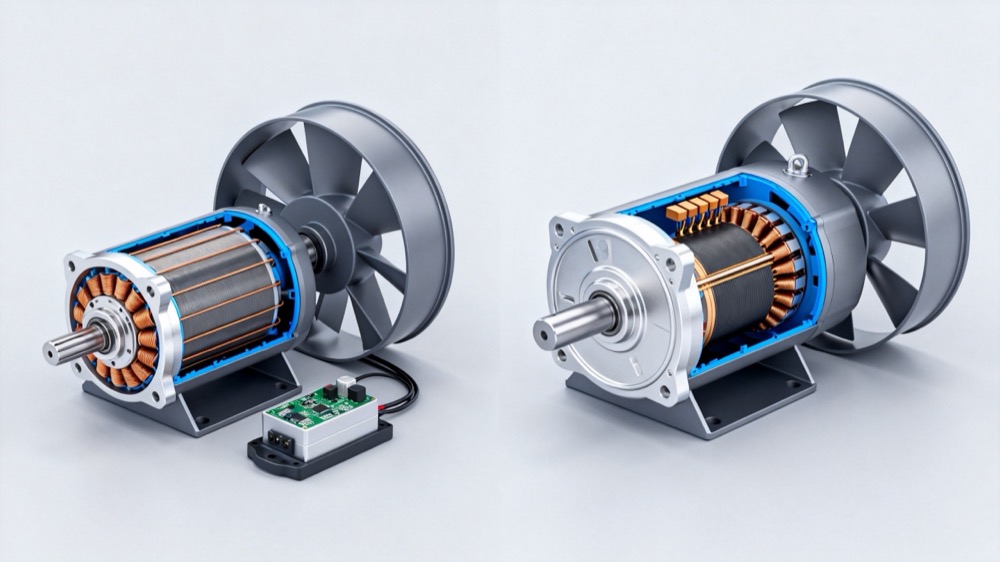
"Standard motor" is not a precise engineering category. Here, it means a conventional brushed DC suction motor. A lower-speed brushless motor is a different comparison and should not be grouped automatically with brushed designs.
| Comparison point | High-speed brushless motor | Conventional brushed motor |
|---|---|---|
| Commutation | Electronic switching | Brushes and a mechanical commutator |
| Main advantage | High-speed capability and power density | Simpler architecture and lower initial cost potential |
| Wear characteristics | No carbon-brush wear | Brushes and commutator wear during operation |
| Control requirements | More sophisticated electronics | Generally simpler drive requirements |
| Efficiency potential | Typically favorable, depending on design | More constrained by brush-related losses |
| Noise | No brush-contact noise; airflow and tonal noise remain | Brush-contact noise plus airflow and vibration |
| Product positioning | Performance-focused handheld and stick vacuums | Entry-level and simpler cleaning products |
| Main purchasing risk | Paying for impressive speed without better cleaning | Accepting lower durability or performance without testing |
Neither column guarantees a successful product. A well-integrated conventional motor can outperform a poorly engineered brushless vacuum in a particular cleaning task.
A brushed DC motor transfers current through carbon brushes contacting a rotating commutator. This arrangement switches current through the rotor windings and maintains rotation.
Its commercial appeal is straightforward: the control architecture can be relatively simple, helping manufacturers manage component and development costs.
The trade-off is mechanical contact. Brushes introduce friction, wear, electrical noise, and potential sparking. Their deterioration can eventually affect operation.
For an occasional-use handheld vacuum, these compromises may be acceptable. For a performance-oriented product, buyers should examine durability and thermal behavior carefully.
A brushless DC motor replaces mechanical commutation with electronically controlled switching. The controller energizes the windings in sequence to drive the rotor.
Removing brush contact eliminates one wear mechanism and supports high-speed operation. However, the design still depends on bearings, rotor balance, electronics, and effective cooling.
The purchasing implication is important: do not evaluate the motor independently of its controller. Motor-control tuning can influence current consumption, heating, operating stability, and useful suction performance.
Revolutions per minute describe rotational speed, not how much dust a vacuum removes.
A high-speed motor needs an appropriately matched impeller and airflow path. Restrictions, leakage, inefficient separation, or an unsuitable floorhead can reduce the benefit of additional speed.
Published commercial examples illustrate the problem with RPM-only comparisons. Dyson lists its V10 Konical at up to 110,000 rpm and 150 air watts, while its V15 Detect listing specifies up to 125,000 rpm and 240 air watts. These are different complete products, not a controlled motor experiment.
The lesson is not that one speed produces a predictable suction figure. It is that RPM must be interpreted alongside measured system performance.
Three measurements answer different questions:
- Pressure indicates the vacuum's ability to create a pressure difference.
- Airflow describes the volume of air moving through the system.
- Pickup testing shows how effectively the complete appliance removes specified debris.
Air watts combine pressure and airflow at a particular operating point. They are more informative than RPM alone, but measurement location and test conditions still matter.
For supplier comparisons, request both laboratory suction measurements and representative cleaning tests.
Brushless motors generally offer efficiency advantages, but "brushless" does not mean "longer runtime" under every condition.
A manufacturer may use efficiency gains to:
- Extend cleaning time.
- Increase suction.
- Reduce battery size.
- Lower operating temperatures.
Consequently, a more powerful brushless vacuum can run for less time than a lower-output brushed model.
The fair question is: how long does each product maintain the required cleaning performance with a comparable battery?
Consider two hypothetical prototypes using the same 100 Wh battery.
If one draws an average of 200 W, ideal runtime is 30 minutes. At 250 W, ideal runtime falls to 24 minutes.
These are illustrations, not product test results. Actual usable runtime depends on battery discharge behavior, protection thresholds, operating mode, and accessory consumption.
This distinction prevents an attractive motor-efficiency claim from becoming an unsupported whole-product runtime promise.
Runtime figures are not comparable unless the operating conditions match.
Independent testing organizations distinguish between minimum runtime at maximum power and maximum runtime at minimum power. Motorized attachments can also change the result.
For a useful comparison, specify:
1. Suction mode.
2. Installed attachment.
3. Floor surface.
4. Battery specification.
5. End-of-test criterion.
A long low-power runtime without a motorized head should not be presented as equivalent to full-power carpet cleaning.
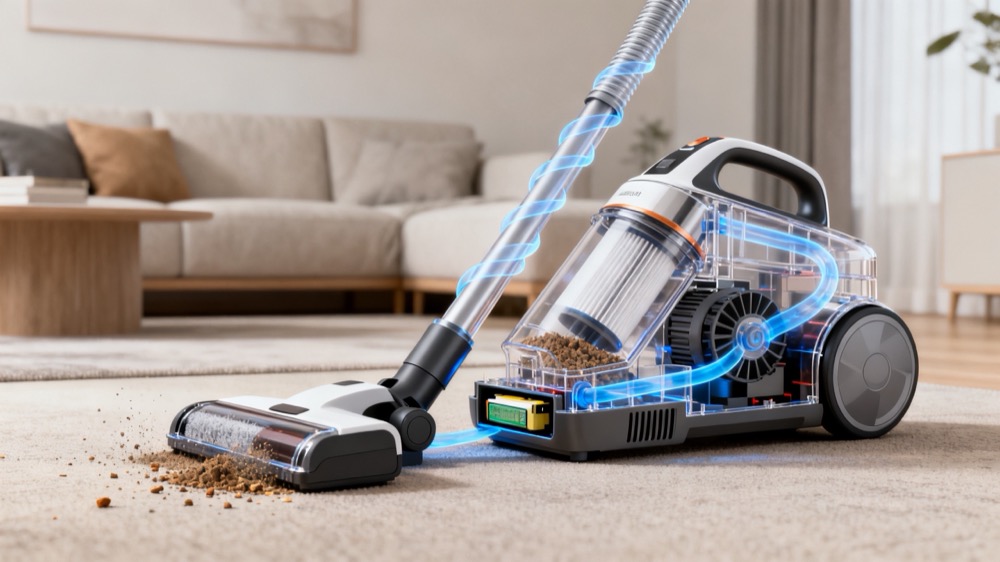
A brushless motor has no carbon brushes to replace or wear out. That is a meaningful durability advantage.
Nevertheless, a cordless vacuum still contains bearings, a battery, electronic components, seals, filters, and mechanical connections.
Avoid accepting an exact service-life claim based solely on motor type. Ask for endurance-test conditions, sample quantities, failure criteria, and results.
A statement such as "tested for repeated operating cycles under defined conditions" is more useful when accompanied by the actual protocol.
For distributors, the initial unit price is only part of the commercial calculation.
Evaluate:
- Replacement battery and filter availability.
- Motor and controller replacement costs.
- Repair labor and diagnostic requirements.
- Warranty arrangements.
- Spare-parts continuity.
A lower-priced product may suit an entry-level range. A higher-priced product may justify its premium through stronger performance or reduced maintenance exposure. Neither outcome should be assumed without evidence.
Eliminating brush contact removes one source of noise. It does not eliminate impeller noise, airflow turbulence, bearing vibration, or floorhead sound.
High-speed operation may also create a noticeable tonal character.
Compare complete appliances in equivalent operating modes. Where practical, evaluate both measured sound levels and perceived sound quality.
A vacuum that sounds harsh may disappoint customers even when its published sound level appears competitive.
Motor heating is influenced by electrical losses, operating load, cooling, and controller behavior.
A clogged filter can also change the system's operating conditions. The correct response is not to assume that one motor type always runs cooler, but to test normal and restricted-airflow operation.
Temperature monitoring should cover the motor, battery, and controller—not just the exterior housing.
High power density can support compact motor assemblies. Yet customer comfort depends on the entire appliance.
When reviewing samples, assess handle balance, trigger effort, overhead cleaning, and the force needed to move the floorhead.
A compact motor is valuable only when the finished vacuum remains comfortable and controllable.
A Texas Instruments cordless-vacuum motor-drive comparison demonstrates why buyers should look beyond the motor label.
In one open-orifice test, the company reported approximately 14.3% lower RMS winding current with one controller configuration than with the reference controller, at similar electrical input power and operating frequency.
This does not establish a 14.3% battery-runtime improvement. Winding current and battery input consumption are different measurements.
Instead, the finding highlights an overlooked purchasing issue: controller selection and tuning can materially change motor operating conditions.
Ask suppliers what they measured before interpreting a percentage improvement as better suction, longer runtime, or lower energy consumption.
Choose representative applications: hard-floor crumbs, carpet dust, upholstery debris, or vehicle interiors.
Avoid approving a product solely because it demonstrates strong suction against a hand.
Use comparable battery energy, charge state, accessories, filters, and ambient conditions.
Document unavoidable differences rather than hiding them.
Record pressure and airflow, then test debris removal.
This reveals whether a strong motor specification translates into useful cleaning.
Evaluate performance after a defined dust load and filter-loading procedure.
Fresh-filter results alone do not describe the entire ownership experience.
Track operating time, performance changes, and temperatures.
Record shutdowns or power reductions instead of counting all running time as equally effective cleaning.
IEC 62885-4 provides performance-measurement methods for cordless dry household vacuums.
Its scope requires attention: the consolidated standard excludes cordless handheld vacuums except for specified clauses. Buyers should confirm the appropriate methods for each product format with their testing laboratory.
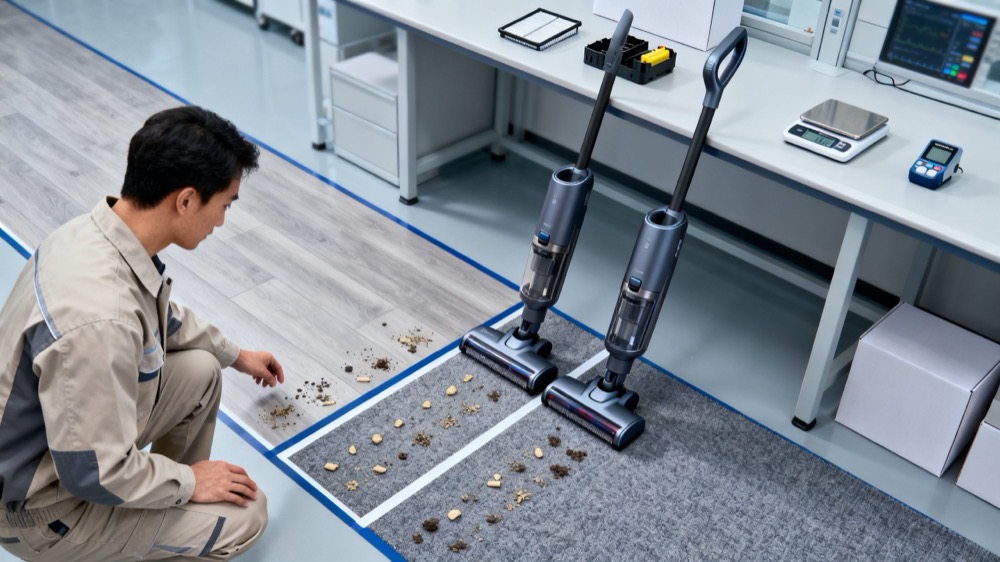
A high-speed brushless motor is generally the stronger starting point when your brief emphasizes compact power, advanced control, and reduced brush-related maintenance.
However, make approval conditional on measured pickup, usable runtime, sound quality, and thermal stability.
The motor label should support the product promise—not replace its validation.
A conventional brushed design can remain relevant when the product targets occasional cleaning, modest performance requirements, and an aggressive purchase price.
The decision should be deliberate. Confirm that the savings remain attractive after durability, noise, maintenance, and support requirements are considered.
An entry-level handheld cleaner and a premium cordless stick vacuum do not need identical engineering priorities.
Create a specification for each intended user, then select the motor architecture that meets it. This is more commercially useful than forcing every product into the same technology category.
Ningbo Eyunhome Electric Technology Co., Ltd. offers upright, handheld, corded, and cordless vacuum solutions, together with OEM/ODM services, production support, and after-sales support.
For your next project, start with a measurable brief rather than a preferred RPM figure.
Share your target market, retail positioning, cleaning applications, battery-runtime expectations, accessory requirements, and order plan. Request a proposal that identifies the motor architecture, performance targets, validation methods, and spare-parts arrangements.
Contact Ningbo Eyunhome to discuss an OEM/ODM vacuum solution aligned with your product positioning and purchasing requirements.
No. Brushless technology offers important motor-level advantages, but complete-product performance depends on airflow, batteries, controls, filtration, and the floorhead. Compare finished appliances.
Not necessarily. RPM measures speed. Suction performance also depends on impeller design, restrictions, leakage, and the operating point. Request pressure, airflow, and pickup results.
It can, at comparable cleaning output. However, manufacturers may use efficiency gains to increase power instead. Compare runtime under matched modes and accessory conditions.
They can be appropriate for simple, price-sensitive applications. Validate their cleaning performance, noise, thermal behavior, and endurance against the intended duty cycle.
Request motor type, battery energy in Wh, suction-test conditions, pickup results, runtime by mode, sound measurements, and endurance-test documentation. Ask how replacement parts and warranty support will work.
1. Texas Instruments — *Brushless-DC Motor Driver Considerations and Selection Guide*. Technical comparison of motor architectures, including efficiency, power density, wear, cost, and control complexity. [ti]
2. Texas Instruments — *Cordless Vacuum Cleaner BLDC Motor Efficiency Test*. Application-specific controller comparison, including electrical input and RMS winding-current measurements. The reported results apply to the tested configurations, not every cordless vacuum. [ti]
3. Dyson — *V10 Konical Cordless Vacuum*. Manufacturer-published motor speed, suction specifications, and suction-measurement conditions. [dyson]
4. Dyson — *V15 Detect Absolute Cordless Vacuum*. Manufacturer-published motor speed and suction specifications. These figures are product claims rather than an independent comparison. [dyson]
5. RTINGS — *Our Vacuum Design Tests: Battery*. Independent methodology explaining minimum and maximum runtime testing, power modes, attachments, and charging measurements. [rtings]
6. International Electrotechnical Commission — *IEC 62885-4:2020+AMD1:2023 CSV*, consolidated standard preview. Performance-measurement framework, runtime terminology, testing conditions, and handheld-vacuum scope limitations. [cdn.standards.iteh]


