
Views: 228 Author: Eyunhome Vacuum Publish Time: 2026-11-02 Origin: Site


Content Menu
● China's Cordless Vacuum Manufacturing Position in 2026
● How These Manufacturers Were Selected
● Manufacturer Comparison: Capacity, MOQ, and Compliance
● The Top 10 Powerful Cordless Stick Vacuum Manufacturers in China
>> 1. Ningbo Eyunhome Electric Technology Co.,Ltd.
>> 2. KingClean Electric Co., Ltd.
>> 3. EUP Group / Suzhou EUP Electric
>> 4. Suzhou Chunju Electric Co., Ltd.
>> 5. TEK Electrical (Suzhou) Co., Ltd.
>> 6. Suzhou Cleva Electric Appliance Co., Ltd.
>> 7. Suzhou Dibea Electrical Technology Co., Ltd.
>> 9. Ningbo Dechang Electrical Machinery Made Co., Ltd.
>> 10. Ningbo Liyyou Group Co., Ltd.
● What Makes a Cordless Stick Vacuum Genuinely Powerful?
>> Evaluate Cleaning Performance, Not Just Motor Wattage
>> Specify Materials and Components Precisely
>> Treat Compliance as Configuration-Specific
● Buyer's Guide: How to Qualify a Long-Term Manufacturing Partner
>> 1. Verify the Factory and Contracting Entity
>> 2. Use a Controlled Sampling Process
>> 3. Assess Capacity Through Production Evidence
>> 4. Build Battery Logistics Into the Purchase Plan
>> 5. Agree on After-Sales Obligations Before Production
● Insider Pitfall: The Sample Configuration Is Not Always the Production Configuration
● Conclusion: Select the Manufacturing Partner That Fits Your Project
>> 1. How Can I Check Whether a Manufacturer's ISO Certificate Has Expired?
>> 2. Can My Private-Label Vacuum Use the Factory's Existing CE Documentation?
>> 3. What Should I Do When Two Suppliers Advertise Similar Suction but Different Cleaning Results?
>> 4. Does a Battery Cell's UN 38.3 Report Automatically Cover the Finished Vacuum Battery Pack?
>> 5. How Can I Obtain a Lower MOQ Without Weakening Quality?
Choosing a powerful cordless stick vacuum manufacturer in China requires more than comparing suction figures and unit prices. For professional buyers, the more important questions concern production consistency, battery reliability, regulatory documentation, customization depth, and the supplier's ability to support products after shipment.
A practical supplier assessment starts with five checks: verifiable factory credentials, relevant engineering capabilities, documented quality-control procedures, realistic delivery commitments, and a workable spare-parts policy. A polished sample is useful, but it does not establish that a factory can reproduce the same performance across several production batches.
China offers a substantial manufacturing base for this category. Established suppliers in Suzhou and Ningbo demonstrate capabilities extending from motors and injection molding to battery packs, assembly, and finished-product testing. These interconnected capabilities make the country attractive to importers seeking both established product platforms and customized cleaning appliances.
This guide compares ten manufacturers and manufacturing groups worth investigating. It identifies their strengths, the types of purchasing projects they may suit, and the evidence buyers should request before placing an order.

China's cleaning-appliance industry continues to expand, although buyers should distinguish broad market figures from cordless-stick-specific demand.
According to the China Household Electrical Appliances Association's April 2026 industry overview, China's cleaning-appliance sales reached 35.5 million units in 2025, increasing 17% year over year. Revenue reached RMB 47.1 billion, up 11.3%. These figures cover the wider cleaning-appliance category, including floor washers and robotic cleaners; they are not a measurement of cordless stick vacuums alone.
A separate association review reported that vacuum cleaners with self-emptying base stations recorded a 262% increase in retail sales in 2025. This indicates interest in reduced-maintenance cleaning systems, but it should not be interpreted as equivalent growth across every cordless vacuum segment.
For overseas buyers, the manufacturing ecosystem offers three useful advantages:
- Product-development options ranging from existing private-label platforms to more extensive engineering projects.
- Access to integrated manufacturing processes, including tooling, molding, motors, battery packs, and assembly.
- Suppliers with established experience serving multiple international markets.
The commercial implication is straightforward: buyers can source different levels of product complexity in China, but supplier scale alone does not establish suitability for a particular brand.
This is an editorial procurement shortlist, not a laboratory-tested performance ranking or a ranking by export volume.
The selection considers publicly available evidence across six areas:
| Assessment Area | What Buyers Should Examine |
|---|---|
| Manufacturing identity | Legal entity, factory address, production ownership, and subcontracting arrangements |
| Product relevance | Cordless stick vacuum platforms or closely related vacuum manufacturing expertise |
| Engineering capability | Motors, airflow systems, battery management, tooling, and product development |
| Quality management | Incoming inspection, process controls, traceability, and finished-product testing |
| International readiness | Export experience and model-specific compliance documentation |
| Commercial suitability | Customization scope, order economics, production scheduling, and after-sales support |
Supplier statements are distinguished from independently verified facts wherever relevant. Unpublished production capacities, minimum order quantities, and certificate details are not estimated.
Capacity figures are not directly comparable unless they cover the same product category, production location, and reporting period. Group-wide appliance output is not the same as available cordless stick vacuum capacity.
Likewise, a certification logo on a company website does not establish that every model, charger, battery pack, or private-label configuration is covered.
| Manufacturer | Published Manufacturing Scale or Capacity | Published MOQ | Compliance Information and Verification Priority |
|---|---|---|---|
| Ningbo Eyunhome | Reports a 7,500 m² facility; annual output not disclosed | Not disclosed; request a project quotation | Website lists CE, CB, GS, RoHS, REACH and other approvals; verify exact model coverage and current documents. |
| KingClean Electric | Substantial integrated manufacturing; current cordless-specific capacity not established in the reviewed sources | Not disclosed | Request current factory-system certificates and product-specific safety, EMC, and substance-compliance records. |
| EUP | Reports annual capacity of 27.5 million small appliances across its wider business | Not disclosed | Website lists quality and environmental systems alongside testing and compliance credentials; confirm issuing bodies, scope, and model applicability. |
| Suzhou Chunju | Reports a 300,000 m² production site; current unit capacity not disclosed on the reviewed official homepage | Not disclosed | Obtain current certificates directly rather than relying on older marketplace listings. |
| TEK Electrical | Chamber profile states 7 million vacuum cleaners annually; treat as historical pending confirmation | Not disclosed | Profile references legacy ISO certificates; request current certificates and current product files. |
| Suzhou Cleva | Reports more than 6 million units delivered in 2018; not a current capacity commitment | Not disclosed | Obtain documentation for the selected cordless platform, battery, and charger. |
| Suzhou Dibea | Current annual capacity not established in reviewed materials | Not disclosed | Request current factory certificates and destination-specific model reports. |
| Dreame | An older official brand page describes one-million-unit annual throughput; current availability requires confirmation | Not disclosed | Verify the contracting entity, production site, and documentation for the proposed project. |
| Ningbo Dechang | Current cordless-stick-specific capacity not established | Not disclosed | Website states UL, CE, CCC, RoHS, and REACH coverage; verify exact products and supporting records. |
| Ningbo Liyyou | An individual cordless product listing states 500,000 units annually; scope requires confirmation | One reviewed model lists 1,000 pieces | Supplier listings reference CE, CB, GS, and RoHS; verify reports for the final configuration. |
Established: 2011
Location: Ningbo, Zhejiang
Market orientation: International buyers; the reviewed introduction does not disclose regional sales shares
Procurement fit: Small and midsized brands evaluating customized cordless cleaning products
Eyunhome describes itself as a manufacturer focused on battery-powered cleaning products. Its company introduction reports a 7,500 m² facility, engineering resources, customized product support, and a structured quality process. Its website also lists cordless stick and handheld vacuum categories.
For buyers seeking a cost-conscious manufacturing partner, Eyunhome is worth evaluating for its product focus and customization-oriented approach. Its published emphasis on personalized solutions and responsive customer service aligns with the needs of brands that require direct communication during product development. These are supplier-stated capabilities, not independently measured service-performance results.
Based on the company's stated OEM/ODM offering, an initial discussion should cover branding, colors, packaging, accessory combinations, and the engineering changes available on the selected platform. More substantial changes—such as battery configuration, motor selection, tooling, or control electronics—should be confirmed through a written feasibility assessment.
Its potential advantage is project flexibility rather than sheer scale. Buyers should validate that advantage by requesting an engineering response schedule, sample revision process, itemized customization quotation, and documented after-sales responsibilities.
Established: 1994
Manufacturing base: Suzhou
Market orientation: International business, with established European-market product history
Procurement fit: Engineering-intensive projects and larger manufacturing programs
KingClean identifies high-speed digital motors as a core technology and cleaning appliances as a major business area. Its published manufacturing capabilities include precision injection molds, electronics, battery-pack assembly, and other integrated processes.
This makes KingClean relevant to buyers whose powerful cordless stick vacuum project requires more than cosmetic differentiation. Motor efficiency, thermal management, airflow design, and manufacturing integration can all influence sustained cleaning performance.
Its European product-development history also provides evidence of longstanding overseas-market engagement.
OEM/ODM discussions should establish which vacuum platforms are available, how engineering resources are allocated, and whether the proposed order volume supports a dedicated development program. Do not assume that capabilities advertised across the group are automatically available for every vacuum project.
Established: 1994
Manufacturing base: Suzhou, with additional production locations
Main market coverage: The Americas, Europe, Asia, Oceania, and Africa
Procurement fit: Multi-product cleaning-appliance portfolios and integrated manufacturing projects
EUP's official website describes a vertically integrated operation covering molds, injection molding, motors, battery packs, and assembly. Its product categories include cordless vacuums, floor washers, steam cleaners, carpet cleaners, and other cleaning equipment.
The company reports annual capacity of 27.5 million small appliances and distribution across approximately 70 countries and regions. Those figures describe the wider business, not dedicated cordless vacuum availability.
Its likely procurement appeal is the ability to coordinate several manufacturing processes within one supply organization.
For OEM/ODM projects, buyers should clarify platform ownership, tooling responsibilities, engineering-change procedures, and which production site will make the goods. A broad manufacturing footprint can create sourcing options, but the contracted factory and actual country of origin must remain explicit.
Established: July 1999
Location: Suzhou, Jiangsu
Main markets: Asia, Europe, Australia, New Zealand, and the Americas
Procurement fit: Buyers seeking established cleaning-appliance engineering resources
Chunju's official website reports a 300,000 m² production site and a portfolio spanning vacuum cleaners, steam cleaners, air purifiers, and humidifiers. It also describes research facilities and reports 203 patents, including 29 invention patents.
Its chamber profile identifies OEM-oriented international business, supporting its relevance to private-label sourcing discussions.
For a cordless stick vacuum project, the important next step is to identify current production-ready platforms and the engineering changes available on each. Buyers should separate standard branding options from changes requiring new tooling, revised testing, or additional development fees.
Older third-party listings provide conflicting founding dates and production figures. The current official company history is the stronger starting point, while capacity should be reconfirmed directly.
Established: March 1998
Location: Suzhou, Jiangsu
Published markets: Europe, the Middle East, Southeast Asia, the Americas, and South Africa
Procurement fit: Established household-cleaning manufacturing programs
TEK's chamber profile describes an operation specializing in the design, development, and production of household cleaning appliances. It reports vacuum cleaner manufacturing capacity and a substantial engineering team, although the profile includes legacy certification references and should not be treated as a current operational audit.
TEK is therefore a relevant candidate for buyers investigating experienced vacuum manufacturers, but its current cordless-stick offering and commercial access require direct confirmation.
OEM/ODM inquiries should focus on available platforms, present development capacity, production location, and ownership of molds and technical documentation.
The key procurement lesson is not to confuse a long manufacturing history with automatically current documentation. Request new evidence for the specific purchasing program.
Established: Official materials differ between 2003 and 2004
Manufacturing base: Suzhou
Market orientation: Global distribution, including North America and Europe
Procurement fit: Buyers developing broader floor-care ranges
Cleva manufactures household and commercial cleaning equipment and markets products through brands including Vacmaster. Its official product materials confirm cordless stick vacuum offerings.
The company's strength is its broad cleaning-equipment background rather than exclusive specialization in cordless sticks. That may suit importers building a portfolio that combines household vacuums with wet/dry or workshop products.
Its OEM/ODM positioning should be evaluated against the exact cordless platform being offered.
Because official company pages give different founding years, buyers should use the business-registration record to establish the date of the contracting legal entity. Similarly, historical delivery figures should not substitute for a current production-slot commitment.
Established: 2007, according to its supplier profile
Location: Suzhou, Jiangsu
Published markets: Europe, the Americas, Asia, and other international markets
Procurement fit: Brands seeking existing cordless stick and handheld platforms
Dibea's supplier profile lists cordless, stick, handheld, and wet/dry vacuum products. It describes a business engaged in research, manufacturing, and marketing, with OEM/ODM products included in its published range.
Its category relevance makes it a useful candidate for buyers comparing ready-made cordless platforms rather than commissioning a completely new appliance.
Customization discussions should distinguish changes to colors, accessories, and packaging from modifications to the motor, electronics, battery pack, or filtration system.
Before approving a project, obtain the selected model's bill of materials, configuration-specific reports, and written rules governing component substitutions. An established product catalog does not guarantee identical specifications across different quotations.
Established: 2017 on its current US company page; an older global brand history dates its origins to 2015
Manufacturing base: China, with a Suzhou development history
Market orientation: International branded distribution
Procurement fit: Advanced technology benchmarking and selectively available development partnerships
Dreame develops cordless stick vacuums alongside robotic cleaners and wet/dry products. Its older official brand history explicitly refers to receiving multi-category ODM orders.
However, a historical ODM statement is not proof that a particular private-label program is currently open. Buyers should first establish whether Dreame is accepting the proposed project, at what scale, and through which legal entity.
Its relevance lies in advanced cleaning-product development and a broad technology portfolio. For smaller importers, it may be more useful as a technical benchmark than as an immediately accessible manufacturing partner.
The discrepancy in founding dates should also be handled transparently: business origins, brand history, and legal incorporation are not necessarily the same event.
Established: January 2002
Location: Yuyao, Ningbo, Zhejiang
Main markets: Europe and the Americas
Procurement fit: Motor-led appliance development and established export manufacturing
Dechang's official introduction identifies electric motors and household vacuum cleaners as core research and manufacturing activities. It states that its products mainly serve European and American markets.
Its motor background makes it relevant to buyers evaluating performance-related manufacturing expertise. Nevertheless, the reviewed company introduction does not establish a currently available, open-to-all cordless stick ODM catalog.
Buyers should therefore treat Dechang as a project-led candidate: confirm whether it can supply the required cordless format, whether development is available to new customers, and what order scale is commercially viable.
Its published compliance statements also need product-level verification rather than company-wide interpretation.
Established: 1998, according to its supplier profile
Location: Ningbo, Zhejiang
Market orientation: International OEM/ODM buyers; regional sales shares are not disclosed in the reviewed listing
Procurement fit: Buyers comparing defined private-label cordless platforms
Liyyou's supplier materials describe vacuum cleaner design, development, assembly, and testing capabilities. A reviewed cordless stick model listing specifies a 1,000-piece MOQ and a stated production capacity of 500,000 units annually.
These figures are useful as a quotation reference, not a commitment covering every model or customization level.
Its OEM/ODM positioning may suit buyers who want to start with an existing platform and adjust appearance, branding, packaging, or accessories.
The reviewed listing also illustrates why specifications need reconciliation: runtime, suction, battery configuration, and operating mode must be recorded together. Buyers should require one controlled specification sheet that overrides inconsistent marketplace descriptions.
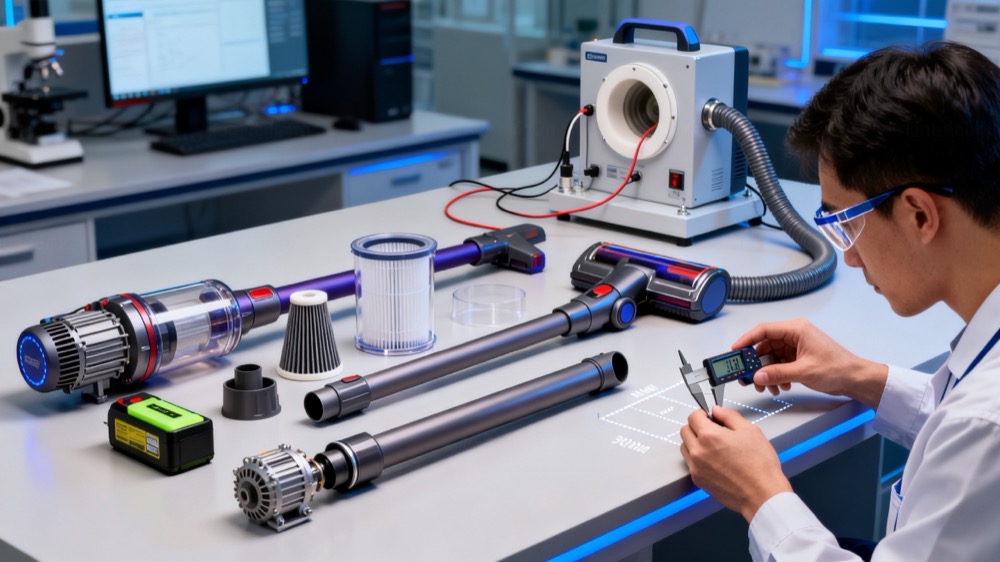
A higher electrical input rating does not, by itself, demonstrate better debris pickup. Likewise, a maximum pressure figure does not describe the complete cleaning system.
A useful purchasing specification should define:
- Debris pickup on the intended hard-floor and carpet surfaces.
- Airflow and suction measurements under an agreed method.
- Runtime using the supplied motorized floor head.
- Performance after controlled dust loading.
- Thermal behavior during sustained operation.
- Dust re-emission and filtration performance.
- Noise under a repeatable operating condition.
Agree on the test method before comparing competing samples. IEC 62885-2:2026 now covers performance measurements for mains-operated and cordless dry vacuum cleaners and includes additional cordless requirements in Annex D. Earlier reports may reference IEC 62885-4; buyers should have the laboratory identify the edition used and explain comparability.
Avoid purchase specifications that simply require "high-quality plastic" or "premium batteries."
Instead, define contractual requirements for:
| Component | Recommended Specification Detail |
|---|---|
| Housing | Resin grade, approved supplier, permitted recycled content, and relevant mechanical or thermal requirements |
| Dust cup | Material, wall thickness, latch durability, and chemical resistance |
| Battery pack | Cell manufacturer and model, rated energy, protection functions, and traceability |
| Motor | Approved model, control settings, balancing requirements, and agreed performance limits |
| Filter assembly | Media identification, sealing design, and whole-product performance requirements |
| Floor head | Brush material, drive components, wiring, and durability test conditions |
| Charger | Exact model, electrical ratings, destination plug, and applicable compliance evidence |
These are recommended purchasing controls, not universal specifications that every product must share.
CE marking is not a general quality award issued to a factory. It represents the manufacturer's declaration that the product meets applicable requirements. The supporting technical file and declaration must match the product placed on the market.
For an EU project, have a qualified compliance specialist establish the applicable requirements for the vacuum, charger, battery, and any radio functions. Do not accept a generic "CE/RoHS certificate" as the entire compliance package.
Also distinguish social-audit programs from product approvals. A factory audit does not establish electrical safety, suction performance, or battery transport compliance.
Request the business license, production address, bank beneficiary details, and a clear explanation of which operations are performed in-house.
During an audit, follow the actual production flow:
1. Incoming material inspection.
2. Battery-pack and motor traceability.
3. Molding and assembly controls.
4. Functional and safety testing.
5. Finished-goods inspection.
6. Handling of rejected or reworked units.
Where a quality-system certificate is supplied, check its legal entity, site address, scope, and current status. IAF CertSearch provides issuer-sourced information for accredited certification verification.
Adopt a staged approval plan rather than relying on one attractive demonstration unit:
1. Evaluate standard samples from competing suppliers.
2. Approve the intended commercial configuration.
3. Test a pilot-production batch.
4. Retain signed reference samples.
5. Inspect randomly selected production units before shipment.
The approved configuration should include the battery, charger, motor, software settings, filters, floor head, accessories, packaging, and labeling—not just the main housing.
Ask suppliers to distinguish theoretical line capacity from the output available for your order.
Useful evidence includes:
- Recent output for the relevant product family.
- Line staffing and shift assumptions.
- Bottleneck processes.
- Yield and rework records.
- Long-lead component commitments.
- Confirmed production and inspection dates.
A large annual figure is less useful than a credible plan for producing your exact configuration consistently and on time.
Battery transport documentation should be reviewed before booking freight.
Request the UN 38.3 test summary matching the battery design and have the freight specialist determine the correct classification, packing, labeling, documentation, and carrier conditions. IATA confirms that manufacturers and subsequent distributors must make the applicable test summary available, including for equipment containing lithium batteries.
Do not assume that the transport treatment for a battery installed in a vacuum is identical to the treatment for spare battery packs shipped separately.
The supply agreement should address:
- Defect investigation and evidence requirements.
- Replacement parts and reimbursement rules.
- Spare battery and charger availability.
- Filter and brush-roll supply.
- Product-change notifications.
- Serial-number traceability.
- Responsibility for corrective actions.
Request spare-parts prices with the initial quotation. Otherwise, an attractive appliance price may conceal an expensive service model.
One important procurement risk is configuration drift.
A supplier may use an approved sample with one battery cell, filter, motor controller, or brush assembly, while subsequent production incorporates an alternative component. Even when the substitute appears equivalent on paper, it can change runtime, temperature behavior, cleaning performance, service life, or the applicability of existing reports.
This is a risk to control, not an accusation against the manufacturers listed above.
A practical prevention system includes:
- A signed bill of materials identifying critical components.
- Written approval before substitutions.
- Revision-controlled drawings and software settings.
- Random production-unit disassembly.
- Retained samples from each shipment.
- Retesting when changes could affect safety, performance, or conformity.
The broader compliance principle is important: supporting documentation must remain aligned with the product actually marketed, rather than an earlier configuration.
A second trap is comparing headline figures taken under different conditions. A maximum suction claim and a maximum runtime claim may describe different operating modes. Require suppliers to report suction, runtime, attachment, battery condition, and test settings together.
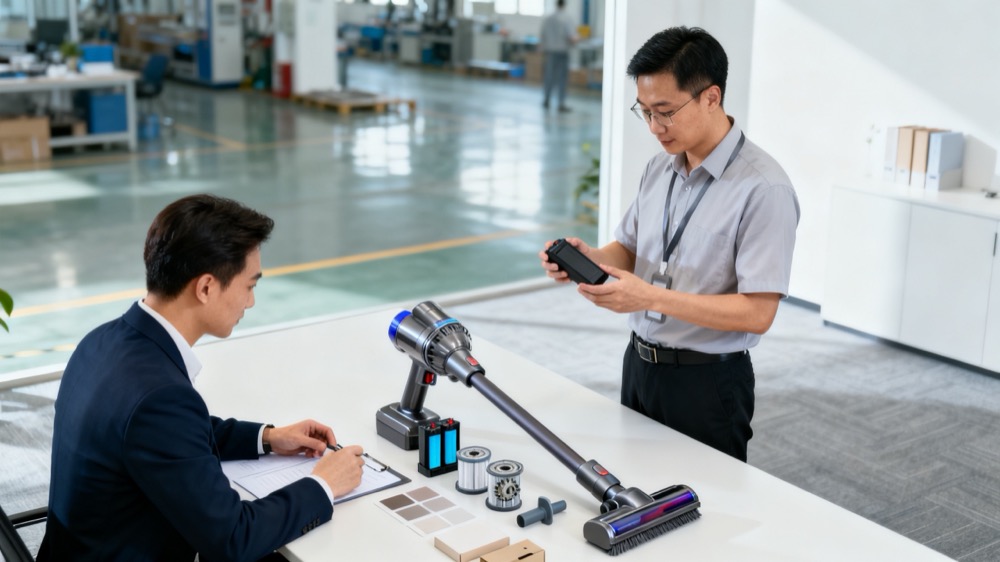
The right powerful cordless stick vacuum manufacturer is the one that can reproduce the approved product, support its documentation, meet agreed delivery milestones, and maintain service parts after launch.
Large integrated manufacturers may suit complex or high-volume programs. More focused suppliers may offer a better fit for brands that need closer project communication and manageable customization.
Ningbo Eyunhome Electric Technology Co., Ltd. provides a relevant starting point for buyers evaluating battery-powered cleaning products and personalized manufacturing support. Its published product focus and customization-oriented service approach warrant a structured technical and commercial discussion—not a decision based on promotional claims alone.
To begin an OEM/ODM evaluation with Eyunhome, provide your target market, desired retail position, annual order forecast, required runtime, floor types, accessory package, and compliance expectations. Request a model-specific quotation, sample plan, documentation checklist, and spare-parts proposal so that performance, cost, and long-term support can be assessed together.
Obtain the complete certificate, then search by certificate number or company name in IAF CertSearch where applicable. Check the status, standard, legal entity, manufacturing address, scope, issuing certification body, and accreditation information.
If no matching record appears, contact the issuer directly rather than immediately concluding that the document is false. Also confirm that the certificate covers the actual production site, not merely an affiliated office.
Possibly, but not automatically.
Check whether the documentation covers the exact configuration and whether your branding arrangement creates manufacturer obligations. EU guidance states that a business having a product made and selling it under its own name or brand is considered the manufacturer for these purposes.
Changing a battery, charger, electronics assembly, or other relevant component may require a documented reassessment.
Require both suppliers to use the same test method, surface, debris, attachment, operating mode, and battery condition.
Then compare pickup, sustained operation, and dust-loaded performance rather than relying on one pressure figure. Ask the laboratory to identify the relevant standard edition, particularly when comparing older IEC 62885-4 reports with newer IEC 62885-2:2026 testing.
Do not assume so.
Request the documentation applicable to the battery design being shipped, including its identification and test summary. Have a qualified laboratory or dangerous-goods specialist determine whether the pack configuration and any design changes are adequately covered.
UN transport testing concerns transport safety; it does not establish the vacuum's cleaning performance or commercial battery-life claims.
Negotiate around an existing platform with an unchanged critical-component configuration. Reduce unnecessary color variations, packaging formats, and accessory combinations rather than requesting cheaper unapproved components.
Ask the supplier to quote separately for:
- A standard platform with custom branding.
- Appearance and accessory changes.
- Electrical or battery changes.
- A new housing or exclusive tooling program.
Evaluate each proposal using its sample requirements, compliance work, component purchasing commitments, and production economics. Treat MOQ as a project-specific commercial term, not a permanent factory-wide number.
- [IEC — IEC 62885-2:2026: Dry Vacuum Cleaner Performance Measurement]
- [IEC — IEC 62885-4:2020+AMD1:2023: Cordless Vacuum Performance Measurement]
- [European Union — CE Marking and Manufacturer Responsibilities]
- [IAF CertSearch — Certificate Search and Verification]
- [IATA — Lithium Battery Transport Fact Sheet]
- [Ningbo Eyunhome — Company Introduction]
- [KingClean Electric — Corporate Website]
- [Suzhou Chunju — Corporate Website]
- [TEK Electrical — China Chamber of Commerce Company Profile]
- [Dreame — Current US Company Introduction]
- [Dreame — Global Brand History and Historical ODM Information]
- [Ningbo Dechang — Company Introduction]
- [Ningbo Liyyou — Cordless Vacuum Product and Supplier Information]


