
Views: 298 Author: Eyunhome Vacuum Publish Time: 2026-11-05 Origin: Site


Content Menu
● What Is a Brushless Motor in a Cordless Vacuum?
>> Are "Digital Motors" Different From Brushless Motors?
>> Does Every Motor Inside the Vacuum Need to Be Brushless?
● Brushless vs. Brushed Motors in Cordless Vacuums
>> Why Premium Cordless Vacuums Favor Brushless Motors
>> When Can Brushed Motors Still Make Sense?
● Why Motor Speed Does Not Tell the Whole Story
>> Industry Example: Identical RPM, Different Suction Ratings
>> Compare RPM, Pascals, and Air Watts Correctly
● How Brushless Motors Affect Runtime, Noise, and Durability
>> Runtime Depends on the Complete Power Budget
>> Brushless Does Not Automatically Mean Quiet
>> Longer Motor Life Does Not Mean Unlimited Product Life
● A Better Way to Specify a Premium Cordless Vacuum
>> Step 1: Define the Cleaning Scenario
>> Step 2: Match the Motor to the Battery and Air Path
>> Step 3: Agree on Comparable Test Conditions
>> Step 4: Check Sustained Performance
● A Practical Supplier Scorecard for Motor Selection
● Which Performance Standards Should Buyers Discuss?
● Develop Your Cordless Vacuum With Eyunhome
>> 1. What motor type do premium cordless vacuums use?
>> 2. Is a brushless cordless vacuum always better?
>> 3. Does higher motor RPM mean stronger suction?
>> 4. Do brushless vacuum motors need maintenance?
>> 5. Are digital vacuum motors the same as brushless motors?
>> 6. What should an OEM buyer request before approving a motor?
Premium cordless vacuums typically use a high-speed brushless DC motor (BLDC) as their main suction motor. This design combines compact dimensions, efficient electronic control, and high rotational speeds—qualities that help manufacturers deliver strong cleaning performance without making a battery-powered vacuum unnecessarily heavy.
However, identifying the motor type is only the beginning. A premium cordless vacuum must balance suction, runtime, noise, durability, and handling. An impressive motor specification cannot compensate for a restrictive filter, inefficient floorhead, or poorly matched battery.
At Ningbo Eyunhome Electric Technology Co., Ltd.,we provide upright, handheld, corded, and cordless vacuum solutions with OEM/ODM services, production support, and after-sales assistance. For businesses developing a cordless product range, our recommended starting point is the cleaning task—not simply the highest motor speed.

A brushless motor uses electronic switching to control current through its windings. This creates a rotating magnetic field that drives the rotor without carbon brushes contacting a mechanical commutator.
A typical cordless vacuum suction system combines:
- A brushless motor.
- An impeller that moves air.
- An electronic motor controller.
- A rechargeable battery pack.
- Air passages, separation components, and filters.
These parts operate as a system. The motor supplies mechanical rotation; the impeller converts that rotation into airflow and pressure.
"Digital motor" is a commercial description, not a universally standardized motor category. It often highlights electronically controlled motor operation.
Buyers should therefore request the underlying motor architecture instead of relying on the label. Useful questions include:
- Is the suction motor brushless?
- What voltage and operating power does it require?
- How is motor speed controlled?
- What protection functions are included?
The answers reveal more than a branded motor name alone.
No. The suction motor and floorhead motor perform different jobs.
The suction motor drives airflow at high speed. A floorhead motor turns a brush roller and must handle changing mechanical loads, including hair entanglement.
Manufacturers may select different motor types for these functions. A product advertised as having a brushless suction motor does not necessarily use brushless motors throughout.
The most useful motor comparison is brushless DC versus brushed DC. Both can power battery-operated equipment, but their design trade-offs differ.
| Comparison point | Brushless DC motor | Brushed DC motor |
|---|---|---|
| Current switching | Electronic commutation | Brushes and mechanical commutator |
| Brush wear | No carbon brushes to replace | Brushes wear during operation |
| High-speed suitability | Well suited to compact suction systems | Brush contact creates additional constraints |
| Control system | Requires electronic drive circuitry | Basic control can be simpler |
| Efficiency potential | Generally favorable when properly matched | Brush friction and contact losses reduce efficiency |
| Initial system cost | Often higher | Often lower |
| Typical selection priority | Performance, compactness, controllability | Cost and simpler implementation |
Removing brush contact eliminates a source of friction, sparking, and wear. Electronic control also gives designers more flexibility in managing speed and power.
For a cordless vacuum, these advantages can support:
- More useful performance from a limited battery.
- Compact, high-speed suction assemblies.
- Better adjustment between cleaning modes.
- Reduced maintenance associated with brush wear.
These are design opportunities, not automatic guarantees. Bearings, electronics, cooling, and manufacturing quality still determine how reliably the finished product performs.
Brushed motors remain relevant where purchase price and simple control matter more than maximum power density.
They may be appropriate for certain cost-sensitive products or auxiliary mechanisms. The correct decision depends on the motor's task and operating conditions.
For a premium cordless suction system, however, brushless technology is generally the stronger starting point.
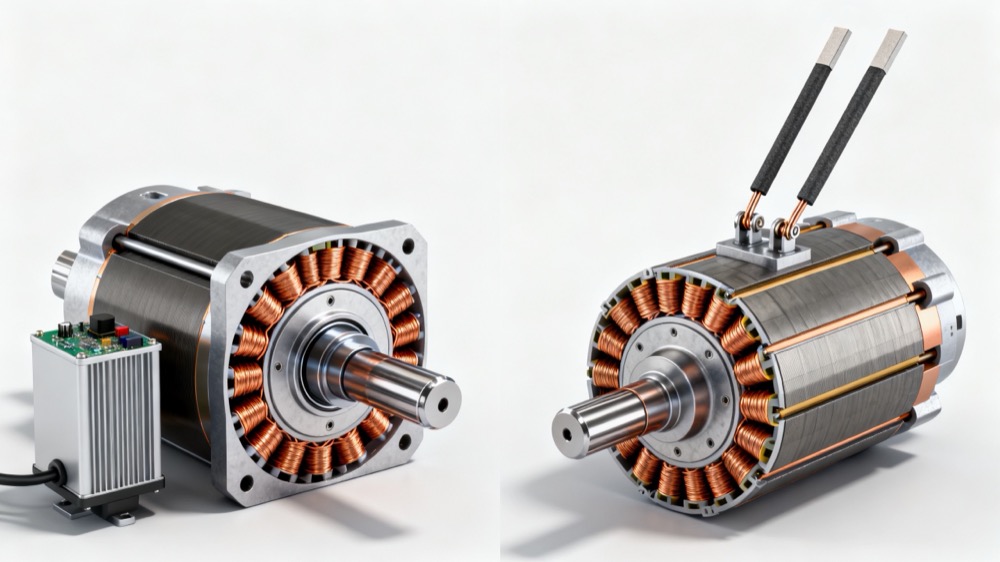
High-speed motors allow manufacturers to create compact suction assemblies. Yet revolutions per minute, or RPM, measure rotational speed—not cleaning performance.
A motor's useful output depends on its interaction with the impeller and airflow path.
Dyson lists its V12 Detect Slim with a motor speed of up to 125,000 RPM and 150 air watts of suction. Its V15 Detect product page lists the same maximum motor speed but 240 air watts.
These are manufacturer-published specifications, not an independent comparison. Nevertheless, they illustrate a valuable purchasing lesson: identical headline RPM does not imply identical suction output.
Motor dimensions, power input, impeller geometry, and other system choices can produce different results at similar speeds.
These measurements describe different characteristics:
| Metric | What it describes | Important limitation |
|---|---|---|
| RPM | Motor rotational speed | Does not directly measure cleaning |
| Watts | Electrical power input, when specified that way | Higher consumption does not guarantee better pickup |
| Pascals or kilopascals | Pressure difference | Pressure alone does not describe airflow |
| Air watts | Pneumatic power based on airflow and pressure | Results depend on measurement conditions |
| Dust pickup | Debris removed under a defined procedure | Depends on surface, debris, head, and test method |
A peak-pressure reading under highly restricted airflow is not equivalent to strong debris transport through a working floorhead.
For product evaluation, combine air-performance measurements with actual pickup testing.
An efficient motor can reduce energy losses. However, runtime also depends on battery capacity, operating mode, floorhead consumption, and system resistance.
As a simplified illustration, a battery with 100 watt-hours of usable energy powering a constant 400-watt load would provide approximately 15 minutes of operation.
This is an energy-balance example, not a product prediction. Actual runtime changes with battery condition, temperature, voltage limits, and control behavior.
A long runtime measured in a low-power mode should not be presented as equivalent to runtime during maximum-power carpet cleaning.
Removing brushes eliminates one noise source. It does not eliminate aerodynamic noise, bearing noise, vibration, or tonal sound from high-speed operation.
Motor control also matters. Field-oriented control, commonly called FOC, manages motor currents to improve operating behavior. Texas Instruments identifies efficiency, torque ripple, and acoustic performance as important differences between control approaches.
However, not every premium vacuum uses FOC. Buyers should verify the controller architecture rather than assume it from the brushless label.
A brushless motor has no carbon brushes to wear out, but other components still age.
Potential failure points include:
- Bearings and rotating assemblies.
- Power electronics.
- Battery cells and connections.
- Seals and mechanical joints.
- Components exposed to excessive heat.
Avoid accepting a universal motor-life claim without a documented test procedure, operating load, and failure criterion.
For OEM/ODM buyers, the strongest product brief connects engineering decisions to customer needs.
Start with the intended user and environment.
A lightweight handheld vacuum for vehicle interiors has different requirements from a cordless upright designed for carpets and pet hair.
Specify:
- Main floor surfaces.
- Typical debris and hair.
- Expected cleaning duration.
- Target product weight.
- Acceptable noise characteristics.
- Retail positioning and cost limits.
This prevents unnecessary spending on specifications that contribute little to the intended cleaning task.
The motor, battery, controller, and impeller should be selected together.
Request information on operating voltage, continuous power demand, current limits, and thermal behavior. Check whether the battery can support the required load without premature shutdown.
Also examine filter area, duct restrictions, and sealing. A powerful motor cannot fully recover performance lost through an inefficient airflow path.
Request results that identify:
1. Power mode and battery condition.
2. Installed floorhead or accessory.
3. Measurement location.
4. Filter and dust-container condition.
5. Surface and debris used.
6. Test duration and ambient conditions.
A result measured at the suction inlet should not be treated as interchangeable with performance measured through a complete cleaning attachment.
Peak output may last only briefly. Evaluate what happens during repeated or extended cleaning.
Useful checks include warm-operation behavior, partially loaded filters, repeated starts, and battery depletion.
The objective is not simply to record the highest number. It is to understand whether the product maintains acceptable cleaning performance throughout its intended use.
A structured scorecard helps procurement teams compare proposals without overvaluing headline specifications.
| Evaluation area | Evidence to request | Why it matters |
|---|---|---|
| Cleaning performance | Surface-specific pickup results | Connects specifications to useful cleaning |
| Suction system | Airflow and pressure data with test conditions | Makes technical comparisons more meaningful |
| Battery performance | Runtime by mode and attachment | Reduces misleading endurance comparisons |
| Thermal behavior | Continuous-operation results | Reveals performance limits |
| Acoustics | Noise measurements and operating conditions | Supports user-comfort assessment |
| Reliability | Endurance procedure and failure criteria | Makes durability claims reviewable |
| Serviceability | Replacement-part and repair arrangements | Supports after-sales planning |
From a product-selection perspective, we would prioritize consistent cleaning and manageable ownership costs over an isolated maximum-RPM figure.
This approach is especially useful for private-label businesses that must balance performance claims, customer satisfaction, and warranty exposure.
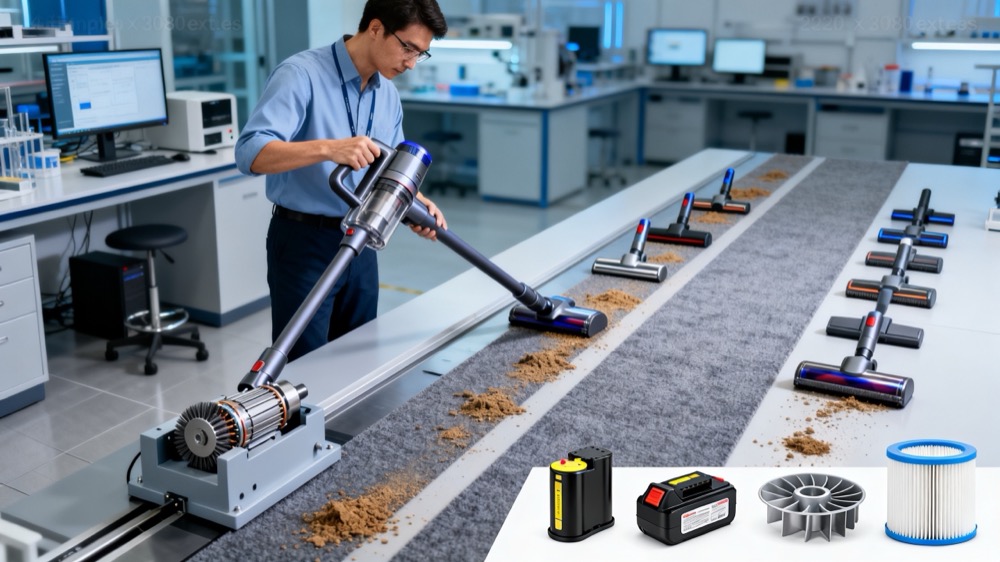
The IEC 62885 series provides methods for measuring vacuum-cleaner performance.
IEC 62885-4:2020, including its 2023 amendment, specifically addresses cordless dry vacuum performance. The newer IEC 62885-2:2026 includes mains-operated and cordless dry vacuum cleaners and introduces cordless-related provisions in Annex D.
The applicable document and test clauses should be confirmed with the testing laboratory. Product categories matter: the 2026 document excludes handheld dry vacuums except for specified clauses.
Also distinguish performance testing from electrical safety and market-access requirements. A performance test report alone does not establish that a product meets every requirement for sale in a destination market.
Choosing a brushless motor is an important decision, but building a competitive cordless vacuum requires coordinated product development.
Ningbo Eyunhome Electric Technology Co., Ltd. supports businesses seeking upright, handheld, corded, and cordless vacuum solutions through OEM/ODM services, stable production, and after-sales support.
Send our team your target market, cleaning application, preferred runtime, weight limit, and price positioning. Request a product discussion that connects the suction motor, battery, filtration, accessories, and agreed testing requirements to your commercial goals.
They typically use high-speed brushless DC motors for suction. Electronic commutation supports compact construction, high-speed operation, and flexible control without carbon-brush contact.
Not automatically. Brushless technology offers advantages, but cleaning quality also depends on airflow, floorhead design, filtration, battery capability, and manufacturing consistency.
Not necessarily. RPM measures speed. Suction performance also depends on the motor's output, impeller, and air path. Compare airflow, pressure, air watts, and pickup results under stated conditions.
They do not need carbon-brush replacement. However, the vacuum still requires filter cleaning, blockage removal, and other maintenance specified by the manufacturer.
"Digital" commonly describes electronic control, but it is not a universal technical classification. Ask the supplier to confirm motor construction and controller specifications.
Request electrical specifications, air-performance data, runtime conditions, thermal results, acoustic measurements, and documented reliability testing. Review the complete vacuum rather than approving the motor in isolation.
1. [Texas Instruments — 25.2-V, 30-A High-Speed Sensorless Brushless DC Motor Drive Reference Design]. Technical discussion of BLDC motor advantages and high-speed cordless vacuum applications. [ti]
2. [Texas Instruments — Drive a Single Phase Brushless DC Motor With a Brushed Motor Driver]. Explanation of mechanical versus electronic commutation and brush-related wear. [ti]
3. [Texas Instruments — Integrated Control BLDC Drivers]. Comparison of motor-control approaches, including efficiency, acoustic behavior, and FOC. [ti]
4. [Dyson — V12 Detect Slim Cordless Vacuum]. Manufacturer-listed maximum motor speed and 150-air-watt suction specification. [dyson]
5. [Dyson — V15 Detect Cordless Vacuum]. Manufacturer-listed maximum motor speed and 240-air-watt suction specification. [dyson]
6. [International Electrotechnical Commission — IEC 62885-4:2020+AMD1:2023]. Scope and purpose of cordless dry vacuum performance measurement methods. [webstore.iec]
7. [International Electrotechnical Commission — IEC 62885-2:2026]. Updated performance-measurement scope, cordless provisions, and handheld exclusions. [webstore.iec]


